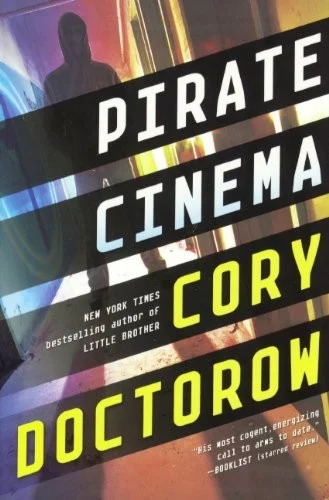
Pirate Cinema
- Publication Date:
- August 27th, 2013
- Publisher:
- Turtleback
- ISBN-13:
- 9780606318877
- ISBN-10:
- 0606318879
- Pages:
- 384
Why Pirate Cinema Has Been Challenged
Some adult gatekeepers have balked at a teenage protagonist who squats, steals, and breaks the law as the story's clear moral center. See more ↓
Challenged or banned in 1 state across 1 school district.
Overview
Cory Doctorow's novel imagines a near-future London where a sixteen-year-old named Trent McCauley lives for one thing: cutting together homemade films from scavenged footage of an aging matinee idol. When a new, more punishing copyright law costs his family their internet access as punishment for his downloading habit, Trent flees home rather than face his parents' anger, landing among a loose community of young squatters, buskers, and media pirates scraping by in the city's forgotten corners.
Among this group, Trent's talent for splicing images finds a real audience, even as the larger political fight closing in around him raises the stakes of his hobby. The bill he once downloaded music under threatens to go much further, treating ordinary acts of remixing, sharing, and borrowing as serious crimes, and Trent's new friends are organizing to stop it before it passes.
What begins as a personal story about a kid chasing a creative obsession widens into a portrait of a generation testing how much control lawmakers and media companies can exert over culture made from existing culture, and what happens when that generation decides to fight back in public.
A Coming-of-Age Story Built Around Digital Rights
Doctorow, known for fiction that doubles as advocacy for open information and user freedom, uses Trent's story to dramatize debates that usually stay confined to policy papers: who owns a remix, where parody ends and infringement begins, and whether criminal penalties are a reasonable response to teenagers editing video on their laptops. The novel sits alongside his other young-adult work in treating technology not as background scenery but as the central terrain where its characters' freedom is won or lost.
The book also functions as a snapshot of early-2010s anxieties about expanding copyright enforcement, written for readers who might otherwise never encounter those arguments. Trent's path from solitary hobbyist to public activist mirrors the arc of real grassroots campaigns against restrictive internet legislation, giving the abstract fight over intellectual property a human, teenage face. Its sympathy clearly lies with the amateur creators and squatters rather than the lawmakers and studios arrayed against them.
Why Pirate Cinema Has Been Challenged
Lifestyle and legality are at the heart of most discomfort with this book: Trent's path forward runs through running away from home, living in abandoned buildings, and routinely breaking copyright and property law, all without the narrative treating these choices as cautionary. Readers uneasy with the novel have pointed to its depiction of underage drinking, casual drug references, and a teenage romance as further evidence that it normalizes behavior some would rather not see modeled approvingly for young audiences. Because the book frames its young pirates and squatters as principled rather than reckless, some adults reviewing it for schools and libraries have questioned whether it glamorizes defiance of authority more than it informs. In the catalog tracked here, that unease has translated into a formal challenge in one state and one school district.
Where to Buy




Affiliate links may generate a small commission at no extra cost to you, which helps support this site.
Banned in Schools
Banned or challenged in 1 state across 1 school district.
Florida 1 district
- Escambia County Public Schools Banned pending investigation