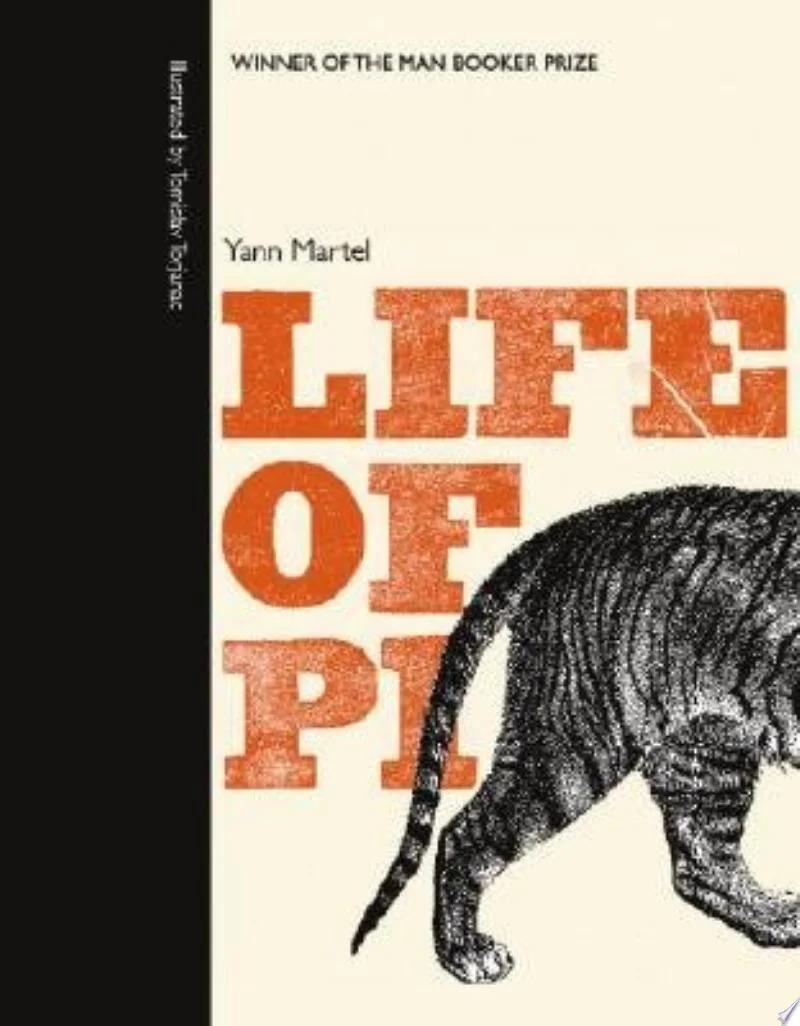
Life of Pi
by Yann Martel
- Publication Date:
- August 1st, 2007
- Publisher:
- Knopf Canada
- ISBN-13:
- 9780676978995
- ISBN-10:
- 0676978991
- Pages:
- 338
Why Life of Pi Has Been Challenged
Complaints against this novel tend to center on how comfortably it mixes grim survival violence with open religious inquiry inside a story assigned to teenagers. See more ↓
Challenged or banned in 2 states across 2 school districts.
Overview
This edition of "Life of Pi" pairs Yann Martel's novel with forty full-color illustrations by Tomislav Torjanac, giving physical form to the castaway world the book's narrator describes in such exacting, strange detail. The story follows Piscine "Pi" Patel, an Indian boy raised among his family's zoo animals, who survives a shipwreck only to find himself adrift on a lifeboat with a Bengal tiger. Martel's prose moves between comic precision and philosophical digression, and the illustrated format leans into that sensibility, slowing readers down to look as closely at the ocean and its creatures as Pi himself must.
Since its original 2002 publication, the novel has reached an unusually wide audience, read as adventure fiction, as a meditation on belief, and as a study in narrative unreliability all at once. Its popularity has made it a frequent choice for classrooms and reading groups, which has in turn exposed it to the kind of scrutiny that follows books into schools.
A Fable About Belief and Survival
At its core, "Life of Pi" is less interested in whether its castaway story is literally true than in why people choose to believe the version that lets them live with what happened. Pi's early chapters, in which he simultaneously practices Hinduism, Christianity, and Islam, set up a book that treats religious faith not as doctrine to be adjudicated but as a tool for making an unbearable world survivable. The novel's final twist, in which Pi offers a second, harsher account of his ordeal, asks readers to decide which story they prefer and why, turning a seafaring adventure into an argument about the function of storytelling itself.
That structure has made the book a frequent subject of literary and philosophical discussion well beyond typical adventure-fiction readership, and it has proven durable enough to generate a major film adaptation and multiple illustrated and collector's editions, including this one. Within Martel's body of work, it remains his best-known achievement, the book against which his later fiction is routinely measured.
Why Life of Pi Has Been Challenged
Most objections to "Life of Pi" point to its presence on high school reading lists and argue that the material is too intense or too unsettling for that age group. Critics cite the novel's unflinching depictions of starvation, animal violence, and a late account of cannibalism aboard the lifeboat, arguing that these scenes are more graphic than students are prepared to process in an assigned text. Some challenges also raise concern about the book's frank treatment of religion, pointing to Pi's simultaneous practice of three faiths as a premise that unsettles readers who expect a novel to treat belief more conventionally. The combination of brutal physical peril and open theological questioning is what tends to draw parental and administrative objection, even as the same qualities are what have made the book a staple of literature curricula. In this catalog, the title has drawn challenges in 2 states and 2 districts, reflecting a pattern of localized rather than widespread objection.
Where to Buy




Affiliate links may generate a small commission at no extra cost to you, which helps support this site.
Banned in Schools
Banned or challenged in 2 states across 2 school districts.
Florida 1 district
- Clay County School District Banned
Wisconsin 1 district
- Elkhorn Area School District Banned pending investigation