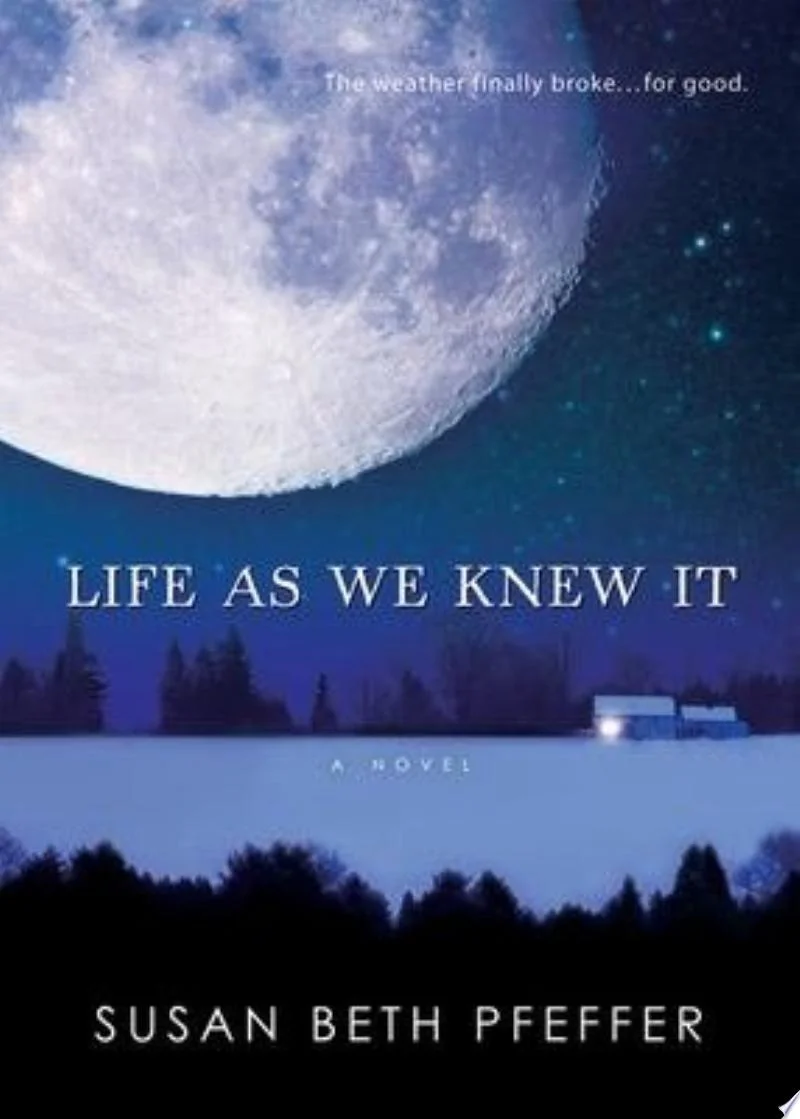
Life as We Knew it
- Publication Date:
- January 1st, 2008
- Publisher:
- Houghton Mifflin Harcourt
- ISBN-13:
- 9780152061548
- ISBN-10:
- 0152061541
- Pages:
- 337
Why Life as We Knew it Has Been Challenged
Some parents and educators have argued that the book's unflinching portrait of societal breakdown and physical suffering is simply too much for the middle-grade and early high-school readers who often encounter it in classrooms. See more ↓
Challenged or banned in 2 states across 2 school districts.
Overview
Sixteen-year-old Miranda begins the story much like any other teenager, keeping a diary of ordinary complaints and small excitements. That changes the night a celestial collision nudges the moon out of its usual orbit, an event scientists and news anchors treat as a curiosity right up until its consequences become impossible to ignore.
What follows is a slow, then rapid, unspooling of the world Miranda knew. Tidal surges swallow coastlines, the ground shudders with new seismic activity, and airborne ash dims the sky until summer gives way to an early, punishing winter. Pfeffer renders all of this through the narrow, credible lens of one household rather than a sweeping disaster-movie canvas.
Confined largely to their Pennsylvania home, Miranda, her mother, and her brothers reorganize their entire existence around a single heated room, rationed supplies, and a wood stove that becomes the family's lifeline. The diary form keeps the focus tight on Miranda's shifting moods, as the book tracks not just what her family loses, but how she reconstructs a reason to keep going.
A Quiet Household at the Center of a Global Catastrophe
Part of what distinguishes this novel within the crowded field of young-adult disaster fiction is its refusal to leave the house. Rather than following scientists, soldiers, or rescue efforts, the narrative stays fixed on domestic minutiae: meal planning, sibling friction, the rationing of firewood, and the strange new etiquette of a world without reliable news. That restraint gives the catastrophe an intimacy that larger-scale disaster narratives often lack.
The diary structure also does specific work. Because Miranda is writing for herself rather than for an audience, her entries capture denial, bargaining, and numbness alongside moments of real tenderness, giving the book an emotional honesty that has made it a touchstone of the genre and the launching point for several companion novels exploring the same catastrophe from other vantage points and locations.
Why Life As We Knew It Has Been Challenged
Reviewers have generally praised the novel for the very qualities that later drew scrutiny: its refusal to soften what widespread scarcity and fear actually do to a family. Where critics saw psychological realism, some challengers have seen material too grim to place in front of younger readers, and the book has been challenged or restricted in 2 states and 2 districts tracked in this catalog.
Much of the objection centers on the novel's sustained bleakness. Its portrayal of starvation, illness left untreated, and the erosion of civic order as neighbors compete for dwindling resources has struck some parents as more disturbing than instructive, particularly for readers encountering it in middle-grade classrooms. Others have pointed to the emotional toll on Miranda herself, arguing that her spiraling fear and despair, however true to the premise, risk unsettling readers not yet ready to sit with that level of dread. A smaller thread of criticism concerns the story's treatment of faith and hopelessness, with some finding its moments of religious doubt inappropriate for the age group most likely to be assigned the book.
Where to Buy



Affiliate links may generate a small commission at no extra cost to you, which helps support this site.
Banned in Schools
Banned or challenged in 2 states across 2 school districts.
Florida 1 district
- Escambia County Public Schools Banned by restriction
Georgia 1 district
- Marietta City Schools Banned by Restriction