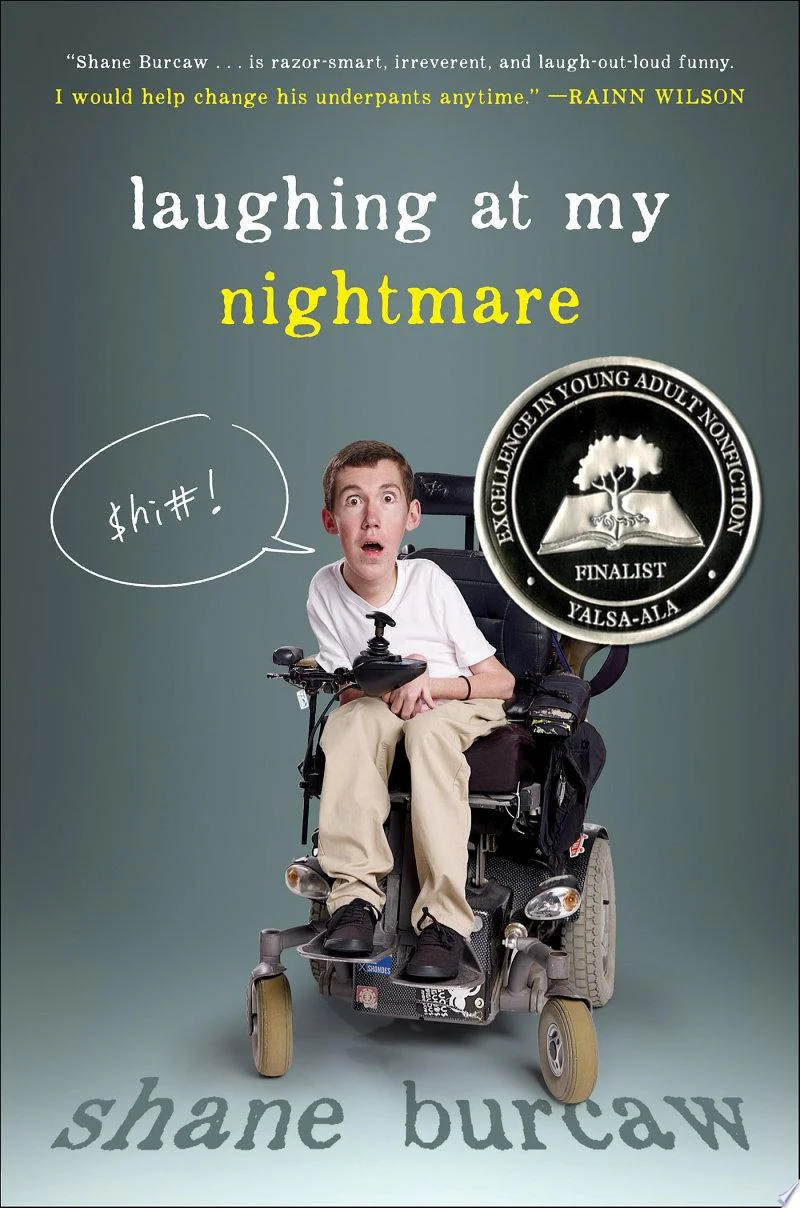
Laughing at My Nightmare
by Shane Burcaw
- Publication Date:
- October 14th, 2014
- Publisher:
- Macmillan + ORM
- ISBN-13:
- 9781626720084
- ISBN-10:
- 1626720088
- Pages:
- 199
Why Laughing at My Nightmare Has Been Challenged
Some parents and school officials have objected less to the book's subject matter than to its tone, arguing that its blunt language and candid discussion of romance are too mature for the teen readers it was written for. See more ↓
Challenged or banned in 2 states across 3 school districts.
Overview
Shane Burcaw was twenty-one when he published this memoir, and he writes like someone who has decided that laughing first beats being laughed at later. The book moves through the particulars of his life with spinal muscular atrophy, a degenerative condition that affects his muscle strength, in short, blunt, funny chapters rather than one continuous narrative arc.
Rather than building sympathy through tragedy, Burcaw leans into absurdity: the mechanics of a handshake, the logistics of using a wheelchair in a world built for walking bodies, the strange etiquette other people fall into around him. He also writes about romance and friendship, refusing to treat his disability as something that disqualifies him from an ordinary social life.
The result reads less like an inspirational survivor story and more like stand-up comedy with a serious undercurrent. Underneath the jokes is a plain-spoken account of what it means to live with a condition that shortens life expectancy, and Burcaw lets both registers sit side by side without smoothing either one over.
A Different Kind of Disability Narrative
Memoirs about illness and disability often default to one of two modes: the triumphant overcomer or the tragic figure to be pitied. Burcaw's book is notable for refusing both. His comic voice functions as a deliberate counter-narrative, insisting that disability can coexist with an irreverent, even raunchy, sense of humor rather than demanding constant solemnity from the people who read or write about it.
That stance has made the book a touchstone in disability memoir and in classrooms interested in own-voices writing about chronic illness. It sits alongside a broader shift in how disability is represented in young adult and crossover nonfiction, away from pity and toward self-determination, humor, and ordinary wants like dating and independence. The book's popularity with teen readers in particular suggests it filled a gap: relatively few widely read books let a narrator with a visible, severe physical disability also be funny, flawed, and horny in print.
Why Laughing at My Nightmare Has Been Challenged
Reviewers and readers have generally praised the book for its candor and its refusal to sanitize disability for an audience's comfort, but that same candor is precisely what has drawn objection from some parents and schools. The frank, often crude language Burcaw uses to describe his body, his relationships, and his physical limitations has struck some readers as inappropriate for the younger end of the memoir's teen audience, even though that bluntness is central to the book's voice and its project of normalizing disability without euphemism.
Discussions of dating and sexuality involving a narrator with a severe physical disability have also unsettled some challengers, who read passages meant to assert Burcaw's full personhood as instead too explicit or too mature for school shelves. In effect, the qualities that make the memoir distinctive and valuable to many readers, its unfiltered language and its insistence that disabled people have ordinary romantic and sexual lives, are the same qualities cited in the two states and three districts tracked here where it has faced formal challenge.
Where to Buy




Affiliate links may generate a small commission at no extra cost to you, which helps support this site.
Banned in Schools
Banned or challenged in 2 states across 3 school districts.
Florida 1 district
- Clay County School District Banned
Iowa 2 districts
- Grundy Center Community School District Banned
- Iowa City Community School District Banned pending investigation