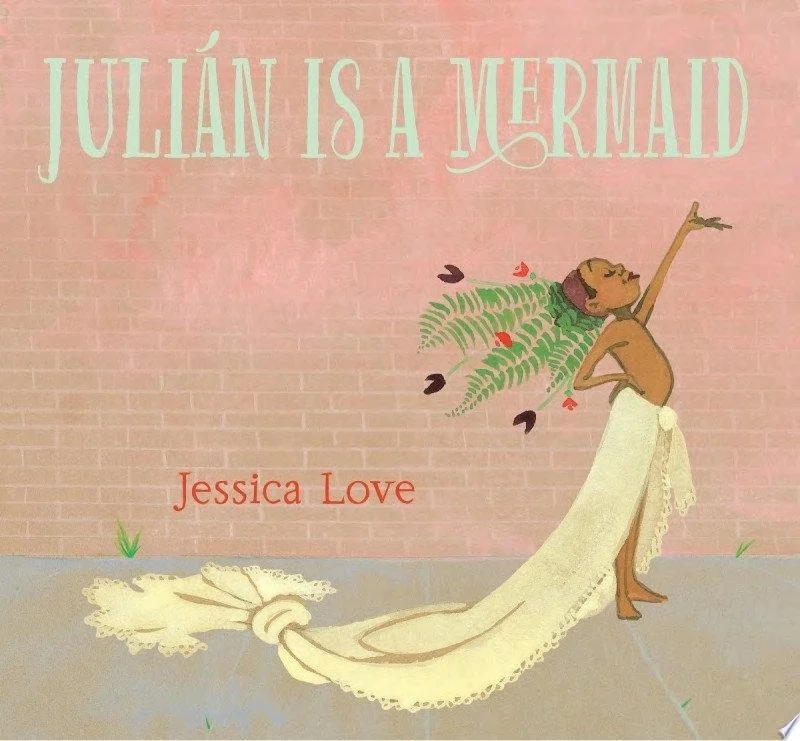
Julián Is a Mermaid
by Jessica Love
- Publication Date:
- April 23rd, 2018
- Publisher:
- Candlewick Press
- ISBN-13:
- 9780763690458
- ISBN-10:
- 0763690457
- Pages:
- 38
Why Julián Is a Mermaid Has Been Challenged
Much of the pushback stems from adults projecting ideas about gender identity onto a child simply playing dress-up, rather than from anything stated outright in the story itself. See more ↓
Challenged or banned in 5 states across 8 school districts.
Overview
Jessica Love's picture book follows Julián, a young boy returning home from the pool with his grandmother, who catches sight of three women on the subway dressed as mermaids, their hair dyed in bold colors and their skirts flowing into fishtails. The encounter leaves him captivated, and the image stays with him the rest of the ride home.
Once inside the apartment, Julián sets about becoming a mermaid himself, repurposing a yellow curtain as a tail and the leaves of a houseplant as a headdress. The transformation is entirely his own invention, built from whatever materials are within reach, and it absorbs him completely.
The story's tension arrives when his grandmother discovers the scene he's made, and what follows is less about the mess than about how she responds to the boy standing in front of her. Love, working as both author and illustrator in her debut, tells the story largely through watercolor imagery rather than dense text, letting the pictures carry much of the emotional weight.
A Debut Built on Image and Gesture
Much of what distinguishes this book is its restraint. Love lets color, posture, and facial expression do the work that dialogue might otherwise carry, and the result reads as more impressionistic than didactic. The subway mermaids, Julián's makeshift costume, and his grandmother's eventual response are all rendered with a warmth that avoids spelling out a moral.
Within the landscape of contemporary picture books, the story is often discussed alongside other works that center a child's unscripted self-expression and an adult's choice to meet it with curiosity rather than correction. Its arrival as an author-illustrator debut, and its subsequent embrace by educators and librarians as a touchstone for conversations about individuality, has shaped its reputation as a quiet rather than polemical entry into those conversations.
Why Julián Is a Mermaid Has Been Challenged
The same qualities that have earned this book praise from critics, librarians, and early-literacy advocates for its gentleness and visual storytelling are the ones that have drawn it into dispute elsewhere. Reviewers have highlighted its tenderness; challengers have focused on what that tenderness depicts.
Objections center on Julián's choice to dress as a mermaid using his grandmother's clothing and household items, which some readers interpret as a story about gender nonconformity or cross-dressing aimed at young children. Critics of the book have argued that its themes are inappropriate for the picture-book age range or that they introduce ideas about gender expression before students are ready to encounter them, a concern that places the title within a broader pattern of scrutiny directed at children's books touching on gender and identity. Supporters counter that the book never names or frames Julián's play in those terms at all, and that the objections read adult categories onto a story about a child's imagination and a grandmother's acceptance. In this catalog, the book has been the subject of challenges in 5 states and 8 districts.
Where to Buy




Affiliate links may generate a small commission at no extra cost to you, which helps support this site.
Banned in Schools
Banned or challenged in 5 states across 8 school districts.
Florida 3 districts
- Hernando County Schools Banned pending investigation
- Hillsborough County Public Schools Banned Pending Investigation
- School District of Manatee County Banned by Restriction
Iowa 2 districts
- Clear Creek-Amana Community School District Banned pending investigation
- Glenwood Community School District Banned
Kentucky 1 district
- Boyle County Schools Banned