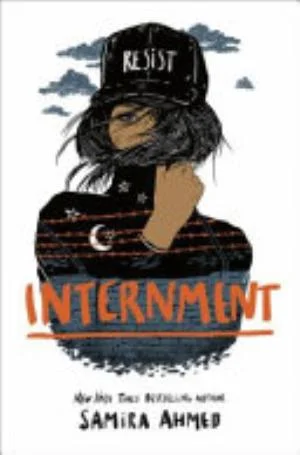
Internment
by Samira Ahmed
- Publication Date:
- September 4th, 2019
- Publisher:
- Thorndike Striving Reader
- ISBN-13:
- 9781432869328
- ISBN-10:
- 1432869329
Why Internment Has Been Challenged
Objections to Internment have generally centered on its political content and how it portrays government authority. See more ↓
Challenged or banned in 1 state across 1 school district.
Overview
Internment imagines an American future that has curdled into authoritarianism, where Muslim citizens are rounded up and confined behind fences under the guise of national security. Layla Amin, seventeen, is taken with her parents to one such camp, separated from the boyfriend she left behind and thrust into a world governed by curfews, surveillance, and an increasingly unstable camp Director.
Rather than resign herself to captivity, Layla begins organizing. She finds allies among the other imprisoned families, forms a fragile connection with someone on the inside of the camp's power structure, and stays tethered to the outside world through the boyfriend working to help her. What starts as small acts of defiance grows into something closer to an uprising.
Samira Ahmed structures the novel as a fast-moving, tension-driven narrative, using the camp setting to dramatize how quickly civil liberties can erode and how resistance can take root even in the most controlled environments.
A Warning Dressed as Speculation
Ahmed wrote Internment as speculative fiction, but its premise draws direct lines to real history and contemporary politics: the incarceration of Japanese Americans during World War II, post-9/11 surveillance of Muslim communities, and rhetoric singling out Muslim citizens and immigrants in more recent political discourse. The novel's near-future setting is less a leap of imagination than an extrapolation of policies and attitudes the author saw as already present in American life.
That framing places the book within a tradition of dystopian fiction used to comment on the present rather than predict the future, alongside other YA titles that use imagined authoritarian states to interrogate real prejudice. Ahmed has described wanting to write a book that pushes back against passivity, and the novel's emotional core is less about the mechanics of the camp than about the moral cost of silence and the risks of speaking up. Its reception has often centered on this tension: some readers and critics have praised its urgency, while others have debated whether the story's intensity serves or overwhelms its message.
Why Internment Has Been Challenged
Objections to Internment have generally centered on its political content and how it portrays government authority. Because the novel depicts a fictionalized American administration imprisoning citizens based on religion, some challengers have characterized it as partisan commentary rather than fiction, objecting to its implicit critique of nationalist and anti-Muslim rhetoric. Others have raised concerns about the book's depictions of violence and the psychological intensity of its camp scenes, arguing the content is too dark or frightening for younger teen readers.
The novel's treatment of religion and its sympathetic, humanizing portrayal of a Muslim protagonist have also drawn scrutiny from those uncomfortable with its subject matter. In the catalog tracked here, Internment has been the subject of challenges in 1 state and 1 district, reflecting the broader pattern of pushback against young adult fiction that engages directly with contemporary political and religious tensions.
"Where to Buy




Affiliate links may generate a small commission at no extra cost to you, which helps support this site.
Banned in Schools
Banned or challenged in 1 state across 1 school district.
Florida 1 district
- Lee County Schools Banned by restriction