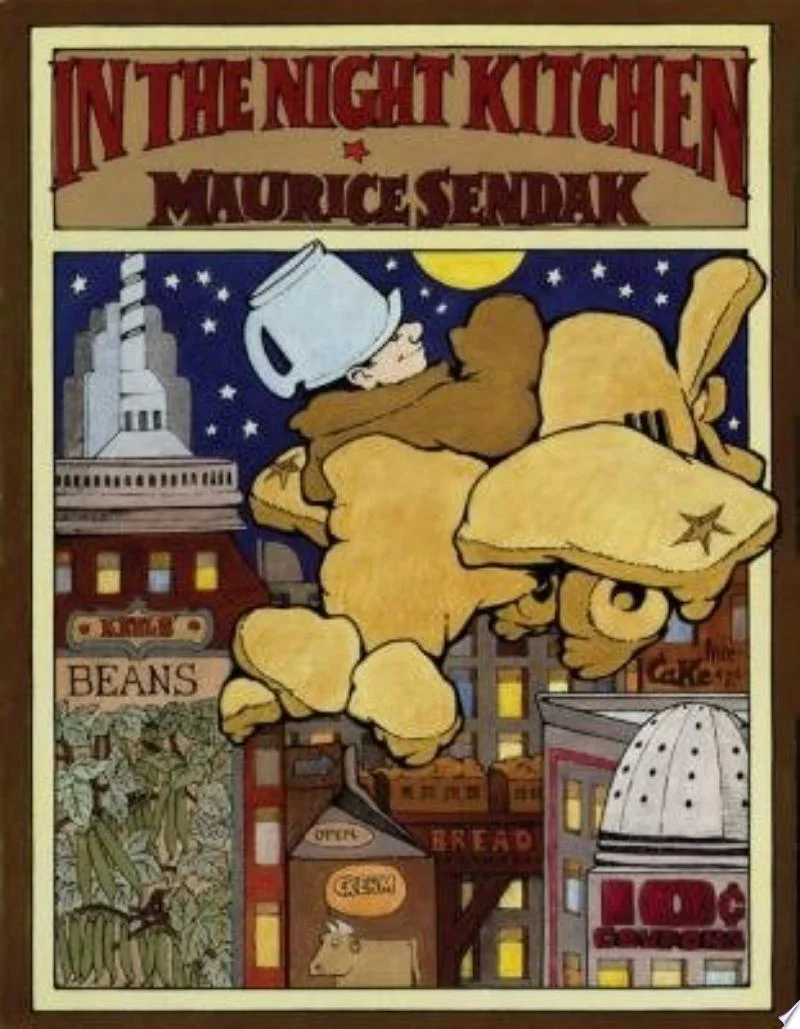
In the Night Kitchen
- Publication Date:
- January 18th, 1996
- Publisher:
- Harper Collins
- ISBN-13:
- 9780064434362
- ISBN-10:
- 0064434362
- Pages:
- 42
Why In the Night Kitchen Has Been Challenged
A young boy's matter-of-fact nudity throughout his dream journey has made this picture book a recurring target for parents and officials uneasy about what children's books are allowed to depict. See more ↓
Challenged or banned in 3 states across 6 school districts.
Overview
Maurice Sendak's picture book sends a boy named Mickey tumbling out of his bed and clothes into a surreal nocturnal kitchen, where bakers mistake him for an ingredient and he must navigate a dreamlike cityscape built from kitchen fixtures and dough. The story unfolds with minimal text, letting Sendak's dense, comic-strip-influenced artwork carry much of the narrative momentum.
Sendak drew on childhood memories of advertising imagery and early film to construct Mickey's dream world, giving the book a distinctly mid-century, almost cinematic visual texture. The result reads less like a conventional bedtime story and more like an illustrated fever dream, anchored by a child's instinct to assert control over a confusing situation.
Despite its brevity, the book has remained a fixture of children's literature discussion for decades, often cited in conversations about what picture books are permitted to show and how illustrators render the vulnerability of childhood.
Themes and Context
In the Night Kitchen arrived as part of Sendak's broader project of taking children's interior lives seriously, including the fear, confusion, and bodily unselfconsciousness that accompany early childhood, rather than smoothing them into tidy moral lessons. The book sits alongside his other major works as an exploration of a child confronting disorientation and asserting agency within it, continuing the trajectory he had begun with earlier explorations of a young protagonist mastering an unruly imaginative landscape.
Critically, the book has long been discussed less for its slight plot than for its artwork, which borrows visual grammar from early twentieth-century commercial illustration and animation. That stylistic choice, paired with Sendak's willingness to depict a young child's body plainly and without embarrassment, has made the book a recurring touchstone in debates over artistic honesty versus protective caution in material aimed at young readers.
Why In the Night Kitchen Has Been Challenged
A number of the formal complaints against this book center on a single visual choice: Mickey loses his clothes early in the story and spends much of it drawn without them, and objecting parents and board members have argued that a widely circulated children's book has no business depicting a nude child, regardless of the artistic intent behind it. Some complainants have framed the issue as one of appropriateness for a shelf shared with very young readers, arguing that the nudity would prompt uncomfortable questions or reactions from children or their families, while others have treated the imagery as categorically unsuitable for a school or public library setting. In this catalog, the book has drawn recorded objections in 3 states and 6 districts, nearly all of them rooted in this same concern over nudity rather than in the book's narrative or language. Defenders of the book have typically responded that the nudity is incidental to a dream-logic story about a child's body and selfhood, not sexual in intent or presentation, a distinction that has kept the dispute alive without resolving it.
Where to Buy




Affiliate links may generate a small commission at no extra cost to you, which helps support this site.
Banned in Schools
Banned or challenged in 3 states across 6 school districts.
Florida 4 districts
- Clay County School District Banned pending investigation
- Hernando County Schools Banned
- Indian River County Schools Banned
- School District of Manatee County Banned by Restriction
Tennessee 1 district
- Knox County Schools Banned