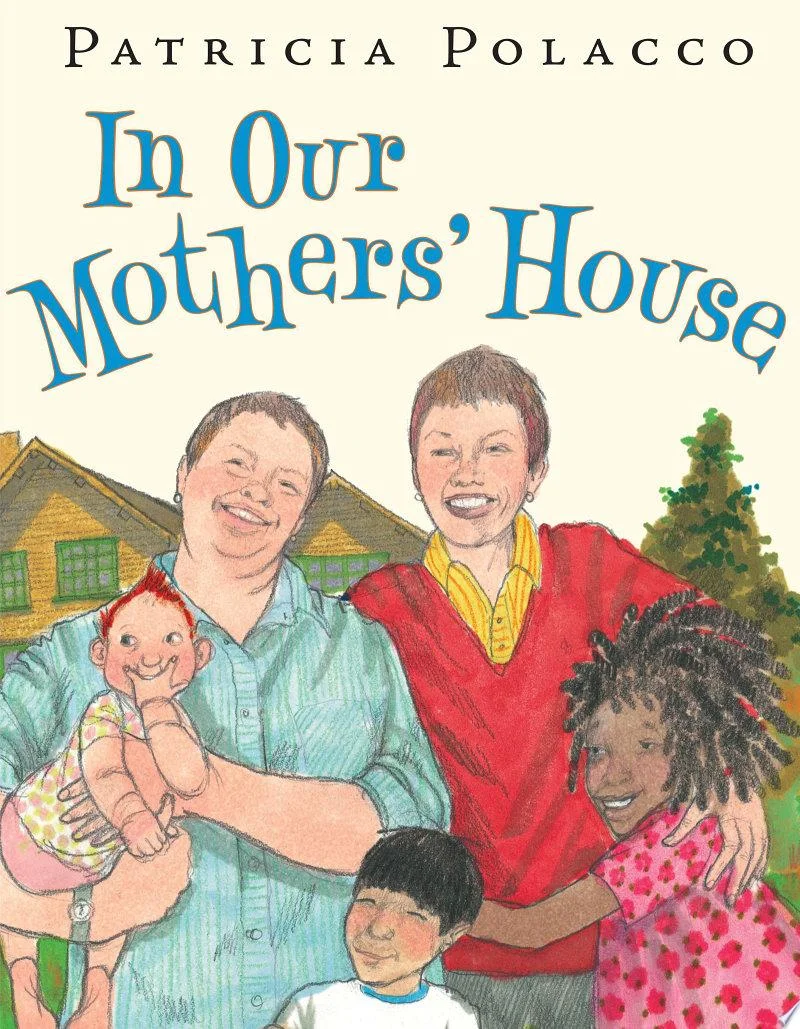
In Our Mothers' House
- Publication Date:
- April 30th, 2009
- Publisher:
- Penguin
- ISBN-13:
- 9780399250767
- ISBN-10:
- 039925076X
- Pages:
- 49
Why In Our Mothers' House Has Been Challenged
Most objections to this picture book trace back to its central premise rather than any scene within it: a family led by two mothers, portrayed to young children as simply another kind of normal. See more ↓
Challenged or banned in 2 states across 2 school districts.
Overview
Patricia Polacco, known for autobiographical picture books such as Thank You, Mr. Falker, draws again on personal history for this story of a household led by two mothers, Marmee and Meema. The narrative settles into the small rituals that define the family: shared meals, music, dancing, and the easy affection that fills their home. Polacco's illustrations and storytelling linger on these ordinary moments rather than framing the family as anything but familiar.
Tension enters through a neighbor who refuses to accept the household, viewing two mothers and no father as a departure from what a family should look like. Rather than building the story around conflict for its own sake, Polacco uses the neighbor's rejection as a contrast to the warmth inside the house, allowing the children's own sense of security and belonging to answer the question the story raises.
The book closes on an affirming note: the family's structure doesn't diminish what it provides. Marmee and Meema's children learn that love, not a fixed template, is what makes a household whole.
Context and Reception
The book sits within Polacco's broader body of work, much of which draws on her own upbringing and family relationships to address themes of identity, belonging, and difference for young readers. Here, that approach extends to a family structure not often depicted in picture books aimed at this age group: two mothers raising children together. Rather than treating the configuration as a subject requiring explanation, the story presents it as simply the shape this particular family takes, with the emotional stakes centered on acceptance rather than novelty.
This placement within picture-book literature for young children, rather than a middle-grade or YA treatment, is part of what has made the book a recurring reference point in debates over which family structures belong in early-childhood and elementary collections. Its gentle, domestic tone has drawn attention precisely because it normalizes rather than problematizes its subject for an audience often assumed by critics to be too young for such material.
Why In Our Mothers' House Has Been Challenged
Reviewers have generally praised the book's tenderness and its portrait of a stable, loving home, qualities consistent with Polacco's broader reputation for writing with emotional honesty about family life. That same portrayal is what has drawn formal objections, recorded in 2 states and 2 districts tracked in this catalog. The challenges center less on any single scene than on the premise itself: a same-sex couple raising children, presented to young readers without qualification or debate.
Objecting parties have typically argued that the book introduces a view of family structure that conflicts with their own beliefs about parenting and marriage, and that picture-book audiences are too young to encounter the topic without parental framing. Some challenges have also pointed to the neighbor character's rejection of the family as itself objectionable material, even though the story treats that rejection as the view to be overcome rather than endorsed. In practice, the objections reflect a broader and recurring dispute over whether LGBTQ+ family representation belongs in collections for young children, rather than concerns about language, violence, or other content typically cited in challenges to books for older readers.
Where to Buy




Affiliate links may generate a small commission at no extra cost to you, which helps support this site.
Banned in Schools
Banned or challenged in 2 states across 2 school districts.
Florida 1 district
- Hillsborough County Public Schools Banned Pending Investigation
Iowa 1 district
- Clear Creek-Amana Community School District Banned pending investigation