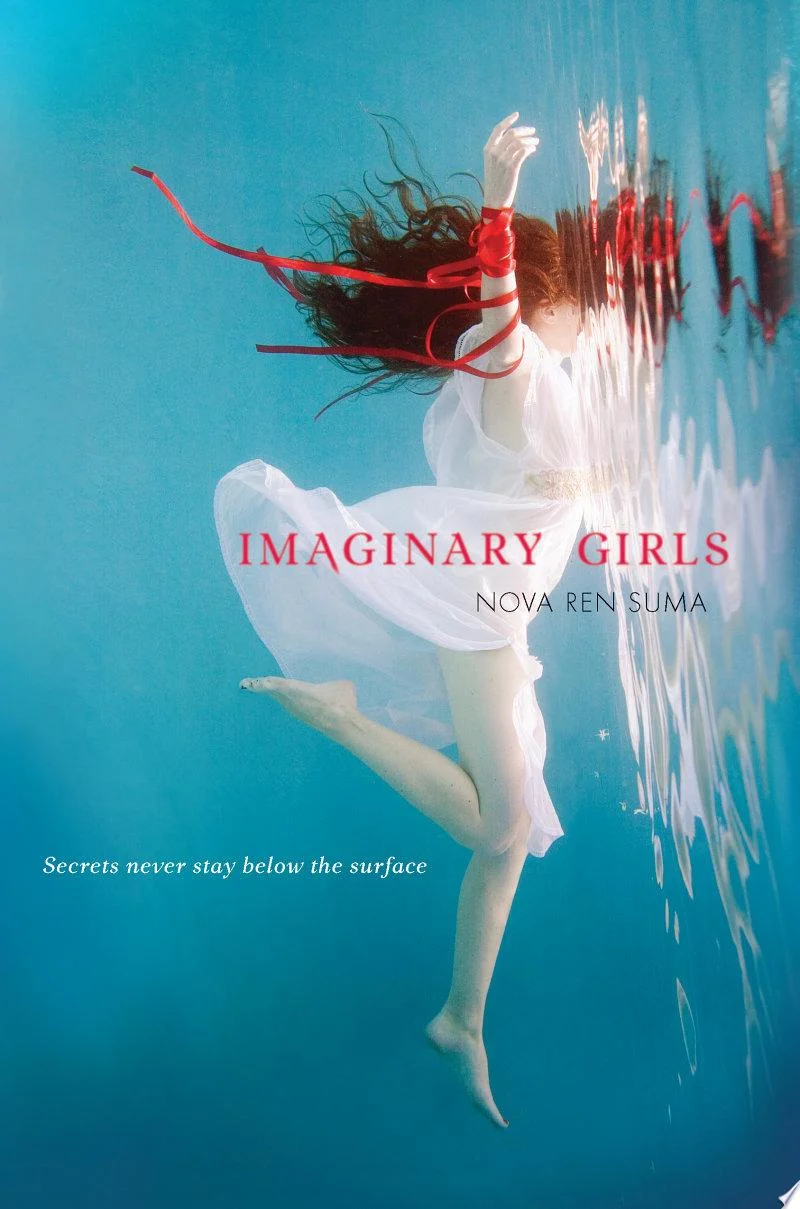
Imaginary Girls
- Publication Date:
- June 14th, 2011
- Publisher:
- Penguin
- ISBN-13:
- 9781101516133
- ISBN-10:
- 1101516135
- Pages:
- 216
Why Imaginary Girls Has Been Challenged
Some parents and reviewers have pushed back on a YA novel that treats a teenager's death and its supernatural aftermath as material for a story rather than a lesson. See more ↓
Challenged or banned in 2 states across 2 school districts.
Overview
Chloe has always lived in the shadow of her older sister Ruby: magnetic, untouchable, the kind of girl a small town builds stories around. That gravitational pull turns dangerous the night Chloe finds the body of a missing classmate, London Hayes, submerged in the local reservoir after a gathering with Ruby's circle of friends spirals out of control.
In the aftermath, Chloe is sent away, severed from Ruby and from the town that shaped them both. But distance doesn't loosen Ruby's hold, and when Chloe returns two years later, she finds a home altered by loss and haunted by unfinished business.
As Chloe edges closer to the truth Ruby has buried, the novel unsettles the boundary separating the living from the dead, using the intensity of sisterhood as the hinge on which its mystery turns.
Sisterhood, Myth, and the Unreliable Everyday
Suma's novel is less interested in solving a mystery than in inhabiting the disorientation of grief and devotion. Chloe's narration is shaped entirely by her worship of Ruby, and the book leans into that distortion rather than correcting it, letting readers feel the seductive unreliability of loving someone larger than life. The reservoir town itself functions almost as a character, a place where local legend and adolescent rumor calcify into something closer to folklore, and where the line between what actually happened and what the town has decided to believe grows increasingly hard to locate.
That ambiguity extends to the novel's treatment of mortality. Rather than offering a tidy explanation for what draws Chloe back into Ruby's orbit, the book uses the eerie and the unexplained to dramatize how far loyalty and dependency can stretch a person, particularly within a family bond as asymmetric as this one. The novel arrived early in the wave of YA fiction willing to let sisterhood carry gothic weight, and its reception has often centered on how effectively it sustains that mood without fully resolving its more supernatural implications.
Why Imaginary Girls Has Been Challenged
Much of the pushback on this title has centered less on a single scene than on where it belongs on a shelf, with some readers arguing its tone and content sit closer to adult fiction than to the young-adult section it's typically placed in. The novel's opening discovery of a drowned teenager, and the death that anchors the plot throughout, has drawn objections from readers uneasy with the frank presence of a corpse and its lingering psychological aftermath in a book aimed at teen audiences. Its unresolved, dreamlike treatment of death, along with hints that Ruby's influence over Chloe extends beyond the ordinary, has also unsettled some who felt the ambiguity read as an endorsement of the supernatural rather than a literary device. Additional objections have pointed to underage drinking and the intensity of Ruby and Chloe's codependent relationship as inappropriate for younger teen readers. Within this catalog, Imaginary Girls has been challenged in 2 states and 2 districts, reflecting a narrower but persistent set of concerns about how the book handles death, obsession, and adolescent vulnerability.
Where to Buy




Affiliate links may generate a small commission at no extra cost to you, which helps support this site.
Banned in Schools
Banned or challenged in 2 states across 2 school districts.
Florida 1 district
- Escambia County Public Schools Banned pending investigation
Iowa 1 district
- Nevada Community School District Banned pending investigation