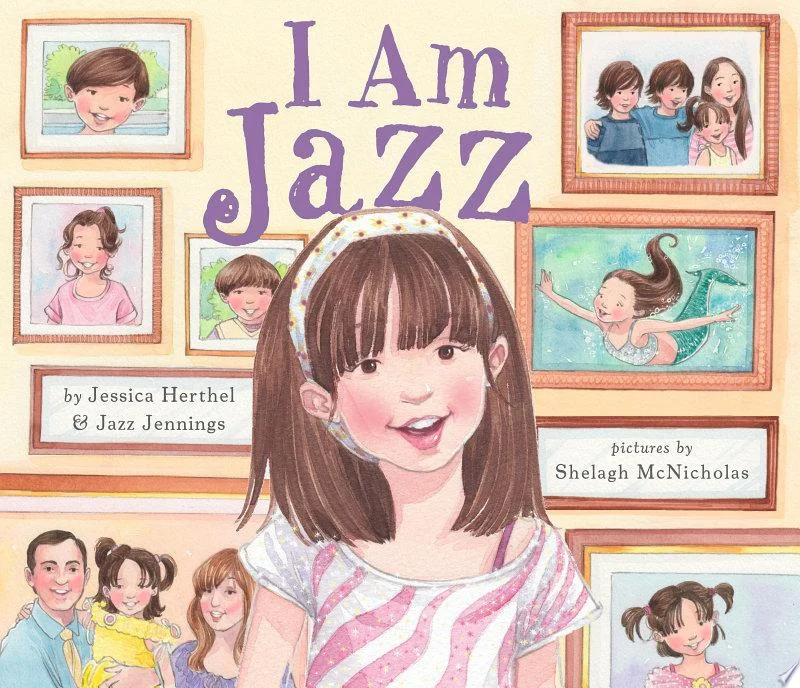
I Am Jazz
- Publication Date:
- September 4th, 2014
- Publisher:
- Penguin
- ISBN-13:
- 9780698176737
- ISBN-10:
- 0698176731
- Pages:
- 28
Why I Am Jazz Has Been Challenged
Much of the pushback centers on whether young children should be introduced to the idea of gender transition before critics believe they can fully process it, and whether a school setting is the right place for that introduction to happen. See more ↓
Challenged or banned in 3 states across 5 school districts.
Overview
Told in the plain, direct language of a picture book, this is Jazz Jennings's account of coming to understand herself as a girl during early childhood, well before she had the vocabulary to explain what she felt. She recalls a preference for pink, for mermaid costumes, and for dresses, and a persistent sense of mismatch with the clothes and expectations assigned to her at birth.
The narrative follows her family through confusion and uncertainty toward a doctor's visit that gave them a framework for what Jazz had already sensed about herself. Rather than dwelling on conflict, the book moves toward acceptance, presenting her transition as something her parents came to support once they understood it.
Aimed at very young readers, the book keeps its scope narrow and personal, favoring a child's-eye view of identity over any broader explanation of gender or medicine.
Context and Reception
The book arrived as Jazz Jennings was already known to a national audience through television appearances and youth advocacy work, and it extended that visibility into the youngest end of the children's book market. Its significance lies less in literary complexity than in scarcity: few picture books at the time offered a transgender child's own account of self-recognition, narrated in the present tense of a child rather than filtered through an adult's retrospective explanation.
That firsthand framing shaped how the book was received. Supporters, including figures from film and television who praised its clarity, positioned it as a mirror for questioning children and a plain-language entry point for parents and teachers unfamiliar with transgender identity. Critics of the book's presence in classrooms and libraries approached it from the opposite direction, treating the same simplicity as a liability rather than a virtue, arguing that a picture book format was being used to normalize a subject they believed required more context than the genre allows.
Why I Am Jazz Has Been Challenged
Because it is shelved and read as material for preschool and early elementary children, most objections center on whether a picture-book audience, typically cited as ages four to eight, is old enough to encounter the concept of gender identity at all. Critics argue that children in this age range lack the developmental footing to process the material and that presenting Jazz's self-understanding as settled fact, rather than as one family's experience, amounts to instruction rather than storytelling.
A related line of objection focuses on the book's discussion of anatomy and its treatment of medical involvement in Jazz's transition, which some parents and advocacy groups have argued is inappropriate for the format regardless of age. Others have challenged its inclusion in classroom read-aloud lists and school libraries specifically, contending that decisions about introducing children to transgender identity belong with parents rather than educators. Within this catalog, the book has drawn challenges in three states and across five school districts.
Where to Buy




Affiliate links may generate a small commission at no extra cost to you, which helps support this site.
Banned in Schools
Banned or challenged in 3 states across 5 school districts.
Florida 3 districts
- Broward County Public Schools Banned by Restriction
- Hillsborough County Public Schools Banned Pending Investigation
- Marion County Public Schools Banned