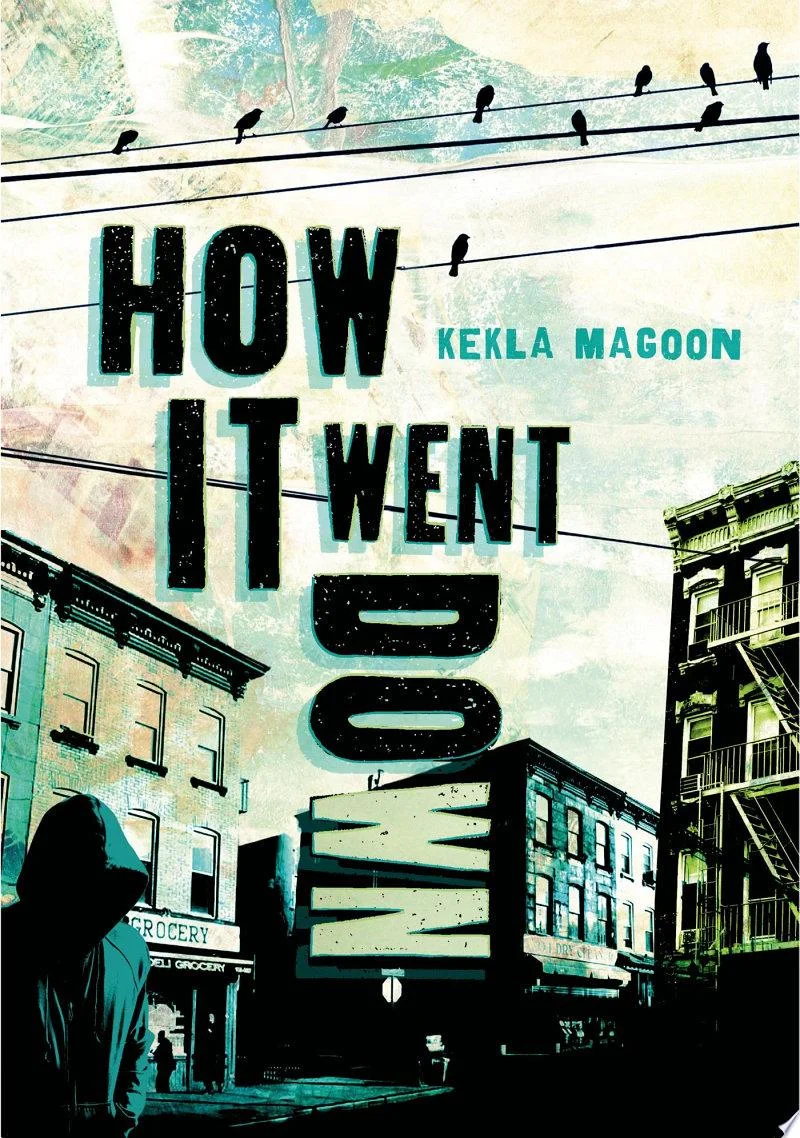
How It Went Down
by Kekla Magoon
- Publication Date:
- October 21st, 2014
- Publisher:
- Macmillan
- ISBN-13:
- 9780805098693
- ISBN-10:
- 0805098690
- Pages:
- 335
Why How It Went Down Has Been Challenged
Readers have pushed back on a novel that keeps a fatal shooting unresolved, uneasy with how pointedly it exposes the racial fault lines in whose account of violence gets trusted. See more ↓
Challenged or banned in 1 state across 1 school district.
Overview
Kekla Magoon's novel opens in the moments after Tariq Johnson, a Black teenager, is killed by Jack Franklin, a white man, on a Brooklyn street corner. From there, the book refuses to settle into a single narrative. Instead, it moves through a chorus of voices — Tariq's family, his friends, neighbors, a local gang leader, a police officer, reporters, and activists — each offering a piece of the story that rarely lines up with the others.
Rather than reconstructing the shooting as a solvable mystery, the novel lets its contradictions stand. Some witnesses describe Tariq as a threat; others insist he was unarmed and harmless. Some accounts shade the event toward a justified use of force, while others frame it unmistakably as a killing rooted in racial fear. Magoon never resolves which version is "true," leaving readers to sit with the uncertainty that the characters themselves cannot escape.
The structure itself becomes the point: a community grieving in public, under media scrutiny, while its members argue not just about facts but about what those facts mean. The novel captures how a single death can fracture into dozens of competing stories, each shaped by who is telling it and what they need it to be true.
A Fractured Narrative as Social Commentary
Magoon's choice of structure owes an evident debt to Robert Cormier's narrative experiments and to real-world cases where eyewitness testimony and public narrative diverged sharply along racial lines. By denying readers a stable, omniscient account, the novel resists the comfort of a tidy resolution and instead dramatizes how racial bias filters perception itself — how the same ten seconds of violence can be remembered as self-defense by one witness and as an execution by another.
The book arrived in the midst of an ongoing national conversation about police violence, vigilantism, and the deaths of young Black men and boys, and it has been read as part of a broader wave of young adult fiction confronting those realities directly rather than through allegory. Its polyphonic form also places it in conversation with journalism and courtroom drama, inviting readers to notice how narratives are constructed, selected, and believed — and whose version typically wins.
Within Magoon's body of work, the novel sits alongside her other writing that engages history and injustice for young readers, but it is distinguished by its refusal to hand down a verdict. The discomfort of not knowing becomes, for many readers and critics, the novel's central achievement.
Why How It Went Down Has Been Challenged
Gun violence sits at the center of nearly every objection raised against this novel, since the story begins with a fatal shooting and keeps returning to the moment of the killing through multiple retellings. Some challengers have argued that dwelling on the circumstances of Tariq's death from so many angles makes the violence feel repetitive or gratuitous rather than illuminating, even though the repetition is structural rather than incidental to the book's point.
The novel's treatment of race and its unflinching depiction of how differently Black and white witnesses are believed has also drawn scrutiny, with some objectors characterizing its frank engagement with racial bias and community anger as divisive material for younger readers. Related complaints have cited the book's language, including profanity used by characters under duress, and its portrayal of gang involvement and street-level conflict as elements some reviewers considered inappropriate without a clear single moral framing. Because the book deliberately withholds judgment about what really happened, some challengers have also objected to the ambiguity itself, arguing that a story about a teenager's death ought to offer readers more certainty than Magoon provides. In this catalog, the title has been formally challenged in 1 state and 1 school district.
Where to Buy




Affiliate links may generate a small commission at no extra cost to you, which helps support this site.
Also by Kekla Magoon
Banned in Schools
Banned or challenged in 1 state across 1 school district.
Florida 1 district
- Escambia County Public Schools Banned pending investigation