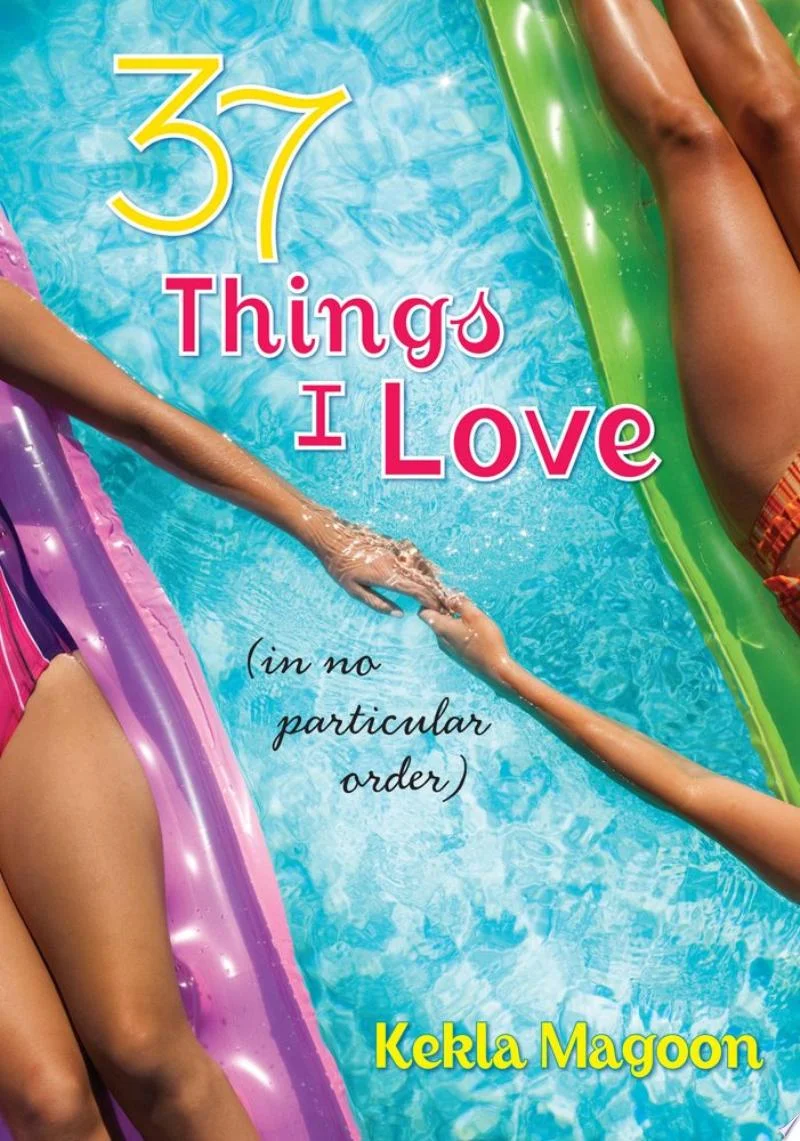
37 Things I Love (in No Particular Order)
by Kekla Magoon
- Publication Date:
- May 22nd, 2012
- Publisher:
- Macmillan
- ISBN-13:
- 9780805094657
- ISBN-10:
- 0805094652
- Pages:
- 225
Why 37 Things I Love (in No Particular Order) Has Been Challenged
Debate over this novel tends to center less on any single scene than on whether teenagers should encounter a family's real-time decision to end life support without an adult guiding the conversation. See more ↓
Challenged or banned in 1 state across 4 school districts.
Overview
Kekla Magoon's novel compresses its entire story into a single, unbearable countdown: four days remain in Ellis's sophomore year, and four days remain before her mother disconnects the machines that have kept her father's body alive since his accident. Rather than narrate that countdown in a straight line, Ellis organizes her experience as a running list of things she loves, an inventory that ranges from the trivial to the devastating and back again.
The list format becomes the novel's structure and its coping mechanism. Ellis reaches for small, concrete pleasures — a song, a smell, a memory of her father before the machines — as a way of holding herself together while the adult world moves toward an ending she cannot stop. The result is a portrait of a teenager trying to make sense of loss in real time, using whatever fragments of joy she can still find.
Magoon keeps the frame narrow and domestic: a bedroom, a hospital room, a school hallway, the final ordinary days of a school year that will never feel ordinary again. The novel doesn't resolve grief so much as sit inside it, following Ellis as she learns to hold love and loss in the same hand.
Grief, Structure, and the Logic of Lists
Part of what distinguishes this book is its form. A list is normally a tool for control — an attempt to organize a chaotic world into discrete, nameable items — and Magoon uses that impulse against itself. Ellis's list keeps slipping from lighthearted to unbearable and back, mirroring the way grief actually behaves: it doesn't proceed in tidy stages but intrudes on ordinary thought without warning. The structure lets the novel move fluidly between humor, memory, and dread without ever feeling like it is minimizing the stakes.
The book also sits within a broader conversation in young adult fiction about mortality and caregiving, subjects more commonly handled through adult protagonists or after-the-fact reflection. By placing a teenage narrator inside the days immediately before a parent's death, and inside her family's active decision-making about that death, Magoon asks young readers to sit with ambiguity rather than resolution. Ellis's mother is not a villain for choosing to let go, and Ellis's grief is not something the novel rushes to fix. That refusal to soften the material is central to the book's reception among readers and reviewers, who have generally praised its emotional honesty over its plot mechanics.
Why 37 Things I Love (in No Particular Order) Has Been Challenged
One school board discussion of the novel centered on whether a story built around a family's decision to withdraw life support belonged on a shelf accessible to middle-school-aged readers, with a board member arguing that the subject matter demanded parental context the classroom or library setting couldn't provide. That framing — that the book's core premise is simply too heavy for its intended audience rather than any single scene or passage — has driven most of the formal objections raised against the title, which has been challenged in 1 state and 4 districts tracked in this catalog.
Beyond concerns about the end-of-life storyline itself, some complaints have pointed to the novel's incidental mature content — scattered profanity and references to teenage romance and sexuality — as evidence that the book skews older than its shelving suggested. Underlying most challenges, though, is less a single objectionable passage than a broader discomfort with handing teenagers an unflinching account of a parent's death and the mechanics of the decision to let it happen, on the theory that such material is better introduced by a parent than encountered independently at school.
Where to Buy



Affiliate links may generate a small commission at no extra cost to you, which helps support this site.
Banned in Schools
Banned or challenged in 1 state across 4 school districts.
Florida 4 districts
- Clay County School District Banned
- Hillsborough County Public Schools Banned Pending Investigation
- Union County School District Banned
- Volusia County Schools Banned Pending Investigation