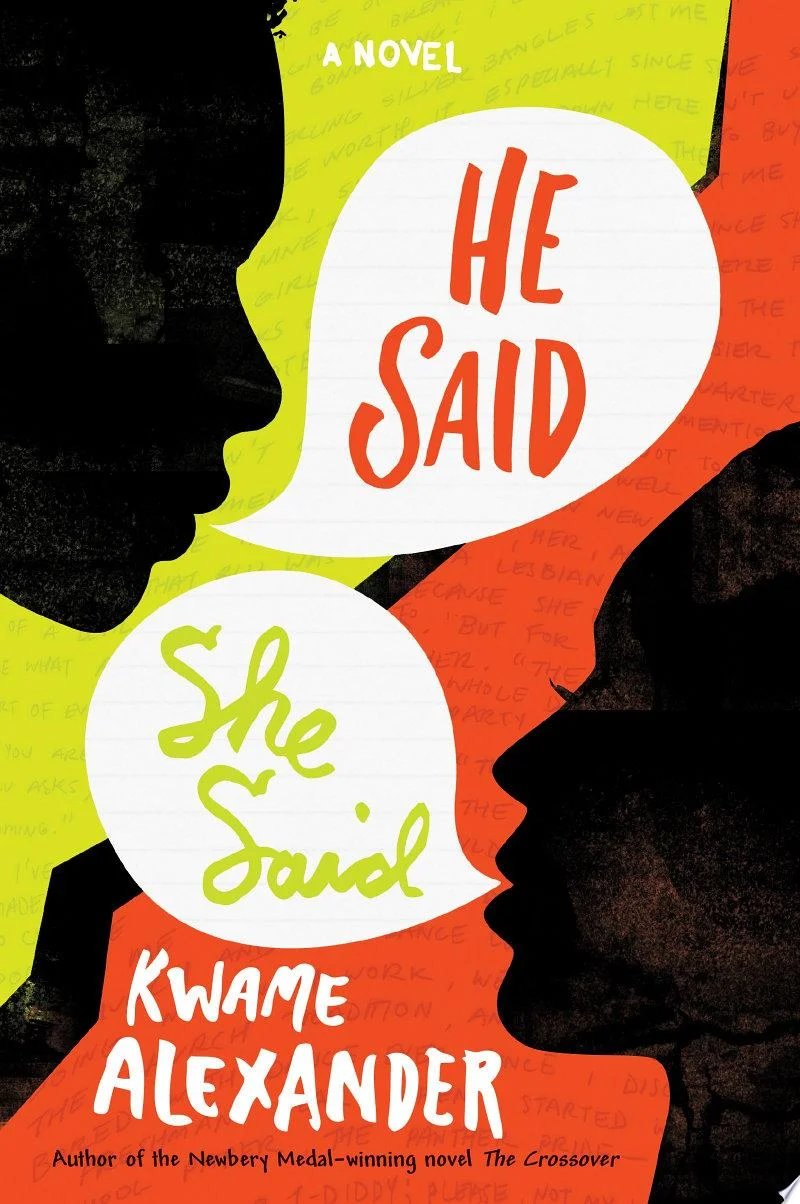
He Said, She Said
- Publication Date:
- November 19th, 2013
- Publisher:
- Harper Collins
- ISBN-13:
- 9780062118998
- ISBN-10:
- 0062118994
- Pages:
- 194
Why He Said, She Said Has Been Challenged
Objections to this novel have mostly centered on how openly it portrays teenage sexuality and pregnancy, subjects some reviewers felt were too mature for the intended readership. See more ↓
Challenged or banned in 2 states across 2 school districts.
Overview
Omar Smalls is West Charleston High's golden boy: a quarterback with a scholarship to Miami already in hand and a fan club that follows him everywhere. Claudia Clarke has no patience for any of it. She's aimed at Harvard, consumed by causes bigger than a football schedule, and she regards Omar as exactly the kind of celebrated nonsense she has no time for.
Kwame Alexander pairs these two opposites and then forces them together, not through romance at first but through circumstance: a shared cause pulls them into leading a protest that spreads far beyond their campus, amplified by the social media tools their classmates already live on. What begins as mutual irritation becomes something more complicated as each is forced to see the other as more than a stereotype.
The novel moves at the clip of a verse, blending banter, activism, and attraction into a story about two teenagers discovering that the causes they care about, and the people they underestimate, can upend everything they thought they knew about themselves.
A Story of Image, Advocacy, and Adolescence
Alexander, known for infusing young adult fiction with the rhythm of hip-hop and spoken word, uses the collision between Omar and Claudia to examine how teenagers are boxed in by other people's expectations: the athlete assumed to be shallow, the activist assumed to be humorless. Their partnership complicates both labels, suggesting that charisma and conscience aren't mutually exclusive traits.
The book also captures a specific moment in how youth organizing works, where a local grievance can be broadcast and mobilized through platforms like Facebook and Twitter faster than any adult institution can respond. That dynamic, alongside the novel's frank interest in issues like poverty and teen pregnancy, places it in a tradition of socially engaged YA fiction that treats teenagers as capable of both romance and real political agency, without asking them to abandon either.
Why He Said, She Said Has Been Challenged
Alexander's work is frequently praised for its energy and its willingness to take teenagers' inner lives seriously, but that same directness is what has drawn scrutiny to this particular title. Reviewers who admire the novel's voice and social conscience have not always been the ones deciding whether it belongs on a school shelf, and objections have tended to focus on its content rather than its craft.
Much of the concern centers on the book's sexual content and romantic material, which some parents and administrators have judged too explicit or too central to the story for the intended age group. The novel's candid handling of teen pregnancy and its surrounding statistics has also drawn objection from those who feel the subject is handled too plainly for a young audience. Additionally, its slang-heavy, colloquial dialogue has occasionally been flagged as inappropriate or coarse for classroom use. Records maintained by this catalog show the book has been challenged in 2 states and 2 districts, reflecting a narrow but recurring discomfort with how frankly the novel treats teenage sexuality and social realities.
Where to Buy




Affiliate links may generate a small commission at no extra cost to you, which helps support this site.
Banned in Schools
Banned or challenged in 2 states across 2 school districts.
Florida 1 district
Iowa 1 district
- Nevada Community School District Banned pending investigation