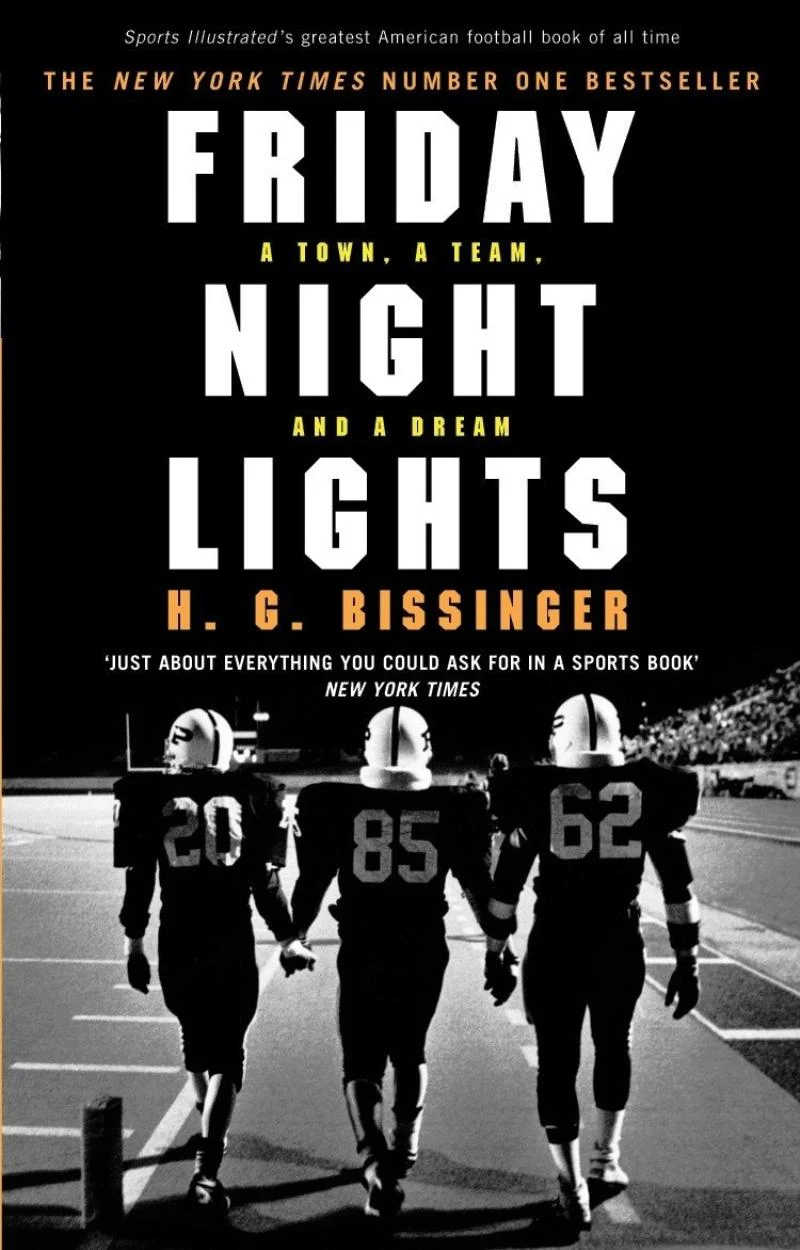
Friday Night Lights
- Publication Date:
- May 31st, 2011
- Publisher:
- Random House
- ISBN-13:
- 9781446449776
- ISBN-10:
- 1446449777
- Pages:
- 416
Why Friday Night Lights Has Been Challenged
A reporter's unflinching look at what a fixated town asks of its teenage athletes has made some readers uneasy about putting the book itself in front of teenagers. See more ↓
Challenged or banned in 2 states across 11 school districts.
Overview
In 1988, journalist H.G. Bissinger relocated to Odessa, Texas, to live alongside the players, coaches, and families of the Permian High School football team for an entire season. What he found was a community where a Friday night game could draw tens of thousands of spectators and where the fortunes of a handful of seventeen-year-olds carried the emotional weight of the whole town.
The resulting book moves between the bruises and triumphs of individual players and a wider portrait of Odessa itself: its boom-and-bust oil economy, its segregated neighborhoods, and the disproportionate resources poured into the football program relative to academics. Bissinger writes with evident affection for the young men he came to know, even as he documents the toll the sport takes on their bodies and the narrowness of the futures available to them once the lights go out.
Rather than a straightforward sports narrative, the book operates as a close study of a particular American place at a particular moment, using one season of football as the lens through which to examine everything the town has invested in it, materially and emotionally.
A Town's Mirror
Friday Night Lights is frequently cited among the most clear-eyed books written about American sports precisely because it refuses to treat football as separable from the social conditions around it. Bissinger's access was extraordinary, and he used it to show how a school district's priorities, a region's racial history, and a family's hopes for upward mobility could all converge on a single game clock.
The book's afterlife has arguably eclipsed its original reporting: it inspired a feature film and a long-running television series, both of which softened or reinterpreted elements of the source material. Read against those adaptations, the original text stands out for its willingness to sit with uncomfortable conclusions rather than resolve them, including the question of what a community owes the young people it asks to carry its identity. Within the broader landscape of narrative sports journalism, it is often credited with establishing a template later writers have followed: embed deeply, report honestly, and let the sport reveal the town rather than the other way around.
Why Friday Night Lights Has Been Challenged
Much of the scrutiny directed at the book centers on its unvarnished depiction of teenage life off the field: underage drinking, casual sexual activity, and coarse language appear as part of Bissinger's account of how these students actually spent their time, rather than as events he stages or dwells on for shock value. Because the subjects are real high schoolers reported on with journalistic candor, some readers have objected to assigning the book to younger students, arguing that its frank content is inappropriate regardless of its documentary purpose.
A second line of objection concerns the book's treatment of race and institutional favoritism. Bissinger does not soften his account of discriminatory attitudes among some Odessa residents or the stark disparity between funding for athletics and funding for academics, and that honesty has occasionally been read as an endorsement of the very attitudes it describes rather than an indictment of them. Some challenges have also pointed to the book's criticism of a beloved local institution, suggesting that its unflinching look at the costs of football culture reflects poorly on the sport or the community rather than illuminating a broader pattern worth examining. Taken together, these objections have led to the book's being challenged in 2 states and 11 school districts within the records this catalog tracks.
Where to Buy




Affiliate links may generate a small commission at no extra cost to you, which helps support this site.
Banned in Schools
Banned or challenged in 2 states across 11 school districts.
Florida 1 district
- Orange County Public Schools Banned by restriction
Iowa 10 districts
- Clear Lake Community School District Banned
- Mason City Community Schools Banned pending investigation
- Mediapolis Community School District Banned
- Melcher-Dallas Community School District Banned pending investigation
- Northwood Kensett Community School District Banned
- Pocahontas Area Community School District Banned
- Sioux Center Community School District Banned
- South Tama County Community School District Banned
- Spencer Community School District Banned
- WACO Community School District Banned