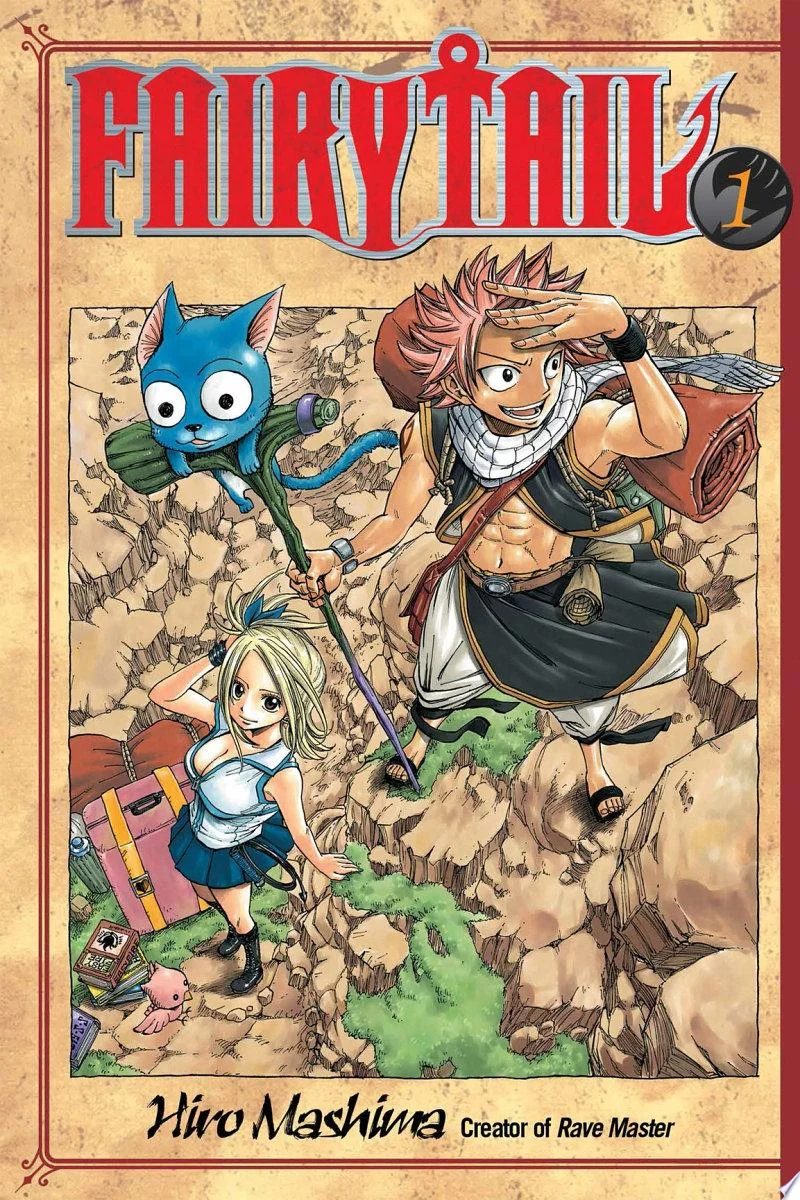
Fairy Tail
by Hiro Mashima
- Publication Date:
- July 16th, 2013
- Publisher:
- Kodansha Comics
- ISBN-13:
- 9781612624600
- ISBN-10:
- 161262460X
- Pages:
- 210
Why Fairy Tail Has Been Challenged
Reviewers have pushed back on the manga's art style, arguing that its depiction of female characters and combat sequences is too mature for the shelves where it's shelved. See more ↓
Challenged or banned in 1 state across 4 school districts.
Overview
Fairy Tail opens on Lucy Heartfilia, a young celestial spirit mage hoping to earn a place in the title guild, famed as a home for the realm's most formidable wizards. Her path there is anything but direct: she's quickly captured by a band of slavers working for a manipulative sorcerer, and finds her prospects of rescue resting on an unlikely stranger she meets along the road.
That stranger is Natsu Dragneel, a Fire Dragon Slayer whose heroic qualities arrive bundled with a weak stomach for travel, an enormous appetite, and a blue cat companion who happens to talk. The mismatch between Natsu's raw power and his goofy, unpolished demeanor sets the tone for the series, which pairs high-stakes magical combat with constant comic deflation.
As Lucy joins the guild and its sprawling cast of mages, the series settles into an episodic rhythm of jobs, rivalries, and escalating threats, built around found-family camaraderie as much as spectacle.
A Guild Built on Found Family
Beneath its battles and bounty-hunting plots, Fairy Tail is fundamentally a story about belonging. The guild hall functions as a surrogate household for characters who are mostly orphaned, displaced, or otherwise unmoored, and the series repeatedly argues that loyalty to that chosen family outweighs raw strength or official rank. Mashima leans on long-running shonen conventions, friendly rivalries, escalating tournaments, villains who force characters to reckon with their pasts, while keeping the humor broad and the emotional stakes legible even to younger readers.
The series became one of the defining shonen-adjacent hits of its era, notable for centering a female protagonist's ambitions alongside its ensemble of male leads and for sustaining its world across a long serialized run. Its popularity has carried it well beyond the page into anime adaptations, spin-offs, and merchandising, cementing its place as a gateway title for many readers new to manga.
Why Fairy Tail Has Been Challenged
A recurring complaint from parents reviewing the series for school and classroom libraries is that its character designs and panel art are too sexualized for the shelves they appear on, pointing to costuming and figure proportions among the guild's female cast as inappropriate for the age group with access to the books. Related objections have focused on fan service-style imagery and suggestive posing played for comic or decorative effect, which reviewers argue sends mixed signals alongside the series' otherwise light, adventure-driven tone. Some challenges have also cited the comic's cartoon violence, including guild brawls and magical combat, as excessive for younger audiences. Collectively, these concerns have led to the title being challenged or restricted in 1 state and 4 districts tracked in this catalog, reflecting broader debates over how manga's visual conventions are evaluated in school library collections.
Where to Buy




Affiliate links may generate a small commission at no extra cost to you, which helps support this site.
Banned in Schools
Banned or challenged in 1 state across 4 school districts.
Florida 4 districts
- Clay County School District Banned
- Hillsborough County Public Schools Banned Pending Investigation
- Union County School District Banned
- Volusia County Schools Banned Pending Investigation