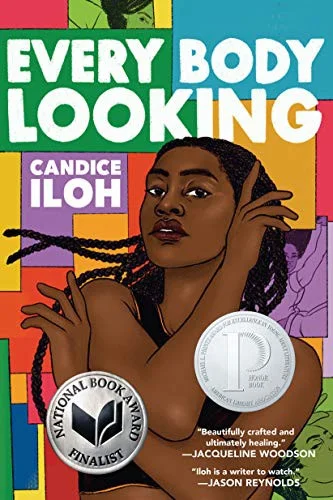
Every Body Looking
by Candice Iloh
- Publication Date:
- September 21st, 2021
- Publisher:
- Dutton Books for Young Readers
- ISBN-13:
- 9780525556220
- ISBN-10:
- 0525556222
- Pages:
- 416
Why Every Body Looking Has Been Challenged
At issue for critics is less the book's underlying themes than how candidly it renders sexual violence, substance use, and a teenager's sexual awakening on the page. See more ↓
Challenged or banned in 2 states across 2 school districts.
Overview
Candice Iloh's Every Body Looking is written in free verse, a form that lets the story move the way memory does — in fragments, repetitions, and sudden returns rather than a straight line. At its center is Ada, a Nigerian American teenager leaving home for college and, for the first time, finding room to ask who she is apart from what her family, her church, and the people around her have told her to be.
The verse structure doubles as a way of tracing a body's history: dance, movement, and physical self-possession recur as the novel's counterweight to an assault from Ada's past that she has not let herself fully name. College becomes less an escape than a space where old silences start to surface.
Threaded through the coming-of-age narrative are questions of faith, family expectation, and sexuality, as Ada works out which parts of her upbringing she wants to keep and which she needs to set down in order to feel at home in herself.
Identity, Inheritance, and the Verse Novel
The book sits in a lineage of verse novels that use spare, rhythmic language to render interior experience — a form particularly suited to a story about reclaiming a body and a voice that have been shaped by other people's expectations. The choppy, song-like structure mirrors Ada's own process of piecing together a self from inherited pressures: a devout mother's faith, a largely absent father, cultural norms around womanhood and respectability, and the dance training that gave her an early, embodied sense of control.
What the novel is ultimately working through is the distance between how a young woman's body is seen — by family, by men, by a community with its own rules about propriety — and how she comes to understand it herself. Trauma recovery, in this telling, is inseparable from questions of heritage and belonging: Ada's path toward naming what happened to her runs alongside her negotiation of what it means to be Nigerian American, queer, and searching for a faith of her own making rather than one simply handed down.
Why Every Body Looking Has Been Challenged
Most objections to this title turn less on whether the subject matter is legitimate and more on where a book handling it so directly belongs — whether it's suited to high school shelves or library displays accessible to younger readers, given its unflinching treatment of mature material. Reviewers and parents who have raised concerns point to its depiction of sexual assault, including scenes recounted in visceral detail, as well as frank passages about sex, drug and alcohol use, and coarse language.
A further strand of objection centers on the novel's exploration of queer identity and sexuality alongside religious upbringing, which some readers have found to be in tension with the values they want reflected in school libraries. Taken together, these concerns reflect a recurring pattern in challenges to coming-of-age narratives that treat trauma and sexuality without softening them: the discomfort is less with the fact that such experiences are portrayed than with how explicitly a young audience encounters them. The book has been challenged or restricted in 2 states and 2 districts tracked in this catalog.
Where to Buy




Affiliate links may generate a small commission at no extra cost to you, which helps support this site.
Banned in Schools
Banned or challenged in 2 states across 2 school districts.
Florida 1 district
- Escambia County Public Schools Banned pending investigation