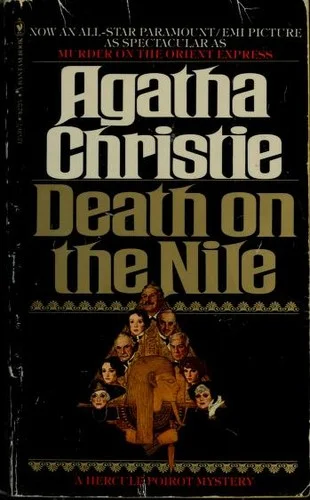
Death on the Nile
- Publication Date:
- January 1st, 1978
- Publisher:
- Bantam Books
- ISBN-13:
- 9780553125399
- ISBN-10:
- 0553125397
Why Death on the Nile Has Been Challenged
Some reviewers have questioned whether a story that treats murder as polite dinner-table conversation belongs in the hands of younger readers. See more ↓
Challenged or banned in 2 states across 2 school districts.
Overview
Death on the Nile follows Hercule Poirot's Egyptian holiday as it turns into a murder investigation. Linnet Doyle, a wealthy and striking young woman who seems to have claimed everything life has to offer, is shot dead aboard a paddle steamer making its way up the Nile. What should have been a leisurely cruise through ancient landscapes becomes a floating crime scene with nowhere for the killer to run.
Poirot has reason to be uneasy well before the shot is fired. He recalls an earlier remark from a fellow traveler, a chilling aside about wanting to press a pistol to Linnet's head, and the comment lingers over the narrative like a held breath. As the detective works through alibis, grudges, and the tangled romantic history binding several passengers together, Christie steers the reader through a puzzle built on jealousy, inheritance, and the private resentments wealth can provoke.
The Nile setting is not mere backdrop; the isolation of the boat and the sweep of the river heighten the sense that civility is a thin veneer over the passengers' true feelings. Christie uses the confined cast and exotic location to stage one of her most tightly constructed whodunits.
A Puzzle Built on Envy and Appearances
Within Christie's body of work, Death on the Nile belongs to the tradition of the closed-circle mystery, where a finite group of suspects and a controlled setting let the author play fair with clues while still surprising the reader. The novel is often singled out among her Poirot books for the way it layers motive: nearly every character aboard the steamer has a private reason to resent Linnet, whether rooted in money, love, or old humiliation. That abundance of plausible suspects, rather than any single twist, has helped keep the book in steady circulation since its original publication, including repeated stage, film, and television adaptations that have introduced new generations of readers to Poirot's methods.
The book also reflects the era's fascination with travel to Egypt as a marker of wealth and sophistication, using the cruise itself as a subtle commentary on class and privilege among its passengers.
Why Death on the Nile Has Been Challenged
Much of the unease directed at this novel centers on the casual menace running through its dialogue, most notably the overheard threat against Linnet that Poirot recalls early in the story, along with the matter-of-fact way violence and death are discussed by characters who otherwise behave with polished manners. Some readers and reviewers have viewed this juxtaposition of refined setting and blunt talk of killing as unsuitable for younger or more impressionable audiences, arguing that a murder mystery normalizes violent fantasy by presenting it as parlor conversation. Others have pointed to the novel's frank treatment of adult relationships, jealousy, and betrayal as themes better suited to mature readers, prompting objections in school and library settings where age-appropriateness is a central concern. In the catalog tracked here, Death on the Nile has drawn challenges in 2 states and 2 districts, reflecting a narrower but persistent set of concerns about exposing young readers to its darker material rather than any broader controversy over the novel's content.
Where to Buy




Affiliate links may generate a small commission at no extra cost to you, which helps support this site.
Banned in Schools
Banned or challenged in 2 states across 2 school districts.
Florida 1 district
- Escambia County Public Schools Banned pending investigation
Wisconsin 1 district
- Elkhorn Area School District Banned pending investigation