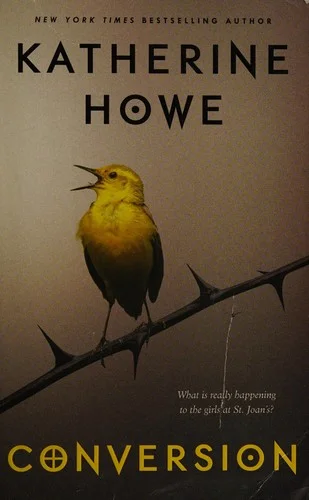
Conversion
- Publication Date:
- January 1st, 2014
- Publisher:
- G. P. Putnam's Sons, an imprint of Penguin Group (USA)
- ISBN-13:
- 9780399167775
- ISBN-10:
- 0399167773
- Pages:
- 402
Why Conversion Has Been Challenged
Some readers have pushed back against the novel's candid link between teenage girls' bodies, sexuality, and social pressure, arguing the material is too explicit for the age group it's aimed at. See more ↓
Challenged or banned in 2 states across 3 school districts.
Overview
Katherine Howe's "Conversion" opens on an ordinary senior year in Danvers, Massachusetts, until ordinary stops being an option. One by one, girls at Colleen's school begin twitching, coughing, and collapsing without any diagnosis to explain it. Doctors are stumped, parents panic, and the school itself starts to feel like a pressure cooker of rumor and suspicion.
Colleen, trying to hold her own college-application anxieties together while the building around her unravels, is the one who notices what others miss: Danvers was once Salem Village, ground zero for one of early America's most notorious outbreaks of fear. As she digs into that history, the novel braids her present-day account with the story of the girls who, centuries earlier, triggered a crisis of a very different and far deadlier kind.
The result is less a mystery to be solved than a mirror held up across time, asking whether the forces that turned neighbors against each other in old Salem have really gone anywhere.
Two Towns, One Affliction
Howe, who has written elsewhere about Salem's legacy, uses the dual timeline to probe a question that outlives any one historical moment: what happens to a community when it cannot explain suffering it can plainly see? The novel treats the Salem trials not as a closed chapter of colonial history but as a template that keeps getting redrawn, wherever uncertainty, scrutiny, and crowd behavior intersect.
Much of the book's tension lives in the pressure placed specifically on teenage girls, whose bodies and behavior become the subject of public diagnosis, speculation, and blame. By setting that pressure against the backdrop of a competitive, high-achieving high school, "Conversion" also reads as commentary on the particular strain modern adolescence places on young women, long before any symptoms appear. The novel sits within a tradition of YA fiction that reaches into American history to illuminate present-day anxieties, rather than simply retelling the past.
Why Conversion Has Been Challenged
The novel's unflinching portrait of teenage girls under psychological and physical strain, including the implication that unexplained symptoms may be bound up with sexual pressure and social expectation, has unsettled some readers who feel the material is too mature or too clinical for a young adult audience. Discomfort with how directly the book links adolescent female bodies to stress, sexuality, and public scrutiny has driven some of the pushback, with critics arguing that the subject matter demands a level of candor some find inappropriate for younger teens.
Objectors have also pointed to the book's language and frank treatment of teenage social life, including depictions of peer dynamics and romantic relationships, as unsuitable for school shelves. Others have taken issue with the novel's skeptical framing of institutional authority, including how adults, doctors, and officials in the story fail or mishandle the girls' crisis, seeing in it an implicit critique they consider inappropriate for a school setting. In this catalog, the book has been the subject of challenges in 2 states and 3 districts.
Where to Buy




Affiliate links may generate a small commission at no extra cost to you, which helps support this site.
Banned in Schools
Banned or challenged in 2 states across 3 school districts.
Florida 2 districts
- Clay County School District Banned
- Escambia County Public Schools Banned pending investigation