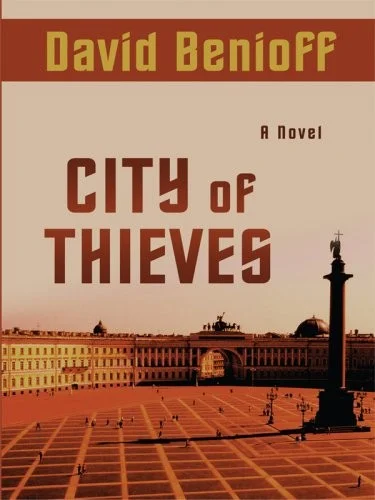
City of thieves
- Publication Date:
- January 1st, 2009
- Publisher:
- Hodder & Stoughton
- ISBN-13:
- 9781848943971
- ISBN-10:
- 1848943970
- Pages:
- 300
Why City of thieves Has Been Challenged
Some parents and administrators have argued the book's frank depictions of wartime brutality and sex are too graphic for the age group assigned to read it. See more ↓
Challenged or banned in 2 states across 5 school districts.
Overview
City of Thieves follows Lev Beniov, a teenager caught looting a corpse during the Nazi siege of Leningrad, who lands in a cell alongside Kolya, a charismatic and reckless deserter. Rather than face execution, the two are handed a strange reprieve: a Soviet colonel wants a dozen eggs for his daughter's wedding cake, and Lev and Kolya have a matter of days to find them in a city where food has all but vanished.
What follows is less a straightforward war narrative than a picaresque journey through a collapsing city and the frozen countryside beyond it. The search for eggs becomes a pretext for encounters with black marketeers, partisans, and occupying soldiers, each scene shifting the tone between absurdity and dread. Lev, bookish and uncertain, and Kolya, brash and endlessly talkative, form an odd-couple partnership that carries much of the novel's warmth.
Benioff builds the story around the tension between the two registers it holds at once: the specific, almost unbearable deprivation of the siege, and the buoyant, often comic voice of its narrator. The result is a coming-of-age story that uses an extreme historical setting to examine how young men are shaped by fear, hunger, and the people they happen to be thrown together with.
A Comic Lens on Historical Horror
The novel sits within a tradition of war fiction that uses humor not to soften atrocity but to make it legible. Leningrad's siege, one of the deadliest in modern history, is rendered through small, human-scaled details rather than sweeping battlefield description: hunger, cold, scarcity, and the black-market economy that springs up around them. Kolya's constant banter and bravado function as a counterweight to that bleakness, giving readers a way into material that might otherwise feel purely unbearable.
The book is framed as a story told late in life, looking back from decades after the events it describes, which lends the narrative a reflective, almost legendary quality even as it depicts specific brutal incidents. This structure has invited comparisons to oral-history storytelling, where the gap between the event and its telling becomes part of the meaning. Critics have generally praised Benioff's ability to balance entertainment with historical weight, and the novel has found a steady readership in classrooms and book clubs interested in World War II from an unconventional angle, outside the more familiar Western Front or Holocaust-camp narratives.
Why City of Thieves Has Been Challenged
Most objections to the novel surface in high school classrooms, where it is sometimes assigned as supplemental World War II reading, and center on whether its content is appropriate for teenage readers. Critics point to scenes depicting violence, including the killing of civilians and soldiers, as well as sexual content involving the occupying forces and the desperate conditions of the besieged city, arguing that the combination is too graphic for students in that age range.
Beyond individual scenes, some challenges have objected to the novel's casual, often darkly comic tone toward subjects like execution, cannibalism rumors, and sexual violence, suggesting that humor is an inappropriate frame for such material regardless of its historical basis. Others have raised concerns about language and crude dialogue between the two leads. In this catalog, the book has been the subject of challenges in 2 states and 5 districts, generally brought by parents or school board members reviewing assigned reading lists rather than by professional educators objecting to its literary merit.
Where to Buy




Affiliate links may generate a small commission at no extra cost to you, which helps support this site.
Banned in Schools
Banned or challenged in 2 states across 5 school districts.
Florida 3 districts
- Escambia County Public Schools Banned pending investigation
- Orange County Public Schools Banned by restriction
- Santa Rosa County Schools Banned Pending Investigation
Georgia 2 districts
- Cobb County School District Banned
- Marietta City Schools Banned