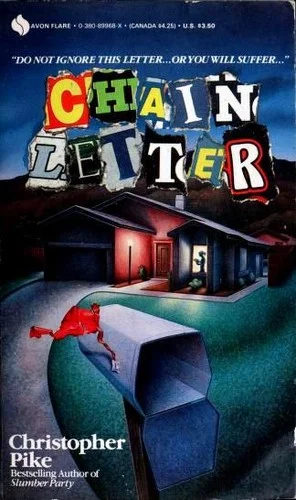
Chain Letter
- Publication Date:
- May 1st, 1986
- Publisher:
- Avon Books
- ISBN-13:
- 9780380899685
- ISBN-10:
- 038089968X
- Pages:
- 185
Why Chain Letter Has Been Challenged
Some readers have pushed back against pairing a body count and sustained sense of menace with a cast of teenage protagonists, arguing the book's thrills come at the cost of age-appropriate content. See more ↓
Challenged or banned in 1 state across 2 school districts.
Overview
Christopher Pike's Chain Letter opens with a group of friends bound together by something they did on a lonely stretch of California desert road — an act none of them has spoken of since. When a letter arrives addressed to the group and signed only "Your Caretaker," Alison and the others assume it's a prank in poor taste. The letter proves otherwise: it knows exactly what happened that night, and it comes with instructions.
What follows is less a mystery about who sent the letter than a slow tightening of the screws. Each demand is stranger and more dangerous than the last, and refusal carries a threat of exposure or worse. As the seven friends try to figure out whether to comply, confess, or fight back, the story shifts from psychological unease into open peril, with the group realizing that whoever is orchestrating this has both the patience and the means to follow through.
Pike structures the novel as a slow-burn thriller aimed at teen readers, using the chain-letter device to explore how guilt, secrecy, and group loyalty can be turned into instruments of control. The California desert setting, established in the book's opening pages, recurs as a kind of unfinished business the characters can't outrun.
Context and Reception
Chain Letter belongs to the wave of YA horror and suspense fiction that flourished from the late 1980s through the 1990s, a genre in which Christopher Pike was one of the most widely read and commercially successful authors alongside contemporaries like R.L. Stine. Pike's novels distinguished themselves from lighter genre fare by their willingness to let teenage characters face real consequences — including death — and by treating adolescent secrets and moral failures with a seriousness that didn't always soften the outcome for the reader's comfort.
The book's premise, in which a hidden crime resurfaces to punish those who tried to bury it, taps into a familiar tradition of guilt-driven suspense fiction, but Pike aims it squarely at a teenage audience and its particular anxieties: the fear of being found out, the pressure to protect friends even when they've done something unforgivable, and the discovery that consequences don't expire just because no one was caught. Its popularity helped cement Pike's reputation as a defining voice in the genre and contributed to a spin-off sequel that continued the story.
Why Chain Letter Has Been Challenged
Pike's fiction has long been credited with hooking reluctant teen readers through pacing and suspense, even as the same qualities that made his books popular in school libraries also made them targets of concern from parents and administrators. Chain Letter has drawn objections rooted in its violent content, including the accidents and deaths that escalate as the story progresses, as well as its central premise of teenagers concealing a serious crime rather than facing consequences through legitimate means. Critics of the book have also pointed to its psychological intensity — the sustained threat, coercion, and sense of dread inflicted on its young characters — as inappropriate for the age group most likely to pick it up. In the catalog tracked here, that unease has translated into a challenge recorded in 1 state and 2 districts, reflecting the broader pattern of scrutiny aimed at YA horror titles that pair mature themes with a young readership rather than any single, isolated complaint.
Where to Buy


Affiliate links may generate a small commission at no extra cost to you, which helps support this site.
Banned in Schools
Banned or challenged in 1 state across 2 school districts.
Florida 2 districts
- Clay County School District Banned by Restriction
- Lee County Schools Banned by restriction