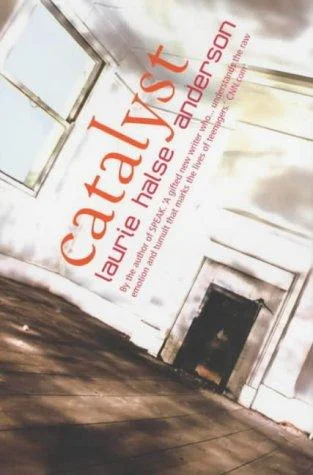
Catalyst
- Publication Date:
- March 13th, 2003
- Publisher:
- Hodder Children's Books
- ISBN-13:
- 9780340854648
- ISBN-10:
- 0340854642
- Pages:
- 240
Why Catalyst Has Been Challenged
Some parents and reviewers have questioned whether a novel this candid about grief, faith, and family strain belongs in front of readers who haven't yet faced those situations themselves. See more ↓
Challenged or banned in 1 state across 2 school districts.
Overview
Kate Malone runs her senior year the way she runs a lab experiment: with controls, hypotheses, and an unshakable belief that discipline yields predictable results. A top student bound for MIT, a minister's daughter, a competitive long-distance runner, and the newly minted girlfriend of an Ivy League-track classmate, Kate has built a life that looks, from the outside, like a solved equation. Holding everyone else together — including a father distracted by his congregation's needs — is simply one more task she has learned to manage.
That equation starts to break down when a fire destroys the home of the Malones' neighbors, and the family she least expects to welcome moves in next door to her own bedroom. Teri Litch, a classmate Kate has resented for years, along with Teri's young brother, becomes an unavoidable presence in Kate's carefully partitioned days. Meanwhile, the only college application Kate submitted sits unanswered, and the certainty she has always relied on starts to feel less like a plan and more like a wish.
As the story moves toward its close, an event occurs that neither Kate's logic nor her coping habits can absorb, forcing her to confront what happens when preparation runs out. The novel traces her slow, reluctant movement from control toward something closer to acceptance.
A Companion Volume Built on Reaction and Change
Catalyst returns readers to the same high school and town depicted in Anderson's earlier novel Speak, though it stands as its own story rather than a direct sequel, following a different narrator through a different kind of crisis. Where that earlier book examined silence after trauma, Catalyst is interested in what happens to a person who has never allowed herself to be anything but composed. Kate's scientific framing of her life — the periodic table as a metaphor for order — gives the novel its title and its central tension: a catalyst changes a reaction without itself being consumed, and much of the book asks whether Kate can go through upheaval and still remain who she was, or whether real change requires being altered in the process.
The novel also sits inside Anderson's broader body of work examining adolescent girls under pressure to perform competence — academic, emotional, or moral — for the benefit of the adults around them. Kate's role as a caretaker within her own family, and her discomfort at being asked to share space, literally and emotionally, with people she has written off, gives the book its interpersonal friction. Critics and readers have generally placed it alongside Anderson's other realistic fiction for teens as an unsentimental look at grief, forgiveness, and the limits of self-reliance.
Why Catalyst Has Been Challenged
Most objections to Catalyst cite its intended high school readership and argue that the material is too emotionally heavy or thematically mature for the younger end of that range. Critics raising concerns have pointed to the novel's unguarded treatment of loss and sudden death, arguing that scenes of grief are presented without enough narrative cushioning for younger teen readers. Others have objected to the way the book portrays a minister's household under strain, including Kate's private doubts about faith and duty, seeing this as an unflattering depiction of religious family life. The portrayal of blended, chaotic living arrangements and resentment between teenagers forced into close quarters has also drawn criticism from those who feel the book normalizes conflict rather than resolving it neatly. In the catalog tracked here, Catalyst has been the subject of challenges in one state and two school districts, reflecting a pattern of concern less about explicit content than about whether adolescents are prepared for the book's unresolved emotional weight.
Where to Buy




Affiliate links may generate a small commission at no extra cost to you, which helps support this site.
About Laurie Halse Anderson
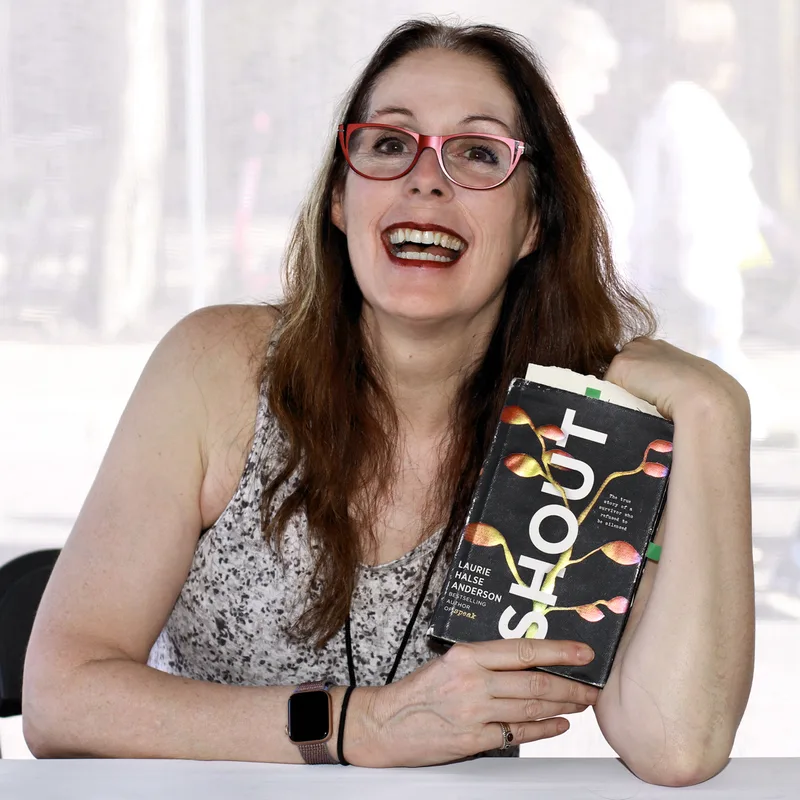
Laurie Halse Anderson is an American author of young adult and historical fiction, best known for Speak (1999), a National Book Award finalist and New York Times bestseller about a teenage rape survivor. Her work has earned the Margaret A. Edwards Award for lifetime contribution to young adult literature and the 2023 Astrid Lindgren Memorial Award, one of the largest cash prizes in children's literature. Her books are among the most challenged in American schools.
Also by Laurie Halse Anderson




Banned in Schools
Banned or challenged in 1 state across 2 school districts.
Florida 2 districts
- Collier County Public Schools Banned
- Escambia County Public Schools Banned by restriction