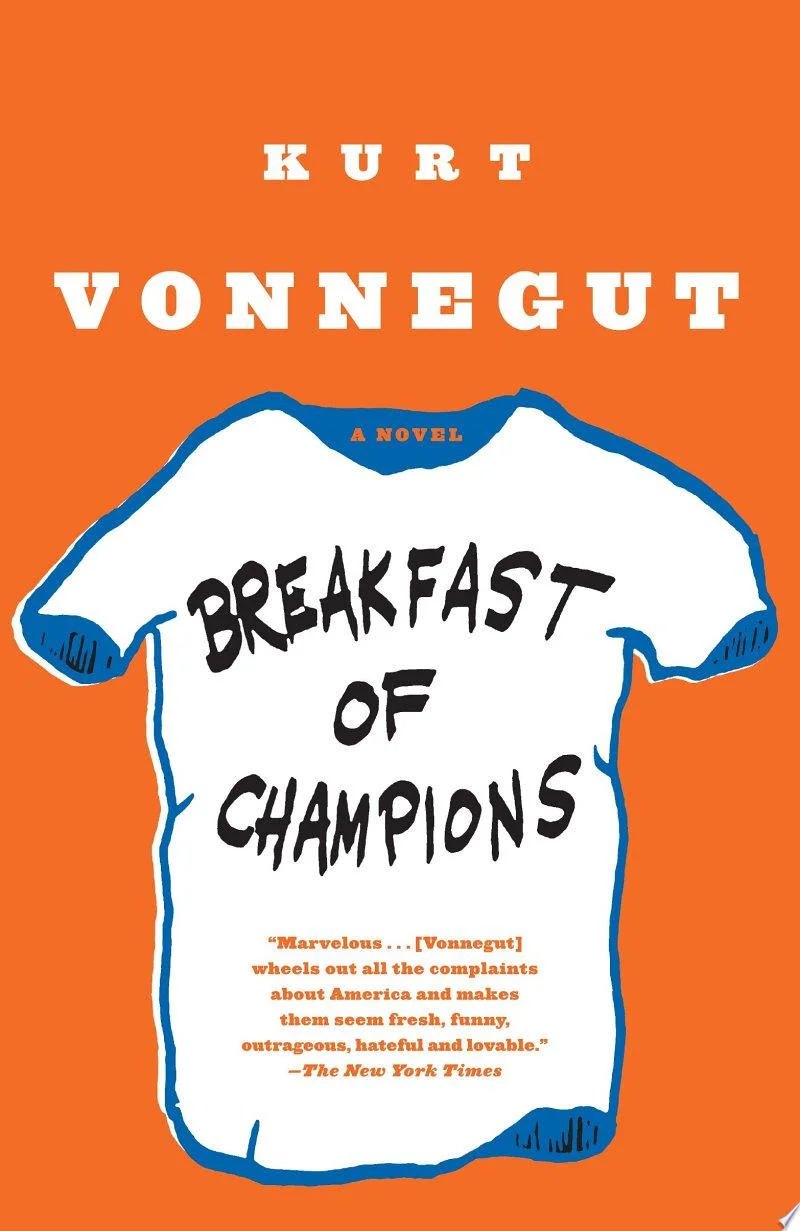
Breakfast of Champions
- Publication Date:
- May 11th, 1999
- Publisher:
- Dial Press Trade Paperback
- ISBN-13:
- 9780385334204
- ISBN-10:
- 0385334206
- Pages:
- 322
Why Breakfast of Champions Has Been Challenged
Critics who praise this novel for its unsparing honesty are met, in some schools, by objections to the very same bluntness about sex, violence, and despair that gives the book its edge. See more ↓
Challenged or banned in 1 state across 1 school district.
Overview
Breakfast of Champions follows two men on a collision course in Midland City: Dwayne Hoover, a prosperous car dealer sliding toward a breakdown, and Kilgore Trout, the obscure science-fiction writer whose work has quietly shaped Vonnegut's other novels. Trout travels to Midland City at Hoover's invitation, unaware that Hoover has begun reading his stories not as invention but as literal fact, a misunderstanding that pushes Hoover's fragile grip on reality toward collapse.
Vonnegut narrates in a loose, self-interrupting style, breaking from the plot to sketch the absurdities of American life in short digressions and his own crude line drawings. The novel's structure mimics the scattershot, information-saturated culture it describes, letting jokes, grim asides, and plain statements of fact sit side by side.
Vonnegut also writes himself into the story as its creator, appearing as a character who watches his inventions move toward their collision and ultimately confronts Trout directly. The gesture turns a satire of national habits of mind into a meditation on the responsibility, and the limits, of the person telling the story.
A Writer Taking Stock
Published after Slaughterhouse-Five had made Vonnegut one of the most widely read American novelists, Breakfast of Champions reads as a kind of inventory, the author announcing that he is clearing out the ideas, characters, and anxieties that had accumulated across two decades of work. The novel has often been read as his most self-conscious book, one that treats storytelling itself as an object of suspicion: if a troubled man can take Trout's fiction as a literal set of instructions, what does that imply about fiction's hold on anyone?
That question connects to Vonnegut's long-standing interest in free will and determinism. Dwayne Hoover's crisis is framed partly as a product of brain chemistry and partly as a product of the stories circulating around him, and the novel refuses to say which cause matters more. Critics have pointed to this ambiguity, along with the book's blunt catalog of American failings, as evidence of a writer working through disillusionment in real time rather than polishing a finished argument. The result sits awkwardly next to Vonnegut's more tightly constructed novels, which is part of why it continues to provoke strong, divided reactions from readers and scholars alike.
Why Breakfast of Champions Has Been Challenged
Readers and critics have long admired the novel for its willingness to say plainly what more polished fiction tends to soften, and that same bluntness is what has drawn formal objection in school settings. The book has been challenged in 1 state and 1 district tracked in this catalog, with complaints centering on its content rather than its literary reputation.
Objecting parents and administrators have pointed to explicit sexual content and coarse language, along with passages addressing racism and violence in terms some consider too graphic or despairing for younger readers. Vonnegut's drawings, which render ordinary objects and body parts with deliberate crudeness, have also been singled out as inappropriate for a classroom setting. Underlying many of these objections is a broader discomfort with the novel's nihilistic tone, a candor about human cruelty and futility that some reviewers have praised as honest and others have viewed as corrosive for student audiences.
Where to Buy




Affiliate links may generate a small commission at no extra cost to you, which helps support this site.
About Kurt Vonnegut Jr.
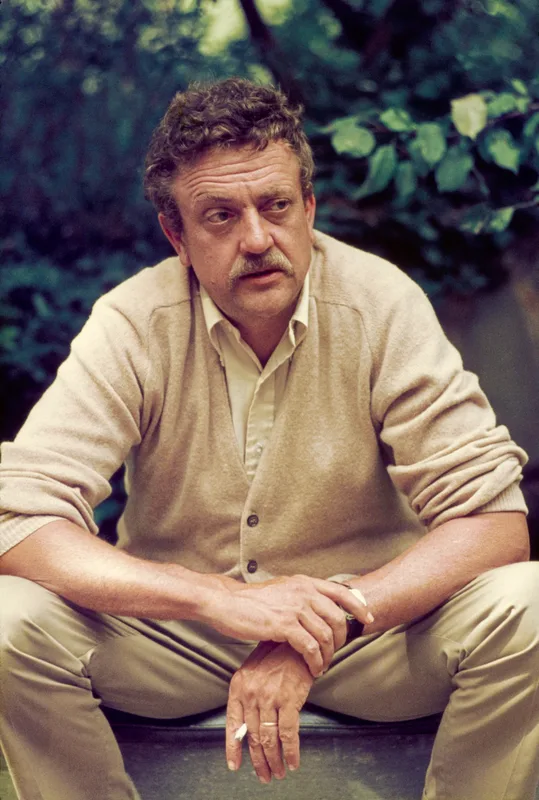
Kurt Vonnegut (1922–2007) was an American novelist whose work blended satire, science fiction, and gallows humor to explore war, free will, and the absurdity of modern life. His novel Slaughterhouse-Five (1969), drawn from his experience as a POW during the firebombing of Dresden, immediately topped the New York Times bestseller list and has been challenged or removed from schools and libraries in at least eighteen instances. He is widely regarded as one of the most important American novelists of the twentieth century.
Also by Kurt Vonnegut Jr.
Banned in Schools
Banned or challenged in 1 state across 1 school district.
Maine 1 district
- Hermon School Department Banned by restriction