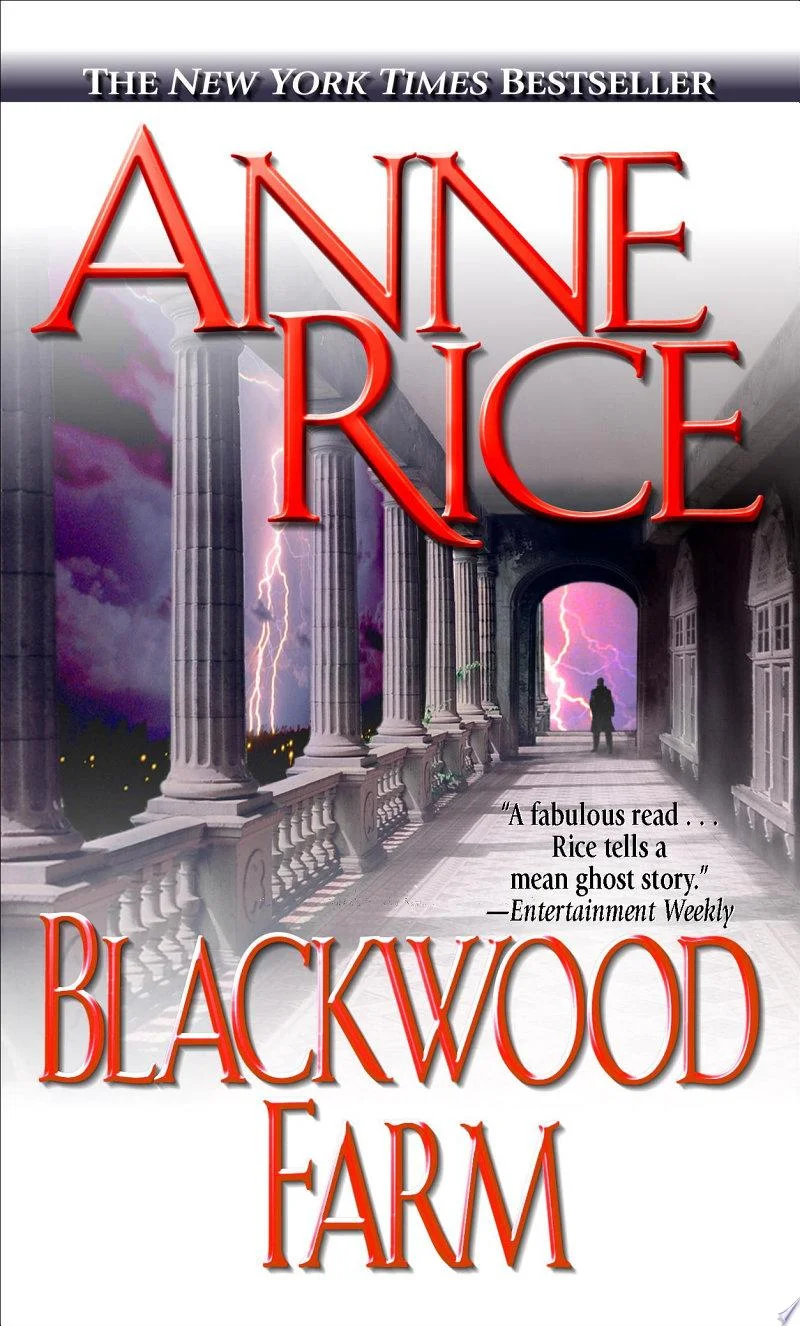
Blackwood Farm
by Anne Rice
- Publication Date:
- October 29th, 2002
- Publisher:
- Ballantine Books
- ISBN-13:
- 9781400040209
- ISBN-10:
- 1400040205
- Pages:
- 580
Why Blackwood Farm Has Been Challenged
Some readers have pushed back on a story that treats the undead, the occult, and physical intimacy as ordinary parts of a young man's coming of age. See more ↓
Challenged or banned in 1 state across 1 school district.
Overview
Blackwood Farm brings together the two mythologies Anne Rice had spent decades building separately: the vampire lineage of Lestat and the witch dynasty of the Mayfairs. At its center is Quinn Blackwood, heir to a grand but faded Louisiana estate, who has been shadowed since childhood by "Goblin," an unexplained double that seems to live in some adjacent dream-world and will not let him go.
Quinn's life splits further when he is turned into a vampire, a transformation that costs him his inheritance of an ordinary future even as it sharpens Goblin into something far more menacing. The narrative moves freely across time and place, from his upbringing at Blackwood Farm to contemporary New Orleans, with detours reaching back to ancient Greece and nineteenth-century Italy.
Searching for a way to understand or escape his companion, Quinn turns to Lestat himself, hoping the elder vampire can help him confront what waits for him back home in the Sugar Devil Swamp. The novel follows that search as both a personal reckoning and a slow unearthing of long-held family secrets.
A Convergence of Two Mythologies
By the time Blackwood Farm appeared, Rice had built two of modern gothic fiction's most elaborate family trees, and this novel is in many ways an experiment in letting them touch. The book leans into doubling as its central preoccupation: Quinn and Goblin are mirror images whose relationship raises questions about identity, dependency, and what it means to be haunted by a version of oneself that refuses to separate.
The Louisiana setting does more than provide atmosphere. Blackwood Farm's columned house and surrounding swamp function as a kind of inheritance in their own right, holding family history the way Rice's fiction often treats land and bloodline as inseparable. Placing a plantation gothic alongside vampire myth lets the novel work through themes of legacy and concealment that run through much of her later Vampire Chronicles work, as characters repeatedly discover that the past was never as settled as it appeared.
Why Blackwood Farm Has Been Challenged
Rice's prose here has generally been received the way her earlier Chronicles were: admired for its ornate, emotionally charged atmosphere and its willingness to treat immortality as a source of grief rather than glamour. That same willingness to linger in dark, uncanny territory is exactly what has drawn objection elsewhere. The novel has been challenged in one state and one district tracked in this catalog, and the objections center less on any single scene than on the overall frame of the story: a teenage protagonist's path to adulthood runs directly through the occult, through death and undeath, and through sexual experience treated as a normal part of growing up rather than as something to be shielded from.
Critics raising these challenges have typically pointed to the book's supernatural horror elements, its matter-of-fact handling of intimacy, and its blending of folk magic and vampirism as unsuitable for younger or school-library readers. Defenders counter that these same elements are inseparable from what the Vampire Chronicles have always done: use monstrous transformation as a vehicle for exploring loneliness, inheritance, and the loss of innocence, themes that are adult in content but not gratuitous in intent.
Where to Buy




Affiliate links may generate a small commission at no extra cost to you, which helps support this site.
Also by Anne Rice
Banned in Schools
Banned or challenged in 1 state across 1 school district.