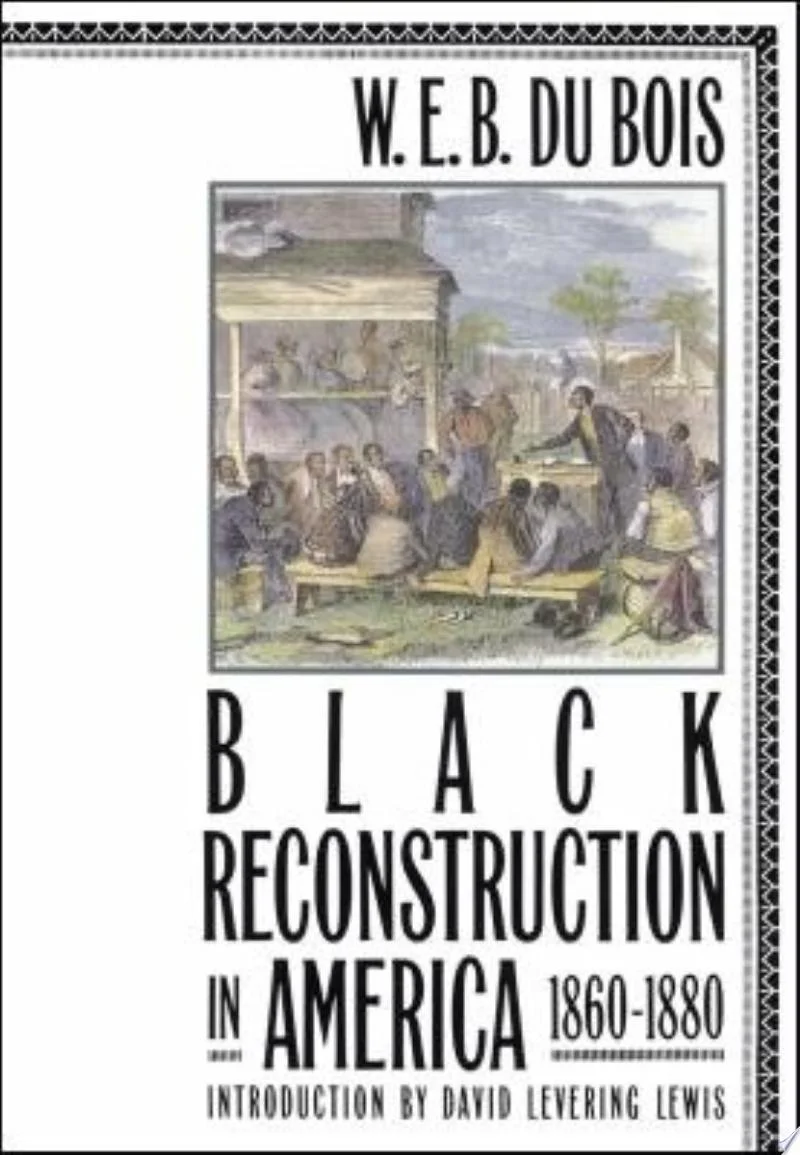
Black Reconstruction in America 1860-1880
- Publication Date:
- January 1st, 1998
- Publisher:
- Simon and Schuster
- ISBN-13:
- 9780684856575
- ISBN-10:
- 0684856573
- Pages:
- 772
Why Black Reconstruction in America 1860-1880 Has Been Challenged
Objections to the book center on its unsparing account of racial violence and its argument that white supremacy, rather than Black incapacity, undid Reconstruction. See more ↓
Challenged or banned in 1 state across 1 school district.
Overview
W.E.B. Du Bois wrote this book to correct the historical record. Decades after the Civil War, most accounts of Reconstruction treated the period as a failed experiment brought on by corrupt officials and unprepared freedpeople. Du Bois, already the era's foremost Black scholar, set out to show that this version of events was not simply incomplete but actively wrong.
Drawing on government records, newspapers, and the testimony of participants, he traced how formerly enslaved people organized, voted, built schools, and held office in the years after emancipation, and how their efforts were ultimately undone by organized violence and the withdrawal of federal support rather than by their own failures. The book was among the first to treat Black Americans of this period as historical actors rather than as a problem to be managed.
It combines dense archival research with an argument about how history gets written — who is believed, whose records are preserved, and whose labor and leadership get erased from the story afterward.
A Reckoning With How History Gets Told
The book sits at an unusual intersection of history, sociology, and polemic. Du Bois had spent his career studying the social conditions of Black Americans, and here he turned that same rigor on the historical profession itself, arguing that scholars of his generation had let racial bias shape their account of Reconstruction rather than the evidence. He gave particular attention to the economic dimension of slavery and its aftermath, describing the labor of enslaved and newly freed people as a force that had shaped the nation's wealth and its politics alike.
The work was received as a serious intervention when it appeared, and its influence only grew in the decades that followed, as later historians revisited Reconstruction and found that Du Bois's account, once dismissed by the mainstream of his field, had anticipated much of what subsequent research would confirm. It stands today as one of the foundational texts in the study of American race and citizenship, and as a demonstration of how Du Bois's broader intellectual project — documenting Black life and achievement against a culture inclined to deny both — extended from sociology into historical writing.
Why Black Reconstruction in America 1860-1880 Has Been Challenged
Objections to the book center on its unsparing account of racial violence and its argument that white supremacy, rather than Black incapacity, undid Reconstruction. Critics have described its passages on lynching, disenfranchisement, and the collapse of federal protection for freedpeople as too graphic or too unsettling for younger readers, while others have objected to its framing of American history as shaped by systemic racism, viewing that interpretation as a divisive or ideological lens rather than settled scholarship. Some challenges have also targeted the book's direct critique of earlier historians, seen by objectors as an inappropriately partisan argument for a work assigned in schools. In the catalog tracked here, the book has been the subject of formal challenges in 1 state and 1 school district.
Where to Buy




Affiliate links may generate a small commission at no extra cost to you, which helps support this site.
Banned in Schools
Banned or challenged in 1 state across 1 school district.
Florida 1 district
- Lee County Schools Banned by restriction