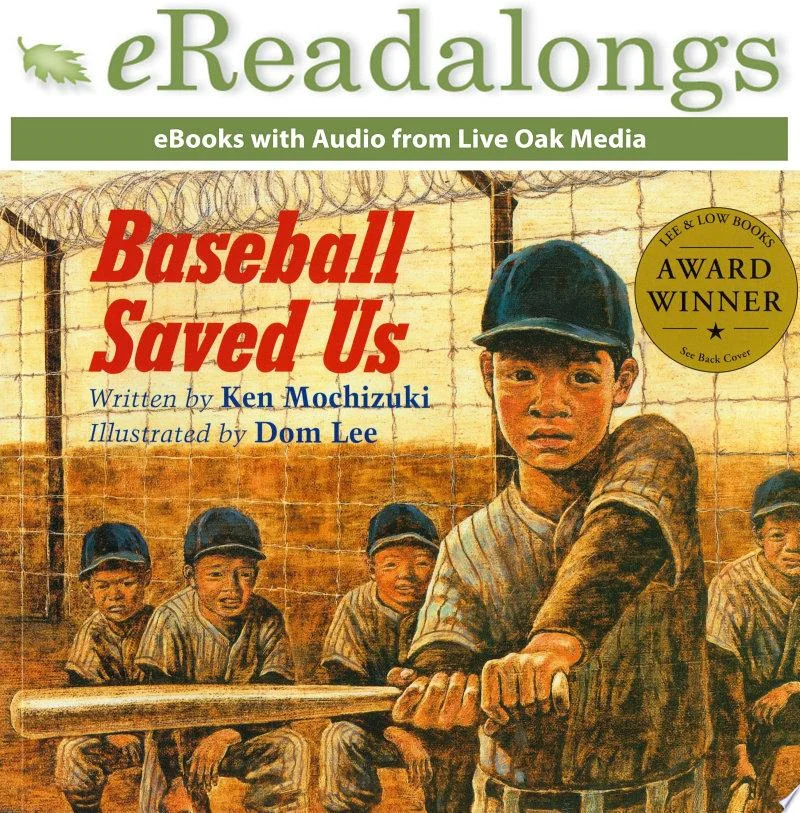
Baseball Saved Us
- Publication Date:
- January 1st, 2018
- Publisher:
- Lerner Publishing Group
- ISBN-13:
- 9781430129820
- ISBN-10:
- 1430129824
- Pages:
- 30
Why Baseball Saved Us Has Been Challenged
A picture book about childhood resilience during Japanese American incarceration has drawn pushback for the plainspoken way it shows prejudice rather than softening it for young readers. See more ↓
Challenged or banned in 2 states across 3 school districts.
Overview
Baseball Saved Us follows a young Japanese American boy and his family after they are forced from their home and sent to live behind barbed wire in a desert camp during World War II. Dust, heat, and the humiliation of confinement define daily life until the boy's father decides to build something the camp cannot take away: a baseball diamond, carved and leveled by hand out of the barren ground.
What begins as a distraction becomes something closer to a lifeline. The boy, small for his age and unsure of himself, works to keep up with older kids on the makeshift field, and the games give the camp's confined community a rhythm of effort, failure, and small triumph that the surrounding circumstances otherwise deny them. Mochizuki renders this through a child's plain, observant voice, letting the contrast between the game's fairness and the camp's injustice speak for itself.
When the family is eventually released and the boy returns to an outside world that has not stopped eyeing him with suspicion, it is the skill and composure he built on that dirt infield that finally earns him a measure of acceptance from classmates. The ending is modest rather than triumphant, consistent with a story more interested in endurance than in neat resolution.
A Spare Account of a Hard Chapter
The book occupies a specific niche in American children's literature: it was among the earlier widely distributed picture books to put the incarceration of Japanese Americans directly in front of young readers, told from a child's point of view rather than an adult's retrospective one. Dom Lee's illustrations, rendered in a scratched and sanded technique that gives every page a grainy, weathered texture, reinforce the sense of a memory being recovered rather than staged.
Because the story keeps its scope tight to one family and one field, it has become a frequent classroom entry point for introducing the broader history of wartime incarceration without overwhelming younger students with the full scale of the policy. That same narrow focus is part of why the book continues to be read decades after its original publication — it trusts a small, concrete image to carry a much larger historical weight. The audio edition that drew attention from reviewers, with Mochizuki narrating his own text, extends that same restraint: minimal production, letting the words do the work.
Why Baseball Saved Us Has Been Challenged
Language is at the center of most objections to this book: the taunts and slurs other children direct at the protagonist, both inside the camp and after his family returns home, appear in the text largely unfiltered, and some parents and reviewing committees have argued that this exposure is too raw for the elementary-age readers the book is otherwise aimed at. A second, related strand of complaint concerns the book's frank treatment of government-sanctioned racial discrimination, with some challengers contending that presenting American wartime policy in this light amounts to a one-sided or unduly negative portrayal of the country's history rather than age-appropriate historical instruction. Taken together, these objections have produced a modest but persistent record of challenges, with this catalog tracking formal action against the book in two states and three school districts.
Where to Buy




Affiliate links may generate a small commission at no extra cost to you, which helps support this site.
Banned in Schools
Banned or challenged in 2 states across 3 school districts.
Iowa 2 districts
- Mid-Prairie Community School District Banned
- Spencer Community School District Banned pending investigation
Wisconsin 1 district
- Elkhorn Area School District Banned pending investigation