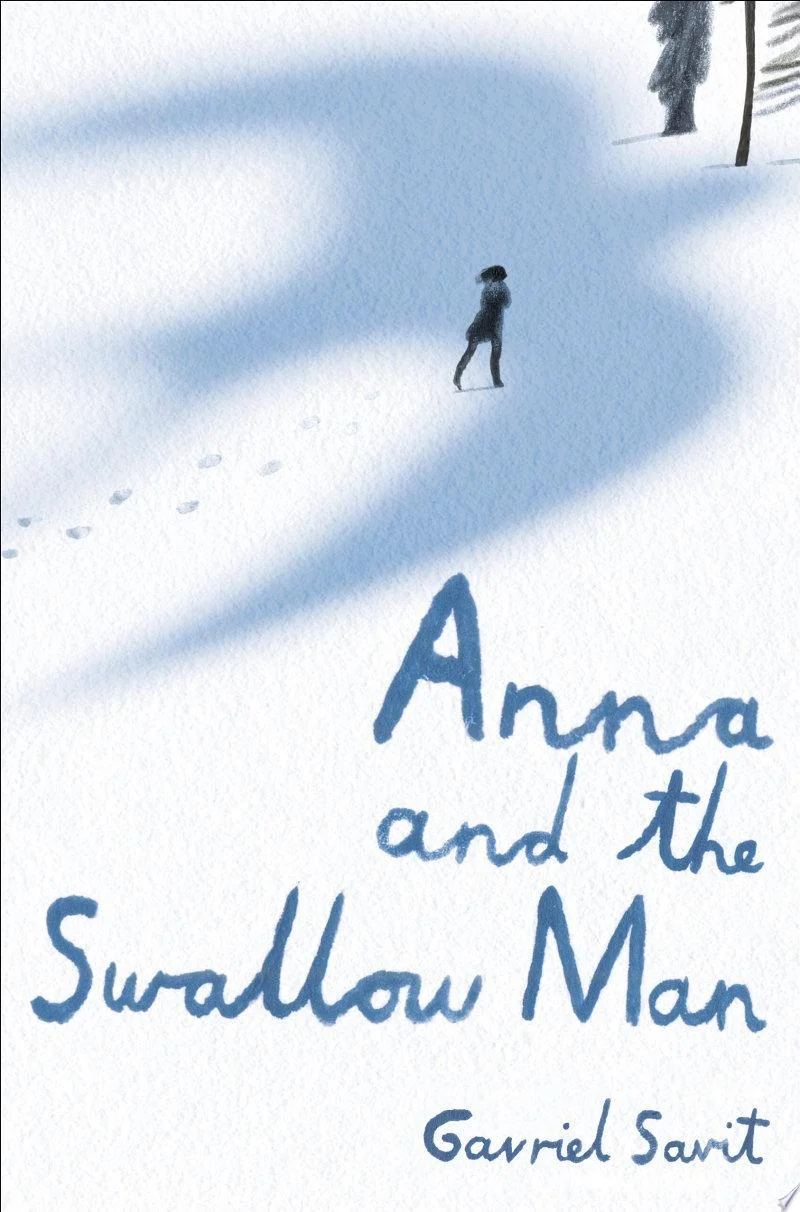
Anna and the Swallow Man
- Publication Date:
- January 26th, 2016
- Publisher:
- Knopf Books for Young Readers
- ISBN-13:
- 9780553522075
- ISBN-10:
- 0553522078
- Pages:
- 242
Why Anna and the Swallow Man Has Been Challenged
Objections to the novel have generally centered on its treatment of war violence and death, including the abduction of Anna's father and the sustained sense of physical danger that surrounds the two protagonists throughout their journey. See more ↓
Challenged or banned in 2 states across 2 school districts.
Overview
Gavriel Savit's debut novel follows seven-year-old Anna Łania, whose father, a linguistics professor, is seized during the German occupation of Kraków at the outset of the Second World War. Left to fend for herself in a city transformed by soldiers and surveillance, Anna falls in with a strange, tall stranger she comes to call the Swallow Man.
The Swallow Man is a linguist and illusionist of sorts, fluent not only in Polish, Russian, German, and Yiddish but in the coded language of survival itself: the ability to be seen, by hostile eyes, as harmless. Anna, drawn by his gentleness with a wild bird and his evident danger, follows him away from the city and into a long, wandering existence on the road.
What follows is less a conventional war narrative than an extended journey through occupied and contested territory, in which the two travelers evade capture, encounter fleeting companionship, and improvise a fragile domestic life out of movement and secrecy.
A Fable of Survival Amid Catastrophe
Savit's novel sits at an angle to most Holocaust-era fiction for young readers. Rather than centering ghettos, camps, or the machinery of persecution directly, it renders the war as an atmosphere of unrelenting menace that a child experiences obliquely, through the adults who shield or fail to shield her. The Swallow Man himself functions as something close to a folkloric figure, a trickster whose fluency and misdirection are framed as survival skills rather than moral virtues, which gives the book a fable-like quality distinct from more documentary approaches to the period.
That ambiguity is central to the book's reception. Critics have praised it as a work of considerable literary ambition, one that trusts young readers with moral uncertainty rather than resolving it, and that treats language itself, its power to protect, deceive, and connect, as a kind of subject matter in its own right. It has been positioned alongside other acclaimed novels of the era that filter large-scale atrocity through a single child's constrained point of view, though its tone is notably more elliptical and its resolutions less comforting.
Why Anna and the Swallow Man Has Been Challenged
Objections to the novel have generally centered on its treatment of war violence and death, including the abduction of Anna's father and the sustained sense of physical danger that surrounds the two protagonists throughout their journey. Some challenges have also pointed to the moral ambiguity of the Swallow Man as a protector figure whose methods, including deception, are not clearly condemned by the narrative, which some have argued complicates the book's suitability for younger or middle-grade readers despite its placement in children's and young adult collections. The bleakness of the wartime setting itself, offering little narrative comfort or clear resolution, has also been cited as a concern. In the catalog tracked here, the book has been formally challenged or banned in 2 states and 2 school districts.
Where to Buy


Affiliate links may generate a small commission at no extra cost to you, which helps support this site.
Banned in Schools
Banned or challenged in 2 states across 2 school districts.
Florida 1 district
- Escambia County Public Schools Banned pending investigation
Wisconsin 1 district
- Elkhorn Area School District Banned by restriction