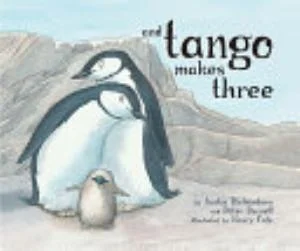
And Tango Makes Three
- Publication Date:
- January 1st, 2007
- Publisher:
- Simon & Schuster Childrens Books
- ISBN-13:
- 9781847381484
- ISBN-10:
- 1847381480
Why And Tango Makes Three Has Been Challenged
Critics have pushed to pull this picture book from shelves on the grounds that young readers shouldn't encounter same-sex parenting before families can decide for themselves how to broach it. See more ↓
Challenged or banned in 4 states across 10 school districts.
Overview
Based on an actual pair of penguins observed at the Central Park Zoo, this picture book follows Roy and Silo, two male chinstraps who build a nest together, try unsuccessfully to hatch a rock as if it were an egg, and are eventually given a real egg to tend by a sympathetic zookeeper.
The narrative stays close to the rhythms of a classic animal story: courtship, nest-building, the long vigil of incubation, and the arrival of a chick, here named Tango. Told in simple, warm language suited to young readers, the book frames the penguins' bond as a matter of everyday zoo life rather than a point to be argued.
Its quiet, observational tone and zoo setting place it alongside other read-aloud nonfiction about animal families, even as its subject has made it one of the more discussed picture books of the past two decades.
A Small Story With an Outsized Afterlife
What makes the book notable is less its plot than the real-world incident behind it and the cultural conversation that followed its publication. Roy and Silo's bond was documented by zoo staff before it became a children's story, and the authors chose to render the episode without embellishment or moral commentary, letting the behavior of the birds speak for itself. That restraint is part of what has made the book durable: it reads as reportage about animal family structures rather than as an argument about human ones.
The book arrived at a moment when picture books rarely depicted same-sex pairings in any form, and its popularity with librarians and early-childhood educators turned it into a touchstone in broader debates about what belongs on children's shelves. It has since become something of a case study in conversations about representation in children's literature, cited by supporters as evidence that inclusive stories can be gentle and age-appropriate, and by critics as an example of ideas they believe do not belong in books for very young readers. That tension has followed the book since its release rather than fading with time.
Why And Tango Makes Three Has Been Challenged
A recurring complaint brought to school boards and library committees is that the book introduces same-sex relationships to children too young, in their view, to be presented with the concept at all, regardless of how factually the animal behavior is described. Parents raising this objection have often argued that the decision to discuss such relationships with young children belongs to families, not schools or public libraries, and that shelving the book in an elementary collection effectively makes that choice for them.
A second strand of objection centers on the book's genre: some challengers contend that presenting the penguins' pairing as a "family" anthropomorphizes animal behavior in a way that implies a social lesson, and that a nonfiction-style picture book is the wrong vehicle for a subject they consider ideological rather than zoological. Others have objected on religious grounds, arguing the book conflicts with beliefs taught at home. Across the 4 states and 10 school districts in this catalog where it has been formally challenged or restricted, the book is regularly cited as an example in wider fights over which family structures children's collections should depict, making it one of the most frequently contested picture books of its kind.
Where to Buy




Affiliate links may generate a small commission at no extra cost to you, which helps support this site.
Also by Justin Richardson
Banned in Schools
Banned or challenged in 4 states across 10 school districts.
Florida 4 districts
- Charlotte County Public Schools Banned
- Hernando County Schools Banned pending investigation
- Hillsborough County Public Schools Banned Pending Investigation
- Nassau County School District Banned
Iowa 4 districts
- Clear Creek-Amana Community School District Banned pending investigation
- Dallas Center-Grimes Community School District Banned pending investigation
- Marshalltown Community School District Banned
- Nodaway Valley Community School District Banned pending investigation
North Carolina 1 district
- Guilford County Schools Banned by Restriction
Tennessee 1 district
- Monroe County Schools Banned