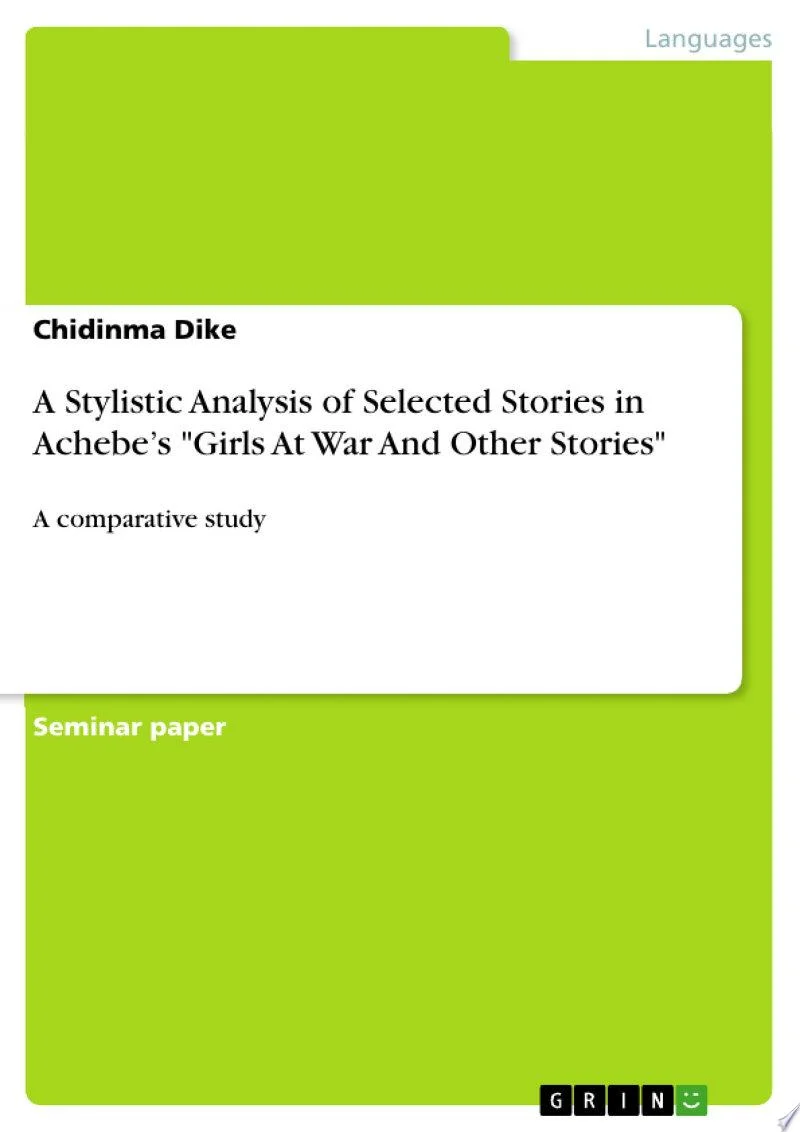
A Stylistic Analysis of Selected Stories in Achebe’s "Girls At War And Other Stories"
- Publication Date:
- March 20th, 2020
- Publisher:
- GRIN Verlag
- ISBN-13:
- 9783346134523
- ISBN-10:
- 3346134520
- Pages:
- 38
Why A Stylistic Analysis of Selected Stories in Achebe’s "Girls At War And Other Stories" Has Been Challenged
Because this academic study quotes and closely examines wartime violence and coercion from Achebe's original stories, some reviewers have questioned whether its excerpts are suited to readers outside a university literature course. See more ↓
Challenged or banned in 1 state across 1 school district.
Overview
This 2020 seminar paper undertakes a stylistic reading of several stories drawn from Chinua Achebe's collection Girls at War and Other Stories. Rather than summarizing plot or theme in the usual literary-critical sense, the author, Chidinma Dike, applies the tools of stylistics — a field positioned at the crossroads of linguistics and literary study — to examine how Achebe's specific choices of diction, syntax, and expression generate meaning and artistic effect.
Before turning to the stories themselves, the paper spends considerable space defining its central terms. It traces "style" to its Latin root as a writing instrument, then surveys competing scholarly definitions, including style as personal idiosyncrasy, as technique, and as literary achievement. It leans on the work of Otagburuagu and colleagues, along with Leech and Short's formulation of stylistics as an approach that asks not merely what a text says but how and why it says it that way.
Having established this framework, the paper applies it to selected Achebe stories, treating them as case studies in how a writer's linguistic choices carry artistic and thematic weight beyond their surface content.
Achebe, Language, and the Study of African Fiction
The paper sits within a long-running conversation about how African writers working in English shape that language to carry indigenous experience and voice — a question Achebe himself addressed directly across his career. By applying stylistics specifically to the short fiction in Girls at War, the analysis extends scholarly attention beyond Achebe's novels, which have dominated critical commentary, toward the shorter, more compressed pieces where his handling of dialogue, register, and narrative distance operates with particular economy.
The stories gathered in this collection span decades of Achebe's writing life and register the upheavals of Nigerian history, including the Biafran war, through fiction rather than direct testimony. A stylistic approach treats that historical weight as inseparable from craft: how a sentence is built, whose speech is rendered and in what idiom, and where a narrator withholds or supplies judgment all become evidence for how the fiction manages difficult material. In this sense the paper belongs to a broader academic tradition that reads African literature as a site where linguistic technique and postcolonial subject matter cannot be cleanly separated.
Why This Study Has Been Challenged
Disputes over this title have generally centered on whether a graduate-level linguistic and literary analysis belongs alongside general-collection materials, rather than on the scholarship itself. Because the paper works closely with the source stories — several of which depict wartime violence, coercion, and the exploitation of women amid conflict — reviewers have sometimes questioned whether the excerpts and discussion it carries over from Achebe's fiction are appropriate for the age groups likely to encounter it outside a university setting. The objection tends to be less about the paper's academic method than about the mature content of the primary material it quotes and analyzes in service of that method. Records reviewed for this catalog show the title challenged in one state and one district, reflecting a narrow but documented dispute over its placement rather than a broad pattern of removal.
Where to Buy



Affiliate links may generate a small commission at no extra cost to you, which helps support this site.
Banned in Schools
Banned or challenged in 1 state across 1 school district.
Florida 1 district
- Lee County Schools Banned by restriction