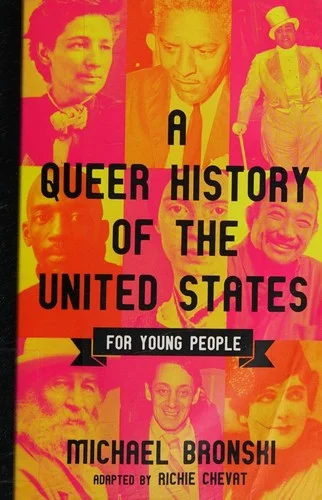
A Queer History of the United States for Young People
- Publication Date:
- January 1st, 2019
- Publisher:
- Beacon Press
- ISBN-13:
- 9780807056127
- ISBN-10:
- 080705612X
- Pages:
- 336
Why A Queer History of the United States for Young People Has Been Challenged
Some parents and administrators have pushed back simply against the idea of a history book that discusses LGBTQ+ lives for a young audience, regarding the subject itself as too mature regardless of how it's presented. See more ↓
Challenged or banned in 3 states across 3 school districts.
Overview
Richie Chevat's book takes on an ambitious task: condensing centuries of American history into a narrative accessible to younger readers, all while centering figures and events that mainstream textbooks have typically omitted. Structured as a chronological journey, it moves from the earliest European settlements through the twentieth century, pausing along the way to reframe familiar historical moments through a different lens.
Rather than treating LGBTQ+ history as a separate or niche subject, the book weaves it into the broader fabric of the American story, touching on labor movements, wartime service, artistic movements, and civil rights struggles. The effect is less a single narrative thread than a mosaic, showing how questions of gender and sexuality have intersected with nearly every major chapter of the nation's development.
As an adaptation written specifically for a younger audience, the book simplifies complex historical arguments into clearer, more digestible language, favoring narrative momentum and relatable framing over academic density.
Context and Reception
The book belongs to a growing category of nonfiction: adult scholarship reworked for younger readers, a genre publishers have leaned on increasingly to bring specialized history to classrooms and school libraries. Its existence reflects a broader push within education circles to widen the historical canon taught to students, arguing that a fuller account of the past requires acknowledging communities and identities long pushed to the margins.
That same premise has made the book a flashpoint in ongoing disputes over what belongs in school curricula and libraries. Its reception has split sharply along those lines, praised by some educators and librarians as a needed corrective and treated with suspicion by others who view any discussion of LGBTQ+ identity for young readers as inherently contested terrain. The book sits at the intersection of two larger fights: how American history should be taught, and what subjects are considered age-appropriate for children and adolescents.
Why A Queer History of the United States for Young People Has Been Challenged
Much of the friction surrounding this book centers not on any single scene or passage but on its premise itself: a history text written for young readers that treats gender identity and sexual orientation as ordinary threads in the American story rather than as topics requiring separate handling or omission. Critics who have sought its removal generally argue that discussions of sexuality and gender, even framed historically and factually, are unsuitable for the age group the book targets, and that its presence in a school or library setting amounts to endorsement of viewpoints they believe should be left to families to address.
Others have objected to the book on curricular grounds, arguing that its interpretive framing of historical events constitutes ideological instruction rather than neutral history, a criticism frequently leveled at nonfiction that foregrounds previously marginalized perspectives. In total, the catalog tracks challenges to the book across three states and three school districts, nearly all of them arising from these same underlying concerns about subject matter rather than from any factual dispute over its historical content.
Where to Buy




Affiliate links may generate a small commission at no extra cost to you, which helps support this site.
Banned in Schools
Banned or challenged in 3 states across 3 school districts.
Iowa 1 district
Nation 1 district
Texas 1 district
- Katy Independent School District Banned by Restriction