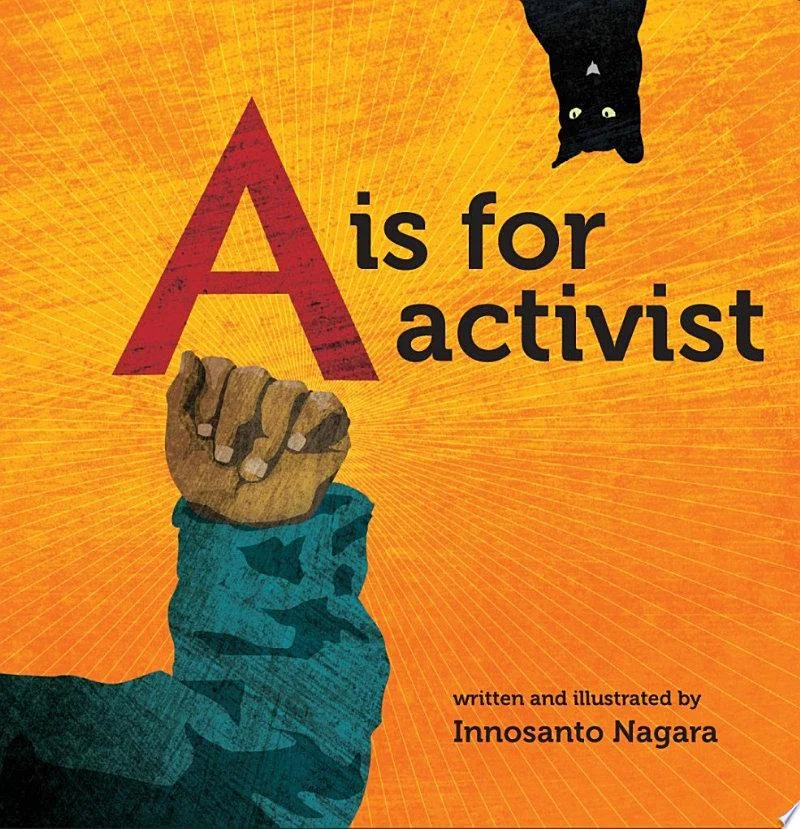
A is for Activist
- Publication Date:
- November 19th, 2013
- Publisher:
- Seven Stories Press
- ISBN-13:
- 9781609805395
- ISBN-10:
- 1609805399
- Pages:
- 31
Why A is for Activist Has Been Challenged
Critics argue the book uses the trusted, repetitive format of a toddler board book to instill a specific political worldview before children are old enough to question it. See more ↓
Challenged or banned in 3 states across 4 school districts.
Overview
"A is for Activist" reimagines the alphabet board book as a vehicle for political vocabulary. Each letter anchors a rhyming phrase and a densely illustrated spread, so "A" opens on activism and apples while "D" moves through diversity and "the do-it-yourself, do-it-together" ethic of grassroots organizing. A small cat is tucked into every page, giving toddlers a search-and-find game layered over the text.
The alliteration and rhythm are built for read-aloud repetition, the register of a standard board book even as the content departs from typical toddler fare. Instead of animals or colors, the letters carry words tied to labor movements, environmental stewardship, and civil rights, introducing concepts well before a child could define them.
The illustrations do much of the interpretive work, depicting marches, diverse families, and community gatherings that give visual weight to words a two-year-old wouldn't yet parse on their own. The book functions less as a story than as an early exposure piece, planting vocabulary that a family might return to and unpack as a child grows.
A Board Book With a Point of View
Board books are traditionally a neutral genre, built around first words and simple concepts rather than ideology. This title breaks from that convention deliberately, aligning itself with a lineage of progressive parenting materials that treat early childhood as a starting point for values formation rather than a period to be kept apart from political life.
Its reception has split along similar lines to its content. Progressive parents and educators have embraced it as a rare artifact that puts names to concepts like equity and solidarity in a format toddlers already enjoy, while critics see it as a genre mismatch, using the trusted, apolitical form of the board book to carry a specific partisan framework. The book's popularity within activist and educator circles has kept it in print and in circulation well beyond its original niche, turning it into a touchstone for debates over whether early-childhood materials can or should be values-neutral at all.
Why This Book Has Been Challenged
Much of the friction around this title centers on where it belongs rather than whether it should exist at all: is a board book aimed at toddlers and young children an appropriate place for material built around political organizing, or does that content belong in collections for older readers who can engage with it critically? Library and school placement decisions have made that question concrete, with the book having been challenged or removed in three states and four districts tracked in this catalog.
The substance of the objections centers on the book's explicit alignment with one side of contested social and political debates, including references to LGBTQ rights, civil rights movements, and anti-capitalist organizing, presented to an audience too young to evaluate the ideas independently. Objectors argue that introducing this vocabulary to toddlers amounts to instilling a political identity before a child can reason about it, and that the book's format, designed to build trust and familiarity through repetition, makes it a more effective vehicle for that instillation than an ordinary picture book would be. Supporters counter that the same concepts, community, fairness, and standing up for others, are age-appropriate in any form; the dispute largely turns on how explicitly political language should be framed for the very young.
Where to Buy


Affiliate links may generate a small commission at no extra cost to you, which helps support this site.
Banned in Schools
Banned or challenged in 3 states across 4 school districts.
Florida 2 districts
- Lake County Schools Banned pending investigation
- Monroe County School District Banned
Nation 1 district
Texas 1 district
- Lake Travis Independent School District Banned by restriction