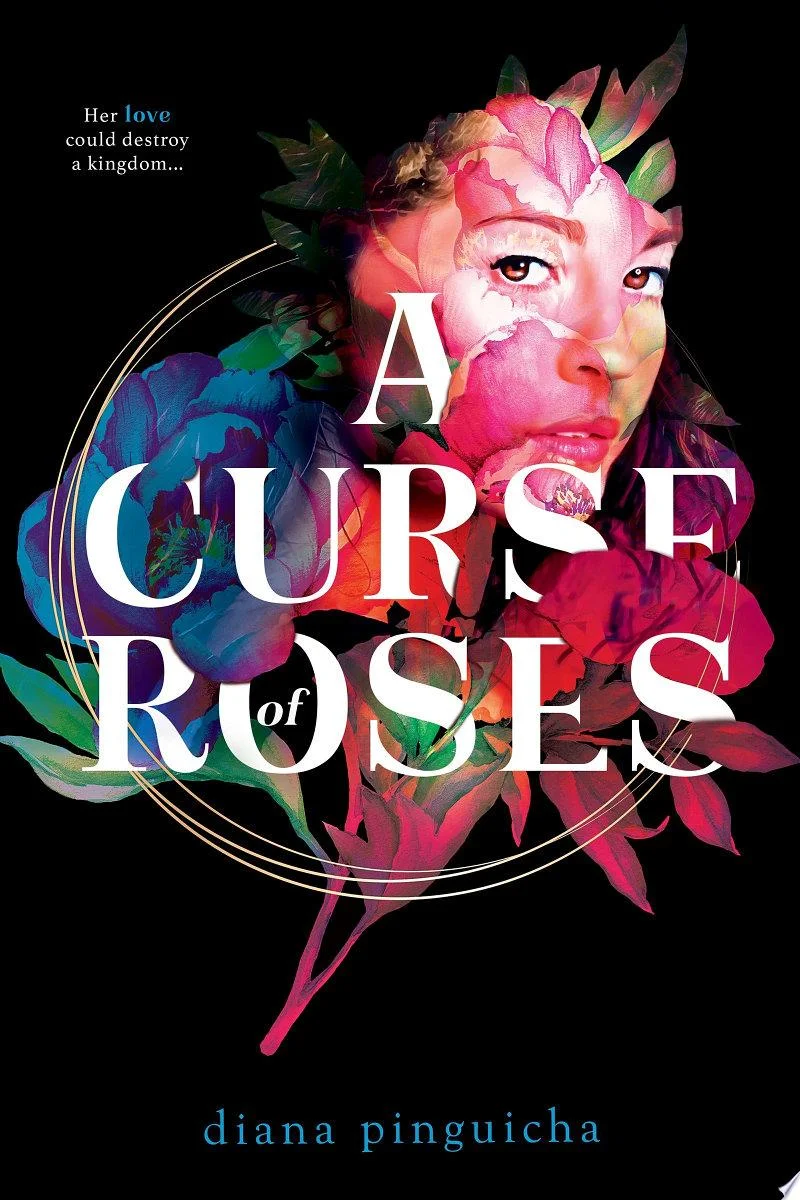
A Curse of Roses
- Publication Date:
- December 1st, 2020
- Publisher:
- Entangled: Teen
- ISBN-13:
- 9781682815106
- ISBN-10:
- 1682815102
- Pages:
- 317
Why A Curse of Roses Has Been Challenged
Critics of this book have taken issue less with its fantasy premise than with the intimacy between its two female leads and the raw honesty with which it links religious guilt to self-harm and disordered eating. See more ↓
Challenged or banned in 2 states across 7 school districts.
Overview
Diana Pinguicha's debut novel reimagines the Portuguese legend of Saint Elizabeth's miracle of the roses as a queer historical fantasy. Princess Yzabel carries a curse rather than a blessing: any food she tries to eat transforms in her hands into flowers, leaving her slowly starving even as her countrymen suffer through a famine she cannot ease.
Yzabel's search for a cure leads her to Fatyan, an Enchanted Moura bound by old magic and able to teach her how to master the curse. Freeing Fatyan requires a kiss, an act that sets both the plot and Yzabel's feelings in motion. What begins as a bid to save her starving kingdom becomes a reckoning with desire, obligation, and the cost of the crown she is due to share with the King of Portugal.
The novel moves between political duty and personal transformation, using Yzabel's magic as a metaphor for bodies and appetites she has been taught to distrust.
A Legend Reworked Around Faith, Hunger, and Identity
Pinguicha builds her story on a real piece of Portuguese folklore, and the choice to retell it through an #OwnVoices, queer lens gives the legend new stakes. Where the traditional tale ends at the moment of miraculous transformation, this version keeps going, asking what it costs a woman to be marked as holy or cursed by forces outside her control, and what happens when duty to a nation collides with an inconvenient, unsanctioned love.
Food and its absence run through the book as more than plot mechanics. Yzabel's inability to eat without consequence becomes a lens on self-denial, and her growing bond with Fatyan forces her to confront guilt that has been shaped by religious teaching long before it was shaped by romance. The novel has drawn attention for pairing a fantasy adventure with unusually direct treatment of the emotional damage that religious shame can inflict on a young woman discovering her own desires.
Why A Curse of Roses Has Been Challenged
Same-sex romance sits at the center of most objections to this book, with critics pointing to Yzabel and Fatyan's relationship, and the betrothed princess's infidelity to a king, as inappropriate for young readers. Some challengers have also flagged the novel's frank engagement with disordered eating, since Yzabel's curse produces behavior around food that mirrors real eating-disorder patterns, and worry that the depiction could be triggering or instructive rather than cautionary. A further line of objection concerns the book's treatment of religion: passages addressing self-harm, eating disorders, and internalized homophobia as they intersect with religious guilt have struck some readers as an attack on faith rather than an exploration of how faith can wound. Taken together, these concerns have led to the book being challenged in 2 states and 7 districts tracked in this catalog, generally on the grounds that its content is unsuitable for the age groups it may reach in school libraries.
Where to Buy




Affiliate links may generate a small commission at no extra cost to you, which helps support this site.
Banned in Schools
Banned or challenged in 2 states across 7 school districts.
Florida 6 districts
- Clay County School District Banned
- Escambia County Public Schools Banned pending investigation
- Hillsborough County Public Schools Banned Pending Investigation
- Santa Rosa County Schools Banned pending investigation
- Union County School District Banned
- Volusia County Schools Banned Pending Investigation