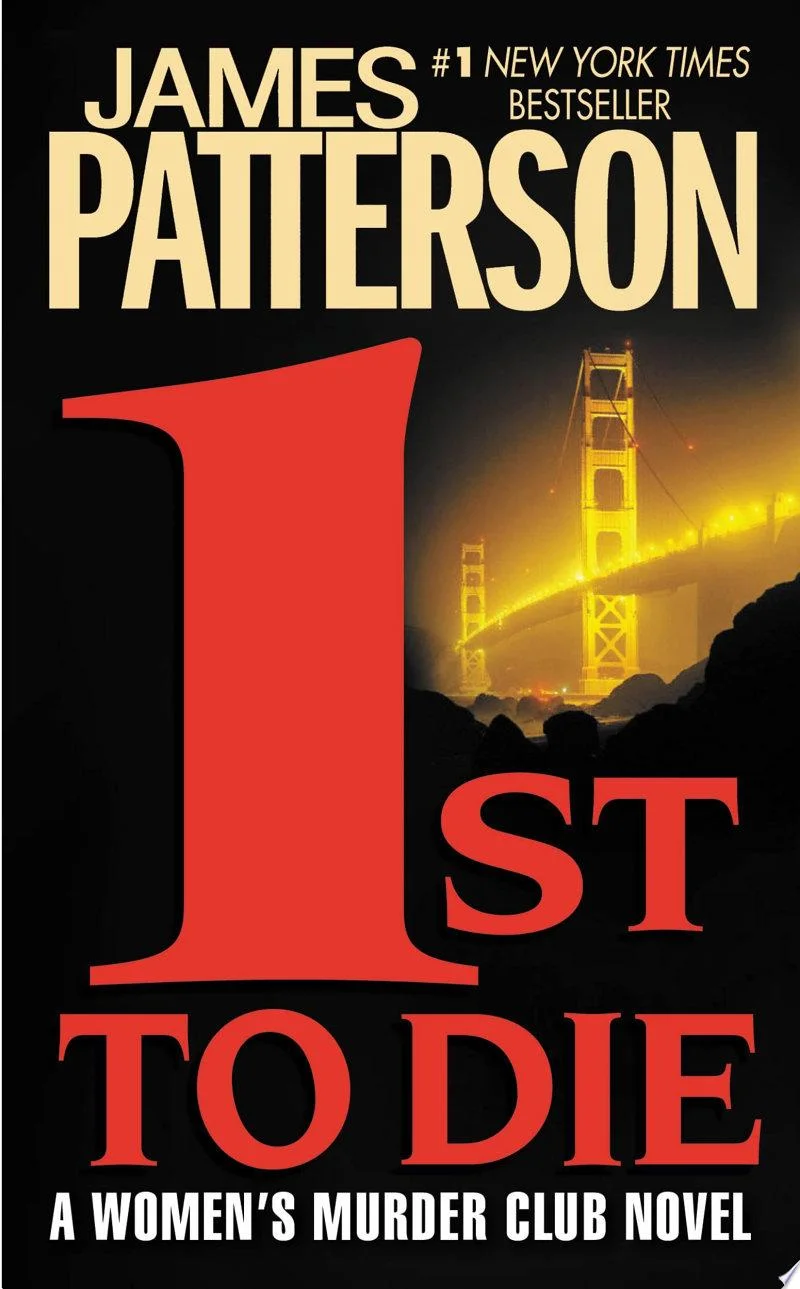
1st to Die
- Publication Date:
- March 5th, 2001
- Publisher:
- Little, Brown
- ISBN-13:
- 9780759524545
- ISBN-10:
- 0759524548
- Pages:
- 254
Why 1st to Die Has Been Challenged
Objections to 1st to Die center on the book's genre conventions rather than any single episode: as a serial-killer thriller aimed at adult readers, it includes graphic descriptions of crime scenes and violence, along with sexual content, that challengers argue are inappropriate for library shelves accessible to younger readers. See more ↓
Challenged or banned in 1 state across 2 school districts.
Overview
1st to Die introduces the Women's Murder Club, an informal alliance of four professional women in San Francisco who each have a foothold in the investigation of a string of killings. Lindsay Boxer works the case as a homicide inspector, Claire Washburn examines the bodies as a medical examiner, Jill Bernhardt weighs the legal angles as an assistant district attorney, and Cindy Thomas covers the story as a newly minted crime reporter.
Frustrated by the limits of protocol and departmental turf, the four women begin sharing information and instincts informally, outside the reach of their respective bosses. Their combined perspective lets them piece together patterns that none of them could see alone, even as the killer's crimes escalate and rattle the city.
The investigation builds toward a resolution that reframes much of what the women believed about the case, delivering the twist-driven pacing that has become a signature of Patterson's novels and of the long-running series this book began.
A Genre Launch Built on Collaboration
What distinguishes 1st to Die within the crowded field of American crime fiction is its structure: rather than following a single detective, it distributes the investigation across four women whose professional roles rarely intersect under ordinary circumstances. Patterson uses that structure to comment, lightly, on the friction between institutions—police, medicine, law, and the press—that are nominally on the same side but bound by separate rules and chains of command.
The novel also marks a turning point in Patterson's career, establishing a franchise that would extend across dozens of sequels and cement his reputation for high-velocity, chapter-a-scene plotting. Read alongside his other series openers, it shows an author refining a formula—short chapters, alternating points of view, a shocking final reveal—that would define popular American thrillers for the following two decades.
Why 1st to Die Has Been Challenged
Objections to 1st to Die center on the book's genre conventions rather than any single episode: as a serial-killer thriller aimed at adult readers, it includes graphic descriptions of crime scenes and violence, along with sexual content, that challengers argue are inappropriate for library shelves accessible to younger readers. Because the novel is often shelved or recommended alongside Patterson's broader body of work, some challenges have also questioned whether adult thrillers of this kind belong in school or young-adult collections at all. In this catalog, the book has been challenged in 1 state and 2 districts, reflecting these concerns about violent and sexual content rather than objections to any particular theme or message in the story.
Where to Buy




Affiliate links may generate a small commission at no extra cost to you, which helps support this site.
About James Patterson

James Patterson is one of the best-selling authors in publishing history, holding the Guinness World Record for the most #1 New York Times bestsellers by a single writer. Born in Newburgh, New York, he built his early career in advertising before turning to fiction full-time, going on to create the Alex Cross, Women's Murder Club, and Maximum Ride series among more than 200 novels. Several of his books, including entries in the Women's Murder Club and Maximum Ride series, are cataloged here as challenged across 5 states and 11 districts, largely over violent or mature content flagged for younger readers.
Also by James Patterson

Banned in Schools
Banned or challenged in 1 state across 2 school districts.
Florida 2 districts
- Collier County Public Schools Banned
- Lee County Schools Banned by restriction