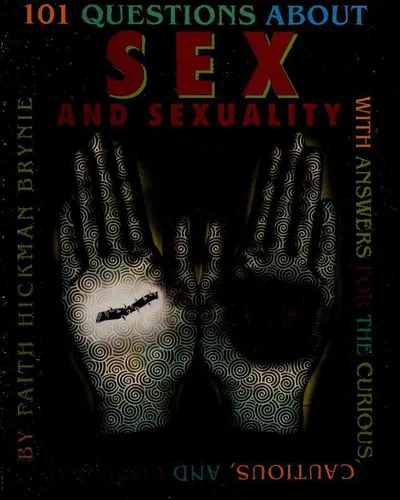
101 Questions about Sex and Sexuality...With Answers for the Curious, Cautious, and Confused
- Publication Date:
- January 1st, 2013
- Publisher:
- Lerner Publishing Group
- ISBN-13:
- 9780761326342
- ISBN-10:
- 0761326340
- Pages:
- 176
Why 101 Questions about Sex and Sexuality...With Answers for the Curious, Cautious, and Confused Has Been Challenged
Objections to this title center overwhelmingly on its explicit treatment of sexual anatomy and behavior, material that some parents and community members consider inappropriate for the age group most likely to pick it up. See more ↓
Challenged or banned in 2 states across 3 school districts.
Overview
Faith Hickman Brynie's book takes the shape of exactly what its title promises: a running list of questions, drawn from the kinds of things adolescents actually ask, paired with direct, factual answers. Rather than a narrative or a single authoritative voice lecturing at length, the structure lets readers dip in wherever their own curiosity or anxiety happens to lead, from the mechanics of puberty to questions about relationships, consent, and sexual health.
The question-and-answer format is itself a kind of argument about how sex education should work. It assumes that young readers already have questions, often ones they are too embarrassed to ask an adult directly, and it tries to meet those questions with plain language rather than euphemism. The "curious, cautious, and confused" of the subtitle signals an intent to reach readers at different comfort levels, not just those who are eager to learn.
As a reference work, the book is designed to be consulted rather than read cover to cover, which places it in a distinct category from the fiction and memoir that make up most of a banned-books catalog. Its presence here says less about narrative content and more about ongoing disagreements over who should be the one answering these particular questions.
A Book Caught Between Two Audiences
Books like this one sit at an uncomfortable intersection between the classroom, the library, and the home. Written for adolescents but necessarily explicit about anatomy and behavior in order to be useful, it is aimed at exactly the age group whose access to such information adults are most divided about. That tension is not incidental; it is the reason a Q&A sex-education title exists at all, since the format only makes sense if there is a real gap between what teenagers want to know and what they are otherwise told.
The book belongs to a long tradition of youth-oriented sex-education guides that attempt to normalize direct, unembarrassed discussion of puberty and sexuality, treating candor as a form of harm reduction rather than a risk in itself. Its place in library collections reflects a judgment, shared by many librarians and educators, that accurate information reduces confusion and misinformation more effectively than silence does. Critics of that approach tend to disagree not with the facts presented but with the premise that this is material libraries or schools should be supplying at all.
Why the Book Has Been Challenged
Objections to this title center overwhelmingly on its explicit treatment of sexual anatomy and behavior, material that some parents and community members consider inappropriate for the age group most likely to pick it up. Because the book answers questions plainly rather than in vague or abstract terms, passages on topics like sexual acts, bodies, and reproduction have been singled out as too graphic for a school or public library setting, particularly one accessible to younger readers.
A related strand of objection concerns parental authority: some challenges argue that decisions about when and how a child learns about sex belong to parents alone, and that a library or classroom offering direct answers on the subject oversteps that role. Still other challenges frame the book's frankness about sexuality in general, apart from any single passage, as inherently unsuitable for a youth collection. Within this catalog, the title has been the subject of 2 state-level and 3 district-level challenges, a modest but persistent record that reflects how contested youth sex education remains, independent of the book's stated aim of answering questions honestly.
Where to Buy



Affiliate links may generate a small commission at no extra cost to you, which helps support this site.
Banned in Schools
Banned or challenged in 2 states across 3 school districts.
Iowa 2 districts
- Clear Lake Community School District Banned
- Iowa City Community School District Banned pending investigation
Pennsylvania 1 district
- Lehighton Area School District Banned Pending Investigation