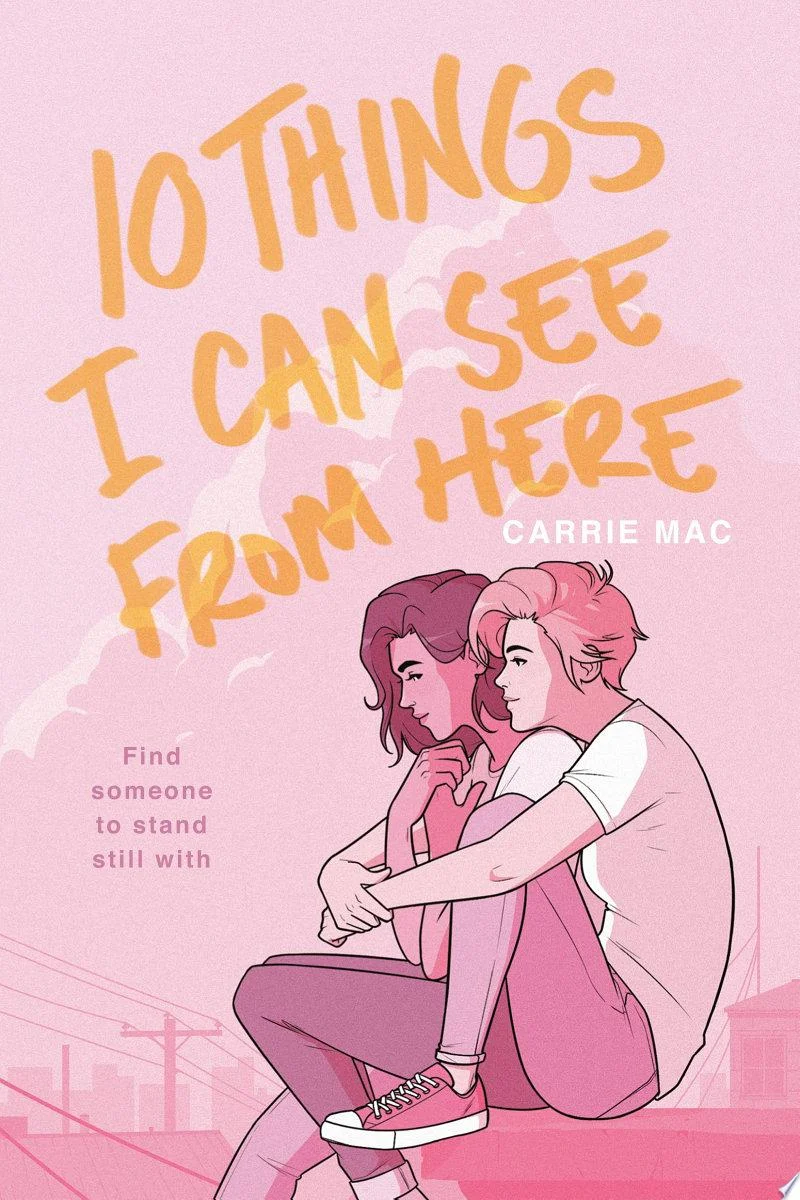
10 Things I Can See From Here
by Carrie Mac
- Publication Date:
- January 28th, 2020
- Publisher:
- Ember
- ISBN-13:
- 9780399556289
- ISBN-10:
- 0399556281
- Pages:
- 336
Why 10 Things I Can See From Here Has Been Challenged
Objections to this novel center on its frank handling of mental illness and its same-sex romance, the two elements that give the story its shape. See more ↓
Challenged or banned in 2 states across 2 school districts.
Overview
Maeve narrates her life the way a worst-case forecaster reads the sky: every quiet moment is a warning sign, every plan a rehearsal for disaster. Her anxiety isn't a personality quirk she can shrug off with a pep talk; it's a constant, exhausting companion that scripts funerals in her head before anything has gone wrong. When her mother, the one person who understands what these spirals cost her, leaves the country for half a year, Maeve is packed off to Vancouver to stay with her father.
There she meets Salix, a girl who moves through the world with an ease Maeve can't imagine, and who becomes both a source of comfort and a fresh set of things to worry about. Around this tentative romance, the household is anything but stable: her father's sobriety is shaky, and her stepmother is set on delivering her baby at home, against all of Maeve's careful calculations of what could go wrong.
The novel follows Maeve across a single unraveling summer, as she tries to hold her fear at arm's length long enough to be present for the people she loves.
A Portrait of an Anxious Mind, Not a Problem to Be Solved
What distinguishes this novel from a more conventional coming-of-age romance is its refusal to treat Maeve's anxiety as an obstacle the plot exists to cure. Her disorder isn't resolved by falling in love, and Salix isn't written as a fix for what ails her; the relationship is allowed to be sweet and grounding without being asked to do therapeutic work it can't do. Instead, Carrie Mac stays close to the mechanics of Maeve's thinking, the intrusive leaps to catastrophe, the compulsive mental rehearsals, letting readers experience anxiety from the inside rather than observing it from a diagnostic distance.
That interiority is part of why the book has been discussed alongside other contemporary YA novels about mental health and identity, and why it earned recognition as a notable LGBTQ+ title. It sits at an intersection often underserved in young adult fiction: a queer romance where the central conflict is psychological rather than about coming out, paired with a blended, imperfect family navigating addiction and impending childbirth with equal candor.
Why 10 Things I Can See From Here Has Been Challenged
Objections to this novel center on its frank handling of mental illness and its same-sex romance, the two elements that give the story its shape. Some challengers have taken issue with Maeve's relationship with Salix as an example of LGBTQ+ content they consider inappropriate for young readers. Others have pointed to the book's depictions of a parent's struggle with alcohol and its unflinching look at anxiety and intrusive, death-focused thinking, arguing that the material is too heavy or destabilizing for a teen audience rather than recognizing it as a portrayal meant to be recognized by readers who live with the same fears. Within the scope of this catalog, the book has drawn 2 challenges at the state level and 2 at the district level.
Where to Buy




Affiliate links may generate a small commission at no extra cost to you, which helps support this site.
Also by Carrie Mac
Banned in Schools
Banned or challenged in 2 states across 2 school districts.
Florida 1 district
- Hillsborough County Public Schools Banned Pending Investigation
Utah 1 district
- Davis School District Banned Pending Investigation