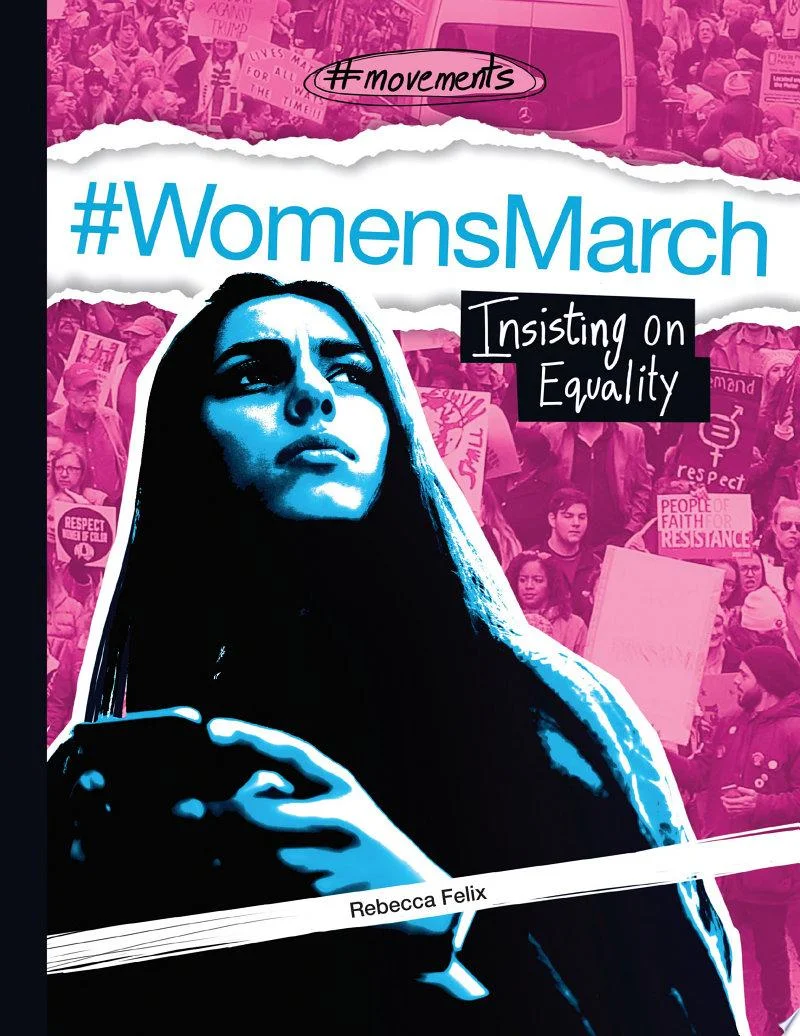
#WomensMarch: Insisting on Equality
- Publication Date:
- August 1st, 2019
- Publisher:
- ABDO
- ISBN-13:
- 9781532173806
- ISBN-10:
- 1532173806
- Pages:
- 35
Why #WomensMarch: Insisting on Equality Has Been Challenged
Objections to this title center on its treatment of subjects some parents and community members consider inappropriate for the age group at which it is aimed, particularly its discussion of reproductive rights and sexual harassment. See more ↓
Challenged or banned in 1 state across 1 school district.
Overview
#WomensMarch: Insisting on Equality traces a long arc of organized activism, beginning with the campaign for women's suffrage and moving forward through decades of legal and social change. Rebecca Felix connects that early history to more recent developments, including laws intended to protect reproductive rights and to shield women from sexual harassment.
The book's central focus is the #WomensMarch itself, the mass demonstrations that took place in 2017 and 2018 in cities across the country. Felix situates these marches within the broader history of women's activism, presenting them not as an isolated event but as a continuation of a movement with roots extending back more than a century.
Written for young readers and tied to educational standards, the book functions as an introductory civics text, framing gender equality as an ongoing project shaped by both legislative milestones and public demonstration.
Movement History as a Throughline
What distinguishes this book within its genre is its attempt to draw a continuous line between suffrage-era organizing and contemporary protest, treating the #WomensMarch as one chapter in a much longer story rather than a standalone news event. This framing places the book among a wave of early 2020s titles for young readers that sought to explain current events by anchoring them in historical precedent, a pedagogical approach common to nonfiction series built around alignment with state and Common Core standards.
That structure also means the book touches on subjects that extend beyond a simple recounting of marches, including the legislative history of reproductive rights and workplace protections against sexual harassment. For a book aimed at younger audiences, this represents an attempt to introduce students to how social movements translate into law, and how legal change and public demonstration can reinforce one another over time.
Why #WomensMarch: Insisting on Equality Has Been Challenged
Objections to this title center on its treatment of subjects some parents and community members consider inappropriate for the age group at which it is aimed, particularly its discussion of reproductive rights and sexual harassment. Because the book presents these topics as part of a civics and history curriculum rather than in a clinical or health-education context, critics have questioned whether the framing is age-appropriate or whether it introduces politically contested material into elementary and middle-grade classrooms and libraries.
The book's explicit alignment with the #WomensMarch movement has also drawn scrutiny from those who view its subject matter as inherently political, arguing that a title organized around a specific protest movement carries an implicit viewpoint unsuited to a school setting. This catalog tracks one state and one district in which the book has been formally challenged or restricted, reflecting the broader debate over how young readers should be introduced to topics of gender, protest, and policy.
Where to Buy




Affiliate links may generate a small commission at no extra cost to you, which helps support this site.
Also by Rebecca Felix
Banned in Schools
Banned or challenged in 1 state across 1 school district.