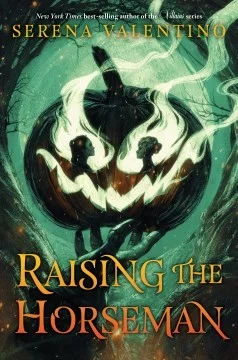
Raising the Horseman
- Publication Date:
- January 1st, 2022
- Publisher:
- Hyperion Books for Children
- ISBN-13:
- 9781368054614
- ISBN-10:
- 1368054617
Why Raising the Horseman Has Been Challenged
Critics have taken issue less with the book's existence than with its placement, arguing that its horror atmosphere and treatment of the supernatural as literal rather than folkloric make it a poor fit for younger or more casual readers. See more ↓
Challenged or banned in 1 state across 1 school district.
Overview
Raising the Horseman takes one of American folklore's most enduring figures—the headless rider of Sleepy Hollow—and asks where such a creature comes from before it becomes a legend. Rather than opening with the chase through the woods that most readers already know, Serena Valentino builds backward, toward the choices and cruelties that might turn a person into a myth.
The novel unfolds in the moody, candlelit register that has become Valentino's signature: equal parts fairy tale and horror story, with a narrator's voice that lingers on dread as much as on plot. Readers familiar with her earlier villain-origin novels will recognize the same instinct here—sympathy extended toward a figure usually reduced to a scare, paired with an unflinching look at the damage that produces monsters in the first place.
It is less a retelling of Washington Irving's tale than a meditation on it, using the Horseman's story as scaffolding for a darker question about what, or who, is responsible when something monstrous is made rather than born.
Villain Origins as a Literary Project
Valentino has built a career on turning familiar antagonists inside out, and Raising the Horseman extends that project from fairy-tale sorceresses to American folk horror. The move is a natural one: the Headless Horseman, like her earlier subjects, exists in the popular imagination almost entirely as a threat, with little curiosity about the years or events that preceded the legend. By supplying that backstory, the novel participates in a broader trend in young-adult and crossover fiction that treats villainy as a consequence rather than a fixed trait.
The book also sits at an interesting angle to its source material. Irving's original story is famous for its ambiguity—readers never learn for certain whether the Horseman is real or an elaborate prank played on a credulous schoolteacher. Valentino's approach resolves that ambiguity in favor of the supernatural, committing to the Horseman as a genuine figure with a genuine history, which shifts the story's center of gravity from comic folktale to gothic tragedy. That shift has made the book a natural fit for readers drawn to Valentino's other work, while also inviting comparison to a long tradition of American Gothic fiction that finds horror in ordinary cruelty as much as in the supernatural.
Why Raising the Horseman Has Been Challenged
Most of the pushback the novel has received centers less on whether it belongs in a library at all and more on where it belongs—whether its horror elements and dark themes are suited to the shelves or reading lists where younger patrons might encounter it. As tracked in this catalog, that disagreement has produced a challenge in one state and one district.
The substantive objections tend to focus on the book's tone and imagery. Because it builds toward the making of a figure defined by violence, the narrative does not shy away from depicting cruelty, fear, and the kind of atmospheric dread associated with horror fiction more broadly. Some challengers have also pointed to the novel's supernatural and occult framing—treating folklore not as metaphor but as literal, ongoing menace—as content they consider inappropriate for younger or more impressionable readers. Underlying both concerns is a question familiar to many challenged books: whether a story that asks readers to empathize with a monster risks normalizing the harm that produced him, or whether that empathy is precisely the point of retelling the legend at all.
Where to Buy




Affiliate links may generate a small commission at no extra cost to you, which helps support this site.
Banned in Schools
Banned or challenged in 1 state across 1 school district.
Iowa 1 district
- Clear Creek-Amana Community School District Banned pending investigation