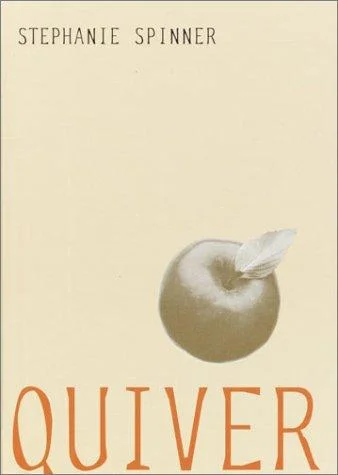
Quiver
- Publication Date:
- April 1st, 2005
- Publisher:
- Turtleback Books Distributed by Demco Media
- ISBN-13:
- 9780606332514
- ISBN-10:
- 0606332510
Why Quiver Has Been Challenged
Objections to Quiver center on its sexual content and its frank treatment of a young woman's autonomy over her own body, elements that some parents and school boards have deemed inappropriate for the middle-grade and early teen readers who make up much of its intended audience. See more ↓
Challenged or banned in 3 states across 3 school districts.
Overview
Stephanie Spinner's Quiver reimagines the Greek legend of Atalanta, the swift-footed huntress raised in the wild and unwilling to bend to the demands of men or gods. When her father resurfaces to insist she marry and produce an heir, Atalanta agrees only on her own terms: any suitor who wishes to wed her must first beat her in a footrace, and any who loses will die.
The premise sets up a contest that is as much about will as it is about speed. Spinner narrates the story with Atalanta's voice interwoven with commentary from Olympian onlookers, who treat the huntress's fate as a matter of divine sport. The结果 push and pull between mortal defiance and immortal manipulation drives the narrative toward its well-known mythological conclusion.
Told in a brisk, wry style aimed at teen readers, the novel treats its ancient material with a light touch, favoring momentum and personality over dense classical exposition.
Atalanta Reconsidered
Quiver belongs to a wave of young-adult retellings that took Greek mythology's women out of the margins and made them narrators of their own stories. Atalanta is a minor but memorable figure in the classical canon, usually remembered for the race and the golden apples that decide it; Spinner's version foregrounds instead the huntress's insistence on bodily autonomy and her resistance to a marriage plot imposed on her from outside.
That resistance is framed against a pantheon depicted as capricious and self-interested, gods who nudge mortal lives toward outcomes that serve their own amusement or rivalries. The tension between Atalanta's self-determination and the gods' interference gives the book its central irony: a heroine who wins on her own terms is ultimately undone by forces she cannot outrun. The novel sits comfortably alongside other mythology-based YA fiction of its era, using an old story to raise contemporary questions about who gets to choose a young woman's future.
Why Quiver Has Been Challenged
Objections to Quiver center on its sexual content and its frank treatment of a young woman's autonomy over her own body, elements that some parents and school boards have deemed inappropriate for the middle-grade and early teen readers who make up much of its intended audience. Because the story is rooted in classical mythology, it also inherits the genre's casual treatment of sex, coercion, and divine misconduct, themes that appear with regularity throughout Greek legend but that read differently once repackaged for a young-adult shelf. Critics of the book have pointed to specific passages depicting sexuality as unsuitable for school libraries and classrooms, arguing they exceed the maturity level of the grade bands where the book is typically shelved.
The novel has been the subject of 3 state-level and 3 district-level challenges tracked in this catalog, part of a broader pattern in which mythology retellings marketed to teens have drawn scrutiny once their content is measured against community standards rather than their classical source material.
Where to Buy




Affiliate links may generate a small commission at no extra cost to you, which helps support this site.
Banned in Schools
Banned or challenged in 3 states across 3 school districts.
Nation 1 district
Tennessee 1 district
- Monroe County Schools Banned
Texas 1 district
- Katy Independent School District Banned by Restriction