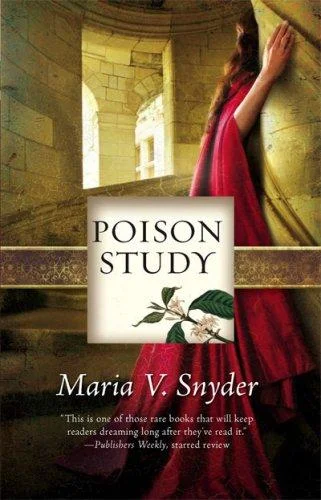
Poison Study
- Publication Date:
- March 1st, 2007
- Publisher:
- Mira
- ISBN-13:
- 9780778324331
- ISBN-10:
- 0778324338
- Pages:
- 409
Why Poison Study Has Been Challenged
Readers have taken issue with how directly the story renders violence and the lingering effects of abuse on its central character, arguing the material calls for a more mature audience than a general shelf placement assumes. See more ↓
Challenged or banned in 1 state across 2 school districts.
Overview
Maria V. Snyder's "Poison Study" opens with its protagonist, Yelena, standing on the threshold of execution for murder. Instead of the gallows, she is given an unusual offer: serve as the Commander's official food taster, a job that trades one form of mortal danger for another. The post comes wrapped in comfort—palace quarters, better food than she's known in years—but also in constant risk, since anyone wishing the Commander harm might just as easily try to eliminate the person standing between them and their target.
That risk becomes literal when the security chief, unwilling to rely on Yelena's goodwill alone, secretly doses her with a slow-acting poison. Her survival now depends on reporting daily for the antidote, a arrangement that binds her to the position as surely as any cell would. Snyder builds tension not just from the political intrigue of the Ixian court but from this ticking biological clock hanging over her heroine.
As Yelena settles into her precarious new life, the plot widens. Rebel factions maneuver against the state, and Yelena herself begins to manifest magical abilities she neither sought nor knows how to control. The novel follows her as she navigates court suspicion, looming threats to her life, and the discovery that survival may require choices far more complicated than simply staying alive.
Magic, Captivity, and Self-Determination
Beneath its court-intrigue plotting, "Poison Study" is preoccupied with the question of what freedom looks like for someone whose body and circumstances are controlled by others. Yelena begins the novel condemned, moves into a role defined by literal physical dependency on her captors, and only gradually accumulates power—first through hard-won competence, then through magical ability she must learn to master rather than fear. The poison itself functions as a sustained metaphor for coercion: her compliance is secured not by loyalty but by chemistry, and much of her arc involves converting that forced obedience into something closer to genuine agency.
The novel also sits within a broader conversation about how fantasy and speculative fiction handle trauma, survival, and power imbalances, particularly for young women protagonists. Snyder, launching what became a long-running series, uses the genre's conventions—court politics, magic systems, found family among fellow palace staff—to examine how a person rebuilds a sense of self after violence and imprisonment. Its popularity with teen and adult readers alike has kept it in circulation well beyond its initial release, and it's frequently discussed alongside other fantasy series that put a traumatized but resourceful young woman at the center of a sprawling political world.
Why Poison Study Has Been Challenged
Most objections to "Poison Study" center on where it belongs on a shelf rather than whether it belongs in a library at all, with disagreement focused on its suitability for younger readers versus a more mature teen or adult audience. The book has drawn formal challenges in 1 state and 2 districts tracked in this catalog, reflecting a narrower but persistent pattern of concern rather than widespread rejection.
The substance of those objections tends to focus on the novel's violence, including the backstory that lands Yelena in captivity, and on sexual content that appears as her relationships develop over the course of the story. Some challengers have also pointed to the book's frank treatment of trauma and abuse, arguing that its depiction of Yelena's past and the threats she continues to face require more context or maturity than younger readers may bring to it. Defenders of the book counter that these same elements are integral to its exploration of survival and recovery, and that removing them would blunt the character study at its core.
Where to Buy




Affiliate links may generate a small commission at no extra cost to you, which helps support this site.
Banned in Schools
Banned or challenged in 1 state across 2 school districts.
Florida 2 districts
- Clay County School District Banned
- Escambia County Public Schools Banned pending investigation