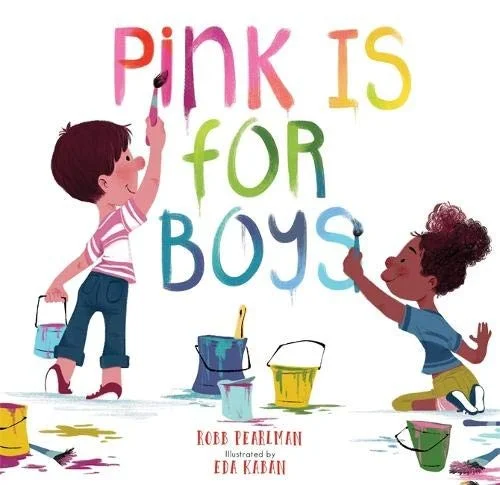
Pink Is for Boys
- Publication Date:
- June 5th, 2018
- Publisher:
- Running Press Kids
- ISBN-13:
- 9780762462476
- ISBN-10:
- 0762462477
- Pages:
- 40
Why Pink Is for Boys Has Been Challenged
Some parents and advocacy groups have sought its removal, arguing that even a lighthearted take on colors and toys introduces gender-identity messaging that very young children's books shouldn't carry. See more ↓
Challenged or banned in 1 state across 2 school districts.
Overview
Robb Pearlman's picture book takes aim at a familiar assumption: that pink belongs to girls and blue belongs to boys. Through a cast of varied young characters, the book shows kids pursuing whatever interests them, whether that means playing sports, racing toy cars, dressing up, or admiring unicorns, without those pursuits being sorted by gender first.
The illustrations lean on color itself as a teaching tool, walking readers through a wide spectrum found in ordinary things: a popsicle's orange, a lawn's green, and eventually the full span of a rainbow. The visual approach doubles as both a color-recognition exercise for young readers and a gentle argument that color, like interest or ability, is not inherently tied to gender.
Aimed at an early picture-book audience, the text is simple and declarative, built to be read aloud to the very young children for whom ideas about what colors or toys are "supposed to" be used are first taking shape.
A Picture Book Entering the Conversation on Gender Norms
Pink Is for Boys belongs to a small but growing shelf of children's books that address gender expectations directly rather than incidentally. Where many picture books simply depict boys and girls in traditional roles without comment, Pearlman's book makes the convention itself the subject, naming the pink-blue divide explicitly in order to question it. That directness is part of what distinguishes the book from gentler, more implicit examples of gender-inclusive storytelling.
The book arrives amid a broader cultural debate about how, or whether, young children should encounter ideas about gender identity and expression before they can articulate those ideas themselves. Supporters frame it as a straightforward extension of long-standing advice that children should feel free to like what they like. Critics see it as part of a larger shift in children's publishing toward material that engages with gender in ways some parents consider premature or ideologically loaded for a preschool and early-elementary audience. Its reception reflects that divide: librarians and early-childhood educators have praised its simple, affirming message, while it has also become a recurring entry on lists of contested titles compiled by advocacy groups on both sides of the debate.
Why Pink Is for Boys Has Been Challenged
The book's core premise, that no color or toy should be fenced off by a child's sex, is also the source of nearly all objections to it. Scenes depicting boys enjoying traditionally feminine-coded colors and activities, and girls engaging in traditionally masculine-coded ones, read to some challengers as an argument about gender identity and roles rather than a simple celebration of personal preference. For readers who hold more traditional views of gender, the book's insistence that pink, blue, and every other color are equally available to any child can seem to carry an implicit message beyond color choice alone.
Other objections center less on specific content than on audience: critics argue that a picture book aimed at very young children is not the appropriate venue for any material touching on gender norms, regardless of how mildly it is presented, and that such conversations belong with parents rather than in school or library collections. This concern has made the book a target for removal requests even though it contains no explicit discussion of sexuality and focuses narrowly on colors, toys, and activities. In this catalog, the title has been challenged in 1 state and 2 districts, reflecting how a seemingly simple message about colors can become a flashpoint in larger disputes over what young children's books should address.
Where to Buy




Affiliate links may generate a small commission at no extra cost to you, which helps support this site.
Banned in Schools
Banned or challenged in 1 state across 2 school districts.
Iowa 2 districts
- Clear Creek-Amana Community School District Banned pending investigation
- Northeast Community School District Banned