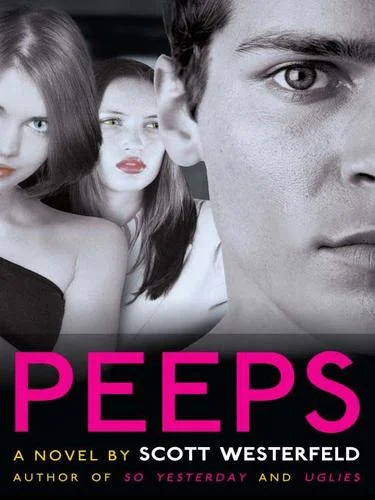
Peeps
- Publication Date:
- January 1st, 2009
- Publisher:
- Penguin USA, Inc.
- ISBN-13:
- 9781101112281
- ISBN-10:
- 110111228X
Why Peeps Has Been Challenged
Critics of the novel have taken issue less with its horror trappings than with the way its central disease metaphor doubles as an unusually candid discussion of sex and its consequences for a teen readership. See more ↓
Challenged or banned in 1 state across 1 school district.
Overview
Scott Westerfeld's Peeps follows Cal Thompson, a onetime college freshman whose priorities shifted overnight after a chance encounter with an enigmatic woman named Morgan. What seemed like a single reckless hookup left Cal carrying a parasite that rewires its host's body and mind into something monstrous — the kind of creature popular culture has long called a vampire, but which Cal, with clinical detachment, refers to simply as a "peep."
Cal himself escaped the parasite's worst effects, becoming an unaffected carrier rather than a victim. The same cannot be said for the women he dated in the months after Morgan, each of whom has since transformed into a feral, bloodthirsty peep. The novel follows Cal's uneasy new profession: tracking down the people he unknowingly infected before they can spread the contagion further.
Westerfeld threads the premise with a dry, observational wit and a biologist's curiosity, using Cal's predicament to examine vampirism less as supernatural curse and more as a grim extension of real-world parasitic behavior.
A Horror Story Grounded in Biology
What distinguishes Peeps within the crowded field of vampire fiction is its insistence on explanation over mythology. Rather than treating the vampire as an ancient supernatural archetype, Westerfeld recasts it as the product of infection — a condition with transmission, incubation, and symptoms rather than curses and bloodlines. That choice lets the novel sit at an unusual crossroads of horror, science fiction, and coming-of-age narrative, using Cal's reluctant role as hunter to explore themes of culpability, contagion, and the aftermath of intimacy gone wrong.
The book arrived as part of Westerfeld's broader body of young-adult work known for taking familiar genre furniture and subjecting it to unusually rigorous internal logic, and it has been read both as a horror novel for teens and as a sly commentary on how fear of disease and fear of sex have always shadowed vampire mythology.
Why Peeps Has Been Challenged
A review prompted by a parent complaint zeroed in on the novel's central mechanism — a parasite spread through sexual contact — arguing that the premise functioned less as a horror conceit and more as a vehicle for normalizing discussion of promiscuity and sexually transmitted disease among teen readers. The complaint framed the book's casual references to Cal's romantic history, and the condition passed along through it, as more explicit than appropriate for a school library's young-adult shelves.
Beyond the sexual-contagion premise, reviewers raising concerns have pointed to the novel's body horror — its unflinching descriptions of the physical and behavioral deterioration experienced by infected characters — as excessively graphic for the intended age group. Taken together, the objections have centered on content rather than literary merit: concerns about mature sexual themes and visceral imagery outweighing, in challengers' view, the book's scientific framing and satirical intent. Within the catalog tracked here, that scrutiny has resulted in a single documented challenge, spanning one state and one school district.
Where to Buy




Affiliate links may generate a small commission at no extra cost to you, which helps support this site.
Also by Scott Westerfeld

Banned in Schools
Banned or challenged in 1 state across 1 school district.