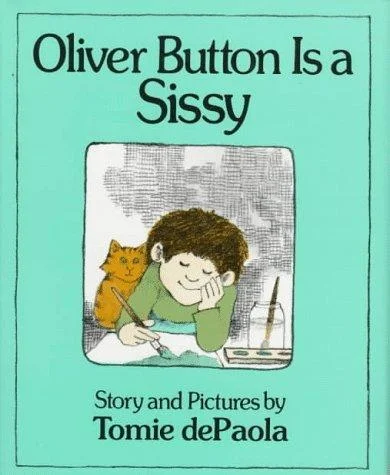
Oliver Button is a Sissy
- Publication Date:
- January 1st, 1991
- Publisher:
- Minon
- ISBN-13:
- 9788430560776
- ISBN-10:
- 8430560777
- Pages:
- 45
Why Oliver Button is a Sissy Has Been Challenged
Critics have pushed back on exposing very young children to a story that treats a boy's interest in dance and dress-up sympathetically rather than as something to discourage. See more ↓
Challenged or banned in 1 state across 1 school district.
Overview
Tomie dePaola's picture book follows a boy named Oliver Button whose favorite pastimes mark him as different from the other children on his street. He would rather dance, draw, and play dress-up than join the rough-and-tumble games his peers gravitate toward, and that difference does not go unnoticed. The other boys mock him for it, pinning a label on him that he has no say in choosing.
Rather than abandon what he loves, Oliver keeps at it, taking dance lessons and building his confidence even as the taunting continues. The story traces his quiet persistence against a backdrop of schoolyard cruelty, culminating in a moment where his talent is finally seen rather than dismissed.
dePaola, drawing on his own childhood experiences, renders the story in his signature folk-art illustration style, pairing simple, warm pictures with a narrative that doesn't shy away from showing how pointed children's cruelty can be.
Context and Reception
Published in 1979, the book predates most contemporary conversations about gender nonconformity in children's literature, yet it has become a touchstone within that body of work precisely because it addresses the subject so directly for its era. dePaola was open about basing Oliver's experience on his own boyhood love of dance and the ridicule it brought him, which gives the book a personal, almost autobiographical weight that distinguishes it from stories constructed purely as message books.
Within dePaola's broader catalog, which ranges from the Strega Nona series to other works exploring identity and belonging, Oliver Button occupies a notable place as one of his more pointed statements about accepting children who don't conform to expected roles. It has remained in print and in classroom and library collections for decades, often cited in discussions of early picture books that touch on gender expression, even though the book itself never frames Oliver's interests in explicitly political terms.
Why Oliver Button Is a Sissy Has Been Challenged
Most objections to this book target it as read-aloud material for early elementary and preschool classrooms, the audience for whom it was written and where it is most commonly shelved. Critics in that context have argued that a story built around a boy being taunted for liking dance and dress-up introduces young children to ideas about gender roles and nonconformity before they argue parents feel is appropriate, with some framing the book's sympathetic portrayal of Oliver's interests as an implicit endorsement of behavior they believe should be corrected rather than affirmed. Others have focused on the title itself, objecting to a slur-based word appearing on a book meant for young readers, regardless of the story's intent to condemn rather than endorse its use. The book has been challenged or banned in 1 state and 1 district tracked in this catalog, reflecting a narrow but persistent line of concern that centers less on any explicit content than on the subject of gender expression being raised at all in material aimed at small children.
Where to Buy




Affiliate links may generate a small commission at no extra cost to you, which helps support this site.
Banned in Schools
Banned or challenged in 1 state across 1 school district.
Florida 1 district
- Escambia County Public Schools Banned pending investigation