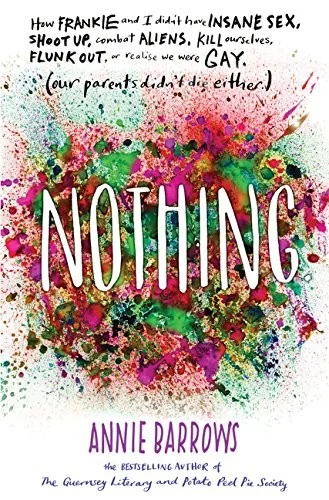
Nothing
- Publication Date:
- September 5th, 2017
- Publisher:
- Greenwillow Books
- ISBN-13:
- 9780062796516
- ISBN-10:
- 0062796518
- Pages:
- 224
Why Nothing Has Been Challenged
Some parents and educators have worried that a story built around emotional emptiness and disconnection could leave younger readers without enough context to process that bleakness on their own. See more ↓
Challenged or banned in 1 state across 1 school district.
Overview
Annie Barrows has built her career on the particular, not the abstract — the texture of a specific childhood, a specific friendship, a specific town. A book titled simply Nothing is, on its face, a departure: a word that refuses particulars and asks the reader to sit with absence instead. That tension between Barrows' usual warmth for small, concrete detail and a title that gestures at the void is what makes the book worth approaching on its own terms rather than as an extension of her more familiar work.
Readers who come to Nothing expecting the gentle comedy of her best-known series should be prepared for something quieter and more unsettled. A title like this one typically signals a narrator working through loss, disconnection, or the sense that life has stopped making sense in the way it used to — territory that asks more of both writer and reader than a straightforward plot summary can convey.
What can be said with confidence, absent a fuller publisher description, is that the book occupies a different register than Barrows' lighter fare, and that its title alone has done enough work to invite both serious critical attention and, as the record shows, formal objection in at least one school community.
A Different Kind of Barrows Book
Writers known for one register are often judged against it when they attempt another, and a book called Nothing sitting alongside a bibliography built on comfort and humor invites exactly that kind of recalibration. It suggests an author interested in testing what her voice can hold beyond the familiar — whether that means grief, apathy, or the particular numbness that can settle over a young person who feels unseen.
Titles that name an absence rather than a subject tend to resist easy shelving. They are harder to market, harder to summarize, and harder to defend to a skeptical reader in a single sentence — which may be precisely the point. A book willing to call itself Nothing is making an argument that emptiness itself is worth a reader's sustained attention, not simply a mood to be resolved by the last chapter.
Why Nothing Has Been Challenged
Books that confront despair, disconnection, or the collapse of meaning head-on tend to draw a particular kind of scrutiny, especially when they are read by or recommended to younger audiences. A narrative built around the idea of "nothing" mattering — whatever specific form that takes on the page — can read to some adults as an endorsement of hopelessness rather than an honest rendering of it, and that distinction is often where objections take root. The worry is less about any single scene than about tone: that a young reader might absorb the bleakness of a character's outlook without the surrounding context an adult reader brings to it.
This title has drawn a formal challenge in one state and one district tracked in this catalog, consistent with the pattern seen around other books that treat grief, meaninglessness, or emotional isolation without softening the material for younger readers. Such challenges typically rest on concern for a student's emotional well-being rather than objection to any single explicit passage, reflecting a broader discomfort with fiction that declines to offer its young characters — or its readers — easy reassurance.
Where to Buy


Affiliate links may generate a small commission at no extra cost to you, which helps support this site.
Banned in Schools
Banned or challenged in 1 state across 1 school district.
Florida 1 district
- St. John's County School District Banned by Restriction