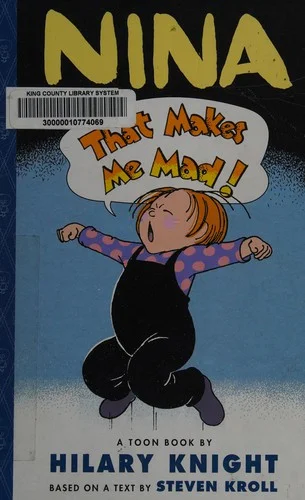
Nina in That makes me mad
by Steven Kroll
- Publication Date:
- January 1st, 2011
- Publisher:
- Toon Books
- ISBN-13:
- 9781935179108
- ISBN-10:
- 1935179101
Why Nina in That makes me mad Has Been Challenged
Some adult readers have pushed back against a story that lets a child's anger stand on its own terms rather than steering her toward a calmer resolution. See more ↓
Challenged or banned in 1 state across 1 school district.
Overview
Steven Kroll's picture book follows Nina through a string of ordinary setbacks — the kind of minor letdowns that accumulate over the course of a single day. Rather than treating these moments as trivial, the book takes Nina's irritation seriously, giving her room to react honestly instead of brushing her feelings aside.
What distinguishes the story is its attention to voice. Nina doesn't simply endure her frustrations; she names them, often loudly and without apology. The narrative follows her through this process of articulation, letting young readers see a model for recognizing anger as it happens rather than suppressing it.
The book's scope is deliberately small. There is no central conflict beyond the accumulation of everyday annoyances, which makes it less a plot-driven story than a character study aimed at very young readers encountering the vocabulary of emotion for the first time.
Nina's Place in the Conversation About Children's Feelings
Kroll's book belongs to a long tradition of picture books that treat emotional literacy as a subject worth dedicating a whole story to, rather than a subplot resolved by a tidy lesson at the end. Nina is not punished or corrected for her moods; she is simply allowed to have them. That choice reflects a broader shift in children's publishing toward validating feelings like anger and frustration as normal parts of growing up, rather than behaviors to be trained out of a child as quickly as possible.
The book's lack of a dramatic arc is itself part of its approach. By keeping the stakes low — spilled milk, a broken toy, an unmet request — it mirrors the actual texture of a young child's day, where big feelings are triggered by small events. This has made it a recognizable entry in the category of bibliotherapy-style picture books used to help children identify and discuss their own moods, even as it has also made it a target for readers who expect children's literature to model only even-tempered responses.
Why Nina in That Makes Me Mad Has Been Challenged
Emotional expression is the specific content category at issue here: some readers have objected to a picture book that centers a child's anger rather than her composure, arguing that it gives young readers permission to voice frustration in ways adults would prefer to see redirected or minimized. The concern is less about any single scene than about the book's overall stance — that irritation is worth naming out loud instead of quietly managing.
Underlying this objection is a disagreement about what children's books are supposed to teach. Critics in this vein tend to favor stories that resolve a child's bad mood through patience or correction, and see Kroll's approach — letting Nina's anger stand without much adult intervention — as modeling defiance rather than healthy self-regulation. According to this catalog's records, the book has drawn a challenge in 1 state and 1 school district, reflecting a narrow but notable instance of this broader disagreement over how directly children's literature should engage with negative emotion.
Where to Buy




Affiliate links may generate a small commission at no extra cost to you, which helps support this site.
Banned in Schools
Banned or challenged in 1 state across 1 school district.