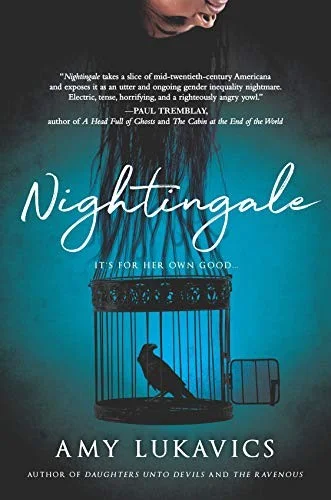
Nightingale
by Amy Lukavics
- Publication Date:
- September 25th, 2018
- Publisher:
- Harlequin Teen
- ISBN-13:
- 9781488095245
- ISBN-10:
- 1488095248
- Pages:
- 352
Why Nightingale Has Been Challenged
Reviewers objecting to this book have focused on its graphic body-horror imagery and its undertones of queer identity and nonconformity, both treated by critics as unsuitable for teen readers rather than as the metaphor for repression the novel intends. See more ↓
Challenged or banned in 1 state across 1 school district.
Overview
Set in the buttoned-down conformity of the early 1950s, Nightingale follows a teenage boy named Matthew whose mother has recently died, leaving him alone with a father who views grief itself as a weakness to be corrected. Convinced that his son is too soft, too strange, too unlike the men around him, Matthew's father enrolls him in a punishing program designed to harden him into an acceptable version of a man.
What begins as a story about discipline and fitting in slides steadily into something stranger. Matthew's body starts to betray him in ways that resist easy explanation, and the novel's horror elements emerge less as external threat than as the physical manifestation of everything Matthew has been told to suppress.
Amy Lukavics, known for grounding supernatural dread in adolescent psychology, uses Matthew's unraveling to examine what happens when a young person is denied the right to simply be who he is.
Grief, Conformity, and the Body as Battleground
Much of Lukavics' work returns to a single question: what happens to the parts of ourselves we're told to hide? Nightingale places that question inside the rigid gender expectations of postwar America, where sensitivity in a boy reads as deviance and a father's love is contingent on compliance. The result is a coming-of-age story that uses body horror not for shock value alone but as a language for describing psychological and emotional pressure that the characters themselves have no vocabulary for.
The novel sits within a broader tradition of YA horror that treats transformation as metaphor, drawing on earlier anxieties about masculinity, illness, and family secrecy to ask what a teenager does when the self he's expected to perform and the self he actually is pull in opposite directions. Its period setting sharpens that tension, giving the story's horror a historical specificity even as its underlying themes of identity and belonging remain recognizable to contemporary readers.
Why Nightingale Has Been Challenged
At the center of the objections to this novel is its unflinching portrayal of a father's attempt to forcibly reshape his son's identity, paired with graphic depictions of bodily transformation that some readers find disturbing rather than illuminating. Critics of the book have pointed to its horror imagery, including scenes of physical change and self-destruction, as too intense or grotesque for a young-adult audience, independent of the metaphor it is meant to serve.
A second, related line of objection concerns the novel's implicit engagement with queerness and nonconformity to gender expectations, which some challengers have characterized as inappropriate subject matter for teen readers rather than as the exploration of identity and acceptance that reviewers and supporters of the book describe. Taken together, these concerns have led to the book's removal or restriction in 1 state and 1 district tracked in this catalog, reflecting discomfort with both its horror content and the identity themes underlying it.
Where to Buy




Affiliate links may generate a small commission at no extra cost to you, which helps support this site.
Banned in Schools
Banned or challenged in 1 state across 1 school district.
Florida 1 district
- Hillsborough County Public Schools Banned Pending Investigation