Why Night Has Been Challenged
Readers have pushed back on this memoir for confronting them with the graphic reality of genocide and with a faith crisis that offers no comforting resolution. See more ↓
Challenged or banned in 2 states across 2 school districts.
Overview
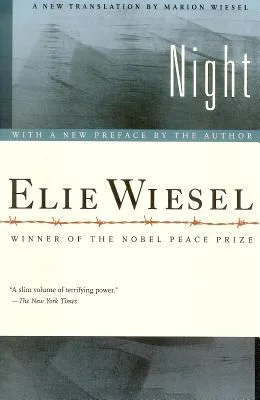
Night is Elie Wiesel's account of being deported as a teenager from his home in Sighet to Auschwitz and later Buchenwald, told in spare, unflinching prose. Rather than a conventional narrative arc, the book moves through a series of scenes — arrival at the camps, forced labor, roll calls, the deaths of people he knew — that accumulate into a portrait of survival stripped of sentimentality.
At the center of the memoir is Wiesel's relationship with his father, who is with him throughout most of the ordeal. Their bond, and its erosion under starvation and exhaustion, becomes the emotional core of the book, standing in for the broader collapse of family, community, and moral order that the camps produced.
The narrative is also an account of a young man's religious upbringing giving way under the weight of what he witnesses. Wiesel does not present his loss of belief as a single dramatic turn but as something that accrues, incident by incident, until the world he once understood no longer holds.
A Memoir That Resists Easy Meaning
Night occupies an unusual place in Holocaust literature: it is often the first, and sometimes the only, book on the subject that American students encounter, which has made it both a cornerstone of curricula and a lightning rod for debate about how such material should be taught. Its brevity and directness are frequently cited as reasons for its use in classrooms, but those same qualities mean it offers little narrative distance from the horror it describes.
The book is also notable for refusing the redemptive framing that often accompanies survivor stories. Wiesel does not conclude with restored faith or a tidy moral lesson; the memoir ends in a state of numbness and alienation that many readers find more difficult to sit with than a story of triumph over adversity. This resistance to closure is part of what has made it a recurring subject of scholarly and educational discussion about memory, testimony, and how atrocity should be represented in writing.
Why Night Has Been Challenged
Graphic descriptions of violence and death are the most frequently cited concern, as the memoir does not soften its depictions of starvation, beatings, executions, and the physical deterioration of camp prisoners, including children. Some challenges have also pointed to passages describing the psychological toll of the camps, including moments of despair and dehumanization, as too intense for younger readers. A related objection concerns the book's treatment of religious faith: because Wiesel describes losing his belief in God as a direct response to what he witnessed, some challengers have argued the book promotes a bleak or faith-negating worldview inappropriate for school settings. Records in this catalog show Night has been challenged or restricted in 2 states and 2 districts, with objections typically framed around age-appropriateness rather than the book's historical accuracy or literary merit.
Where to Buy



Affiliate links may generate a small commission at no extra cost to you, which helps support this site.
Banned in Schools
Banned or challenged in 2 states across 2 school districts.
Iowa 1 district
- Nevada Community School District Banned pending investigation
Tennessee 1 district
- Monroe County Schools Banned