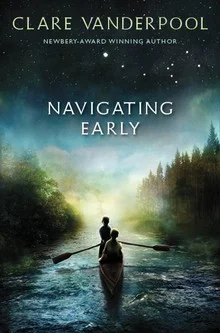
Navigating Early
- Publication Date:
- January 1st, 2015
- Publisher:
- Random House Children's Books
- ISBN-13:
- 9781484444207
- ISBN-10:
- 1484444205
Why Navigating Early Has Been Challenged
Some parents and educators have pushed back on pairing a children's adventure story with sustained themes of death, war, and a child's unresolved mourning, arguing the emotional weight outpaces the age group it's shelved for. See more ↓
Challenged or banned in 1 state across 1 school district.
Overview
Clare Vanderpool's "Navigating Early" follows Jack Baker, a Kansas boy uprooted to an all-boys boarding school on the coast of Maine after his mother's death and his father's wartime deployment. Adrift in an unfamiliar world of granite dormitories and unspoken rules, Jack is drawn to Early Auden, a classmate everyone else treats as strange: a boy who reads the digits of pi as a story, refuses to accept that his older brother died in the war, and keeps his own private logic for making sense of a confusing world.
When the two boys set out on a river journey meant to prove Early's brother might still be out there, the novel shifts from campus drama into something closer to myth. The trip through wilderness and small, half-hidden communities tests both boys' endurance and forces them to reckon with loss, survival, and what it means to trust someone whose mind works differently from your own.
Vanderpool interlaces the boys' real journey with the story Early tells from pi's endless digits, so that two narratives, one grounded, one fantastical, run side by side and eventually meet. The result is a novel about navigating grief as much as geography.
A Story Told in Two Currents
What distinguishes "Navigating Early" within middle-grade fiction is its structural ambition: a realistic coming-of-age story braided with an invented legend, used to explore how children process loss before they have the language for it. Jack's grief for his mother and Early's refusal to accept his brother's death are mirror images of the same impulse, to keep moving rather than sit still with sorrow, and the river becomes the space where both boys are finally forced to stop and face what they've been avoiding.
The book also sits within a broader conversation about how children's literature portrays neurodivergence, since Early's fixations and his singular way of relating to numbers and narrative read to many as coded autistic traits, even though the text never names a diagnosis. Critics and teachers have debated whether this approach offers a sympathetic, interior view of a character who is never treated as a puzzle to be solved, or whether leaving the portrayal unlabeled sidesteps a more direct conversation. That ambiguity, paired with the novel's willingness to let its young characters wander into real danger largely unsupervised, has made it a frequent choice for classroom discussion of grief, friendship, and difference.
Why Navigating Early Has Been Challenged
Most objections to the novel target its suitability for readers in the upper-elementary and middle-school range, roughly ages nine to twelve, the band for which the book is most often assigned. Critics in this camp argue that its sustained focus on parental death, wartime loss, and a child's prolonged, unresolved grief is heavier material than younger readers are prepared to process without adult guidance, and that scenes of real peril during the boys' unsupervised river journey, including encounters with threatening adults and isolated, unpredictable strangers, read as frightening or inappropriate for the intended audience.
A smaller set of objections concerns the book's handling of mental and emotional difference: some readers have questioned whether Early's unconventional behavior is framed in a way that risks mischaracterizing or sensationalizing neurodivergence for a young audience not equipped to contextualize it. Taken together, these concerns, rather than any single passage, account for the book's presence on challenge lists, which in this catalog record one state and one school district where it has been formally contested.
Where to Buy




Affiliate links may generate a small commission at no extra cost to you, which helps support this site.
Banned in Schools
Banned or challenged in 1 state across 1 school district.
Florida 1 district
- Escambia County Public Schools Banned pending investigation