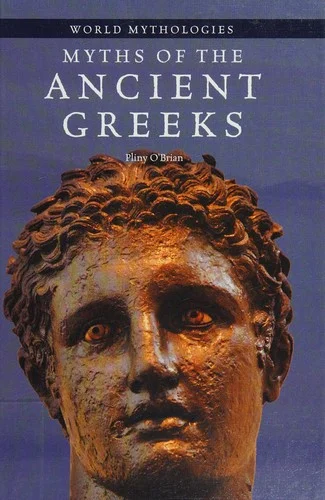
Myths of the ancient Greeks
- Publication Date:
- January 1st, 2015
- Publisher:
- Cavendish Square Publishing LLC
- ISBN-13:
- 9781502609892
- ISBN-10:
- 1502609894
Why Myths of the ancient Greeks Has Been Challenged
Some reviewers have objected to a young-reader reference book summarizing mythology's darker episodes and treating a polytheistic belief system as a subject of classroom-style study. See more ↓
Challenged or banned in 1 state across 1 school district.
Overview
"Myths of the Ancient Greeks" by Pliny O'Brian is a reference-style introduction to classical antiquity aimed at young readers. Rather than retelling a single myth from start to finish, it functions as a guided toolkit, pairing short narrative passages with maps, timelines, and sidebars that situate the stories within the physical and historical world of ancient Greece.
The structure encourages readers to move between registers: one page might trace the geography of the Aegean, the next might summarize a god's family tree, and a sidebar might pose a question meant to prompt further investigation. This format positions the book less as a storybook and more as a launching point for classroom or independent research into mythology, history, and culture together.
By treating myth, map, and historical fact as interconnected pieces of the same subject, the book asks young readers to see Greek mythology not as an isolated set of tales but as a lens for understanding how an ancient civilization explained its world.
A Reference Book's Balancing Act
Children's nonfiction about mythology occupies an unusual niche: it must simplify source material that was never written with young audiences in mind, while still conveying why those stories mattered to the people who told them. O'Brian's book sits squarely in that tradition, alongside the many illustrated compendiums that schools and libraries have long used to introduce the Greek pantheon, heroic epics, and foundational myths of Western literature.
What makes this kind of book distinct from a straightforward storybook is its insistence on context. By pairing myths with maps and historical sidebars, it frames mythology as inseparable from geography and daily life in antiquity, rather than as fantasy detached from a real place and time. That framing reflects a broader trend in educational publishing toward interdisciplinary learning tools, where a single volume is expected to serve as history primer, geography lesson, and literary introduction at once.
Why "Myths of the Ancient Greeks" Has Been Challenged
The source of scrutiny for this book lies in the myths themselves rather than in anything O'Brian adds to them. Greek mythology is populated with stories of divine infidelity, abduction, transformation, and violent retribution among gods and mortals alike, and a reference book that surveys the pantheon broadly cannot avoid summarizing at least some of this material for young readers. Objectors have pointed to these elements as unsuitable for the age group the book targets, arguing that even a brief, factual summary of a myth like Zeus's pursuits or Persephone's abduction introduces themes of coercion and sexuality that parents may not expect in a book shelved as history or reference material.
A separate line of objection concerns the presentation of mythology alongside historical fact. Because the book treats Greek religious belief as a legitimate subject of study, framed with the same tools used for geography and history, some challengers have raised concerns about young readers encountering a polytheistic belief system presented in an instructional context, seeing it as being taught on equal footing with factual history rather than clearly marked as ancient belief. In this catalog, the book has been formally challenged in 1 state and 1 district, with reviewers weighing these concerns against the book's stated function as an educational resource for studying antiquity.
Where to Buy




Affiliate links may generate a small commission at no extra cost to you, which helps support this site.
Banned in Schools
Banned or challenged in 1 state across 1 school district.