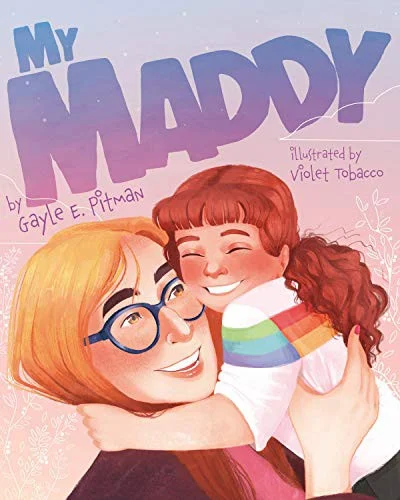
My Maddy
- Publication Date:
- May 25th, 2020
- Publisher:
- Magination Press
- ISBN-13:
- 9781433830440
- ISBN-10:
- 1433830442
- Pages:
- 32
Why My Maddy Has Been Challenged
At its core, the dispute isn't about imagery or story events but about whether young children's books should affirm that gender itself can fall outside a strict boy-or-girl framework. See more ↓
Challenged or banned in 2 states across 2 school districts.
Overview
My Maddy is a picture book narrated by a young child describing a parent who defies easy categories. The child notices small, concrete details first: eyes that are hazel rather than clearly brown or green, a fondness for sporks instead of spoons or forks. These everyday observations become a gentle on-ramp into a larger idea.
From there, the book widens its lens to family structure itself. Most mothers are women and most fathers are men, the narrator notes, but some parents are neither — and this parent, called "Maddy," is one of them. Rather than resolving that ambiguity, the book treats it as simply another feature of the world worth naming.
The result reads less like an argument and more like an invitation to notice. By pairing whimsical, child-scale examples with a quiet statement about gender, the author builds toward the idea that things existing "in between" two poles can be ordinary, even delightful, rather than confusing or wrong.
A Small Book With a Larger Claim
Gayle E. Pitman, a psychology professor as well as a children's author, has built a body of picture-book work around introducing young readers to identity and family diversity through accessible, often playful framing. My Maddy fits that pattern: it doesn't attempt to explain nonbinary identity in abstract or clinical terms, but instead borrows the logic a small child already understands — that some things just aren't fully one category or another — and extends it to a parent's gender.
That approach places the book at the center of an ongoing debate over how, and how early, children's literature should address gender beyond a binary framework. Supporters view it as a low-key, developmentally appropriate way to help children who have a nonbinary parent, or who will simply encounter gender diversity in the world, find language and reassurance. Critics see the same material as introducing a contested social and political topic into a format aimed at very young readers, often before families have had a chance to weigh in themselves. The book's reception has largely tracked that broader divide rather than any controversy specific to its plot or illustrations, since its content is observational rather than narrative-driven.
Why My Maddy Has Been Challenged
Most objections to My Maddy center less on any single scene than on where the book belongs — specifically, whether its subject matter is suited to the picture-book shelf and the early-elementary audience that shelf implies. Challengers argue that gender identity, and nonbinary identity in particular, is a topic best introduced later and by parents rather than encountered unprompted in a library display or classroom read-aloud.
Underlying that placement concern is a more substantive objection to the book's content: that describing a parent as "neither a boy nor a girl" asserts a view of gender that some families consider factually or morally incorrect, and that doing so in a book aimed at young children amounts to instruction rather than mere representation. Pitman's defenders counter that the book simply describes a family that exists, without instructing readers on broader theory. That disagreement has made My Maddy a recurring target in the wider debate over gender-related content in children's collections, with the book challenged or restricted in 2 states and 2 districts tracked in this catalog.
Where to Buy




Affiliate links may generate a small commission at no extra cost to you, which helps support this site.
Banned in Schools
Banned or challenged in 2 states across 2 school districts.