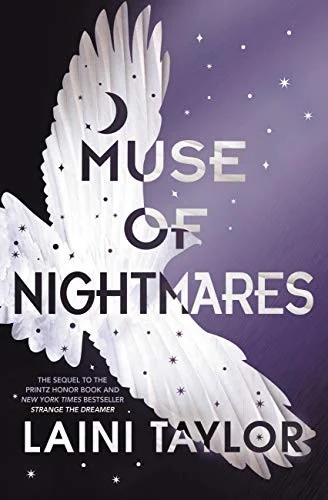
Muse of Nightmares
by Laini Taylor
- Publication Date:
- October 2nd, 2018
- Publisher:
- Little, Brown Books for Young Readers
- ISBN-13:
- 9780316341707
- ISBN-10:
- 0316341703
- Pages:
- 528
Why Muse of Nightmares Has Been Challenged
Some parents and reviewers have argued that the book's romantic and physical content is too mature for the young-adult shelves where it's typically shelved. See more ↓
Challenged or banned in 1 state across 1 school district.
Overview
Muse of Nightmares picks up in the unsettled aftermath of catastrophe, when the city of Weep is still reckoning with what was lost and who was changed. Lazlo, no longer merely the dreamer he once was, and Sarai, existing now in a form she never expected, are each trying to understand what they have become. Neither transformation is comfortable, and both come with costs that ripple outward into the people around them.
Complicating their uncertain new existence is Minya, a godspawn child whose grief has hardened into a desire for retribution against the city that wronged her and the others like her. Her hold over the survivors forces Lazlo into a choice with no acceptable answer: protect the person he loves most, or protect everyone else. Sarai, meanwhile, must decide whether she is truly as powerless as she has always assumed.
As the story widens, old questions about the citadel's origins resurface, along with new ones about the fate of children who disappeared from its nursery long ago. Taylor uses these revelations to push her central inquiry further: whether beings framed as monstrous can be understood, and perhaps saved, rather than simply defeated.
A Widening Mythology
Where its predecessor introduced the fractured world of Weep and the wounds dividing gods from the humans who suffered under them, this sequel expands that history considerably. Taylor is less interested in restaging a conflict between good and evil than in tracing how trauma passes between generations and how power, once seized, reshapes everyone who touches it. The novel's godspawn characters are neither purely victims nor purely threats; their claims to vengeance are treated as legible, even as the narrative resists letting vengeance stand as a final answer.
This concern with redemption over conquest places the book within a broader current of fantasy that reworks the genre's older instincts toward monster-slaying, asking readers to sit with ambiguity rather than resolve it neatly. As the second half of a duology, the novel also carries the weight of closing out threads about origin, inheritance, and what survivors owe one another, giving it a more melancholic, interior register than a typical fantasy climax.
Why Muse of Nightmares Has Been Challenged
Reviewers and readers have generally praised the duology for its inventive world-building and for handling grief and moral complexity with unusual care for the genre; the challenges it has drawn come from a narrower, more specific concern. Objecting parties have focused on scenes depicting physical intimacy between characters, arguing that this content sits uneasily with the book's placement in young-adult and school library collections aimed at younger teen readers.
The disagreement, in other words, is less about the novel's themes of vengeance, loss, or political upheaval and more about whether its treatment of romance and sexuality matches the maturity level assumed by its shelving. This book has been challenged in 1 state and 1 school district tracked in this catalog, reflecting a narrow but recurring pattern seen across young-adult fantasy titles that pair complex world-building with frank depictions of physical relationships.
Where to Buy




Affiliate links may generate a small commission at no extra cost to you, which helps support this site.
Also by Laini Taylor

Banned in Schools
Banned or challenged in 1 state across 1 school district.
Florida 1 district
- Escambia County Public Schools Banned pending investigation