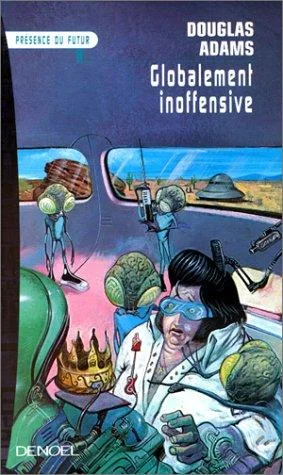
Mostly Harmless
- Publication Date:
- February 22nd, 2000
- Publisher:
- Denoël
- ISBN-13:
- 9782207251058
- ISBN-10:
- 2207251055
- Pages:
- 284
Why Mostly Harmless Has Been Challenged
Some parents and school officials have pushed back on the book's casual treatment of sex, violence, and nihilism, arguing the material is too mature for the younger end of the series' readership. See more ↓
Challenged or banned in 1 state across 1 school district.
Overview
Mostly Harmless closes out Douglas Adams's original Hitchhiker's Guide to the Galaxy sequence by shifting its focus to a new generation. Random Dent, the daughter Arthur never knew he had, grows up isolated on a backwater planet far from the chaos that defined her father's adventures. Restless and estranged from the only life she has known, she abandons that quiet existence to chase down the origins of her own bloodline.
Her search becomes an improvised tour through the same absurd, indifferent cosmos that shaped the earlier books, except now seen through the eyes of someone who never asked to be part of it. Familiar faces resurface along the way, older and more worn down by the universe's refusal to make sense, while Random pieces together a family history scattered across planets and timelines.
As the installment meant to close the series, the novel trades some of its predecessors' manic comic energy for a more weary, reflective register, following its characters toward endings that feel earned rather than punchlined.
A Darker Turn for a Comic Saga
Adams built his reputation on turning cosmic insignificance into a running joke, and Mostly Harmless is where that joke curdles. Having spent four books establishing a universe that shrugs off human concerns with bureaucratic indifference, Adams uses this closing volume to ask what it actually feels like to live inside that indifference rather than laugh at it from a safe distance. Random's search for a place to belong reframes the series' comic nihilism as something closer to genuine alienation.
That shift has made the book a point of debate among longtime readers of the series, some of whom view it as a fitting, mature capstone to Arthur Dent's story, and others who see it as a retreat from the lighter spirit that made the earlier novels beloved. Within Adams's bibliography, it stands as his most somber extended work, written at a point when he was reportedly ambivalent about returning to the series at all, a tension that shows in the narrative's willingness to deny its characters easy comfort.
Why Mostly Harmless Has Been Challenged
Challenges to this title have most often centered on its suitability for middle-school-aged readers, who frequently encounter the Hitchhiker's Guide series through classroom reading lists or library displays built around its earlier, more overtly comic volumes. Critics raising objections argue that the series' tonal shift in this installment, into material involving sexual references, graphic violence, and a bleaker worldview, outpaces what younger fans of the earlier books are prepared for, even though the vocabulary and surface humor remain accessible to them.
Beyond matters of age-appropriateness, some objections have focused on the novel's underlying philosophy. Its portrayal of a universe without inherent meaning or reliable authority, and its willingness to let that outlook stand largely unchallenged within the story, has struck some reviewers as corrosive for impressionable readers rather than simply comic exaggeration. In the catalog tracked here, the book has drawn a challenge in 1 state and 1 school district, reflecting a narrower but still notable instance of this broader concern about pairing the series' kid-friendly reputation with its more adult closing chapter.
Where to Buy




Affiliate links may generate a small commission at no extra cost to you, which helps support this site.
Banned in Schools
Banned or challenged in 1 state across 1 school district.
Florida 1 district
- Escambia County Public Schools Banned pending investigation